Overview :
Every great SaaS product starts the same way: someone gets frustrated with a problem and thinks, “There has to be a better way.” Maybe it is a clunky invoicing process, an untidy HR workflow, or a customer support system that never quite works. That spark is where it all begins.
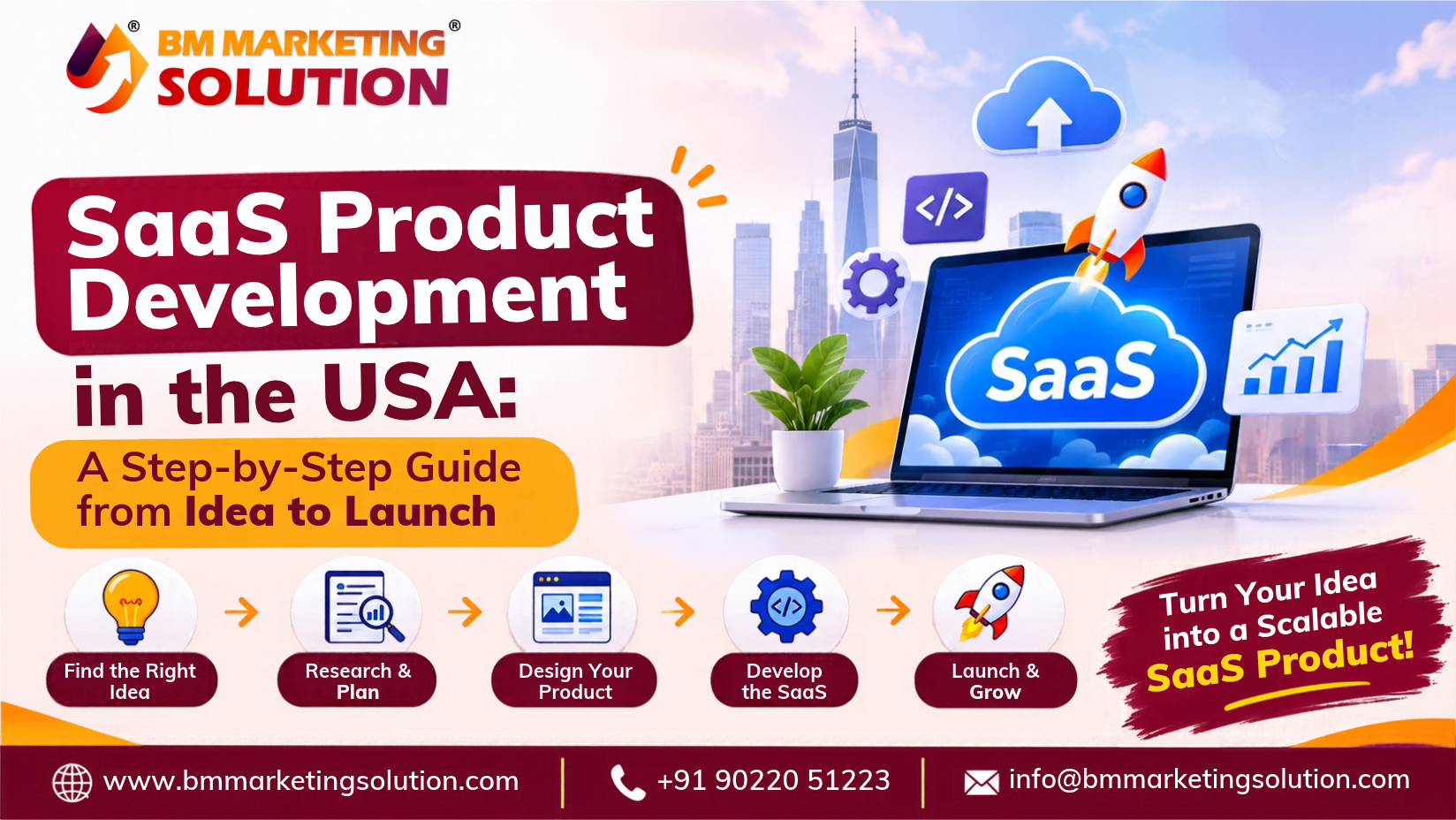
But turning that spark into a live, paying-customer-ready product takes more than a good idea. SaaS product development in USA demands careful planning, the right people, and a clear roadmap. Whether you are building with an in-house team or partnering with a trusted SaaS development company USA, knowing the process makes every decision easier. And if your idea needs something unique, custom SaaS development lets you build a product that fits your business and your customers, instead of forcing them into a one-size-fits-all tool.
Let us walk through what it really looks like with this step-by-step guide to SaaS development, from the first idea to launch day and beyond.
Why the USA Is Still the Big Stage for SaaS :
The US remains one of the largest and most competitive SaaS markets in the world. American businesses, from startups to enterprises, are used to paying for subscription software, and they expect it to be fast, secure, and easy to use.
That is good news and a challenge at the same time. Demand is high, but so are expectations. Your product does not just need to work. It needs to feel polished from day one.
Step 1: Validate Your Idea Before You Build Anything :
it is tempting to jump straight into development. Don’t. The most expensive mistake in SaaS is building something nobody wants.
Before writing a single line of code, ask yourself:
Who exactly is this for?
What problem does it solve, and how painful is that problem?
Are people already paying for a solution, even a bad one?
What would make them switch to you?
Talk to real potential users. Run surveys, hold short interviews, and study your competitors. Their reviews are a goldmine, because every complaint is an opportunity.
Step 2: Define Your MVP (Minimum Viable Product)
An MVP is not a half-baked product. It is the simplest version that solves the core problem really well.
Think of it like opening a restaurant. You do not launch with a 100-item menu. You start with a few dishes you can make perfectly. List the one or two features that deliver your main value, and save the rest for later. This keeps your costs down and gets you to market faster, which means you start learning from real users sooner.
Step 3: Design for Humans, Not Just Screens.
Good UX is the quiet hero of successful SaaS. If users need a tutorial just to find the dashboard, they will leave before they ever see your best feature.
Focus on:
Simple onboarding that gets users to their first “aha” moment quickly
Clean, intuitive navigation with no clutter
Mobile responsiveness, since people check tools on the go
Accessibility, which matters in the US both ethically and legally
Create wireframes and clickable prototypes first. Changing a design in Figma is far cheaper than changing it after development.
Step 4: Choose the Right Technology Stack and Architecture :
Your technology choices will shape how well your product scales, so think long term. A few key decisions:
Multi-tenant architecture so multiple customers can share the same infrastructure efficiently
Cloud hosting (AWS, Google Cloud, or Azure) for flexibility and reliability
API-first design, so your product can integrate with other tools your customers already use
Scalable databases that will not buckle as your user base grows
there is no single “best” stack. The right one depends on your product, your team, and your growth plans.
Step 5: Build in Agile Sprints :
Rather than disappearing for six months and hoping for the best, modern SaaS teams build in short sprints, usually two weeks each. Every sprint delivers something testable.
This approach lets you gather feedback early, adjust quickly, and avoid big, costly surprises. It also keeps everyone, from developers to stakeholders, on the same page.
Step 6: do not Skip Security and Compliance :
In the US, customers take data protection seriously, and rightly so. Depending on your industry, you may need to think about:
SOC 2 for demonstrating strong security practices
HIPAA if you handle healthcare data
CCPA for California residents’ privacy rights
GDPR if you also serve European users
Build security in from the start: encryption, role-based access, regular audits, and secure backups. Retrofitting it later is painful and expensive.
Step 7: Test, Test, and Test Again :
Before launch, your product should go through functional testing, performance and load testing, security testing, and real-user beta testing. A small group of beta users will find issues your team never would, and they often give you your best early testimonials too.
Step 8: Plan Your Launch Like a Product, Not an Event :
Launch day is not the finish line. It is the starting gun. A strong go-to-market plan includes:
A clear value proposition and pricing model (freemium, tiered, or usage-based)
A landing page that converts
Content marketing and SEO to attract organic traffic
Email campaigns and outreach to your early adopters
Analytics set up from day one so you know what is working
Step 9: Keep Improving After Launch
The real work begins once people start using your product. Track metrics like churn rate, monthly recurring revenue (MRR), customer acquisition cost (CAC), and user engagement. Listen to support tickets and feedback, because users will tell you exactly what to build next if you pay attention.
The SaaS products that win are not always the ones that launched first. They are the ones that kept getting better.
Final Thoughts :
Building a SaaS product in the USA is a journey with a lot of moving parts, but it’s absolutely achievable with the right approach and the right partner. Validate early, build lean, design thoughtfully, protect your users’ data, and keep listening after launch. That is the real heart of successful SaaS product development in USA.
If you’re ready to turn your SaaS idea into reality, having an experienced team by your side can save you months of trial and error. A reliable SaaS development company USA can guide you through every stage, from planning and design to launch and growth. And with custom SaaS development, you get a product built around your goals, not a generic tool that only half fits.
Use this step-by-step guide to SaaS development as your roadmap, and take the first step today.
Frequently Asked Questions (FAQs) :
1. How long does it take to build a SaaS product?
Ans : It depends on complexity. A focused MVP typically takes 3 to 6 months, while a more feature-rich platform can take 9 to 12 months or longer. Starting with a lean MVP is the fastest way to get to market.
2. How much does SaaS product development cost in the USA?
Ans : Costs vary widely based on features, design, integrations, and team location. A simple MVP may start in the tens of thousands of dollars, while complex enterprise platforms can run significantly higher. A clear scope and phased development help keep costs under control.
3. Do I need a technical background to launch a SaaS product?
Ans : Not at all. Many successful founders come from business or industry backgrounds. What matters is a clear understanding of the problem you’re solving and a reliable development partner who can handle the technical side.
4. What is the biggest mistake to avoid when building SaaS?
Ans : Skipping validation. Building a full product without confirming real demand is the most common and costly mistake. Talk to potential customers first, start small, and let user feedback guide your roadmap.
Get in Touch :
Have a SaaS idea you want to bring to life? Let’s talk about it.
Website: https://bmmarketingsolution.com/
Phone: +91 90220 51223
Email: info@bmmarketingsolution.com
Contact Page: https://bmmarketingsolution.com/contact-us/