Automating repetitive tasks saves time, reduces human error, and lets your team focus on higher-value work.
Popular off-the-shelf tools are common targets for attacks. Custom software can include security measures designed around your data and compliance needs.
It connects easily with your existing tools, such as payment gateways, accounting software, or third-party APIs.
Every business reaches a point where ready-made tools stop being enough. Spreadsheets get messy, apps don’t talk to each other, and your team spends more time working around software than working with it.
That is usually the moment to consider custom software development.
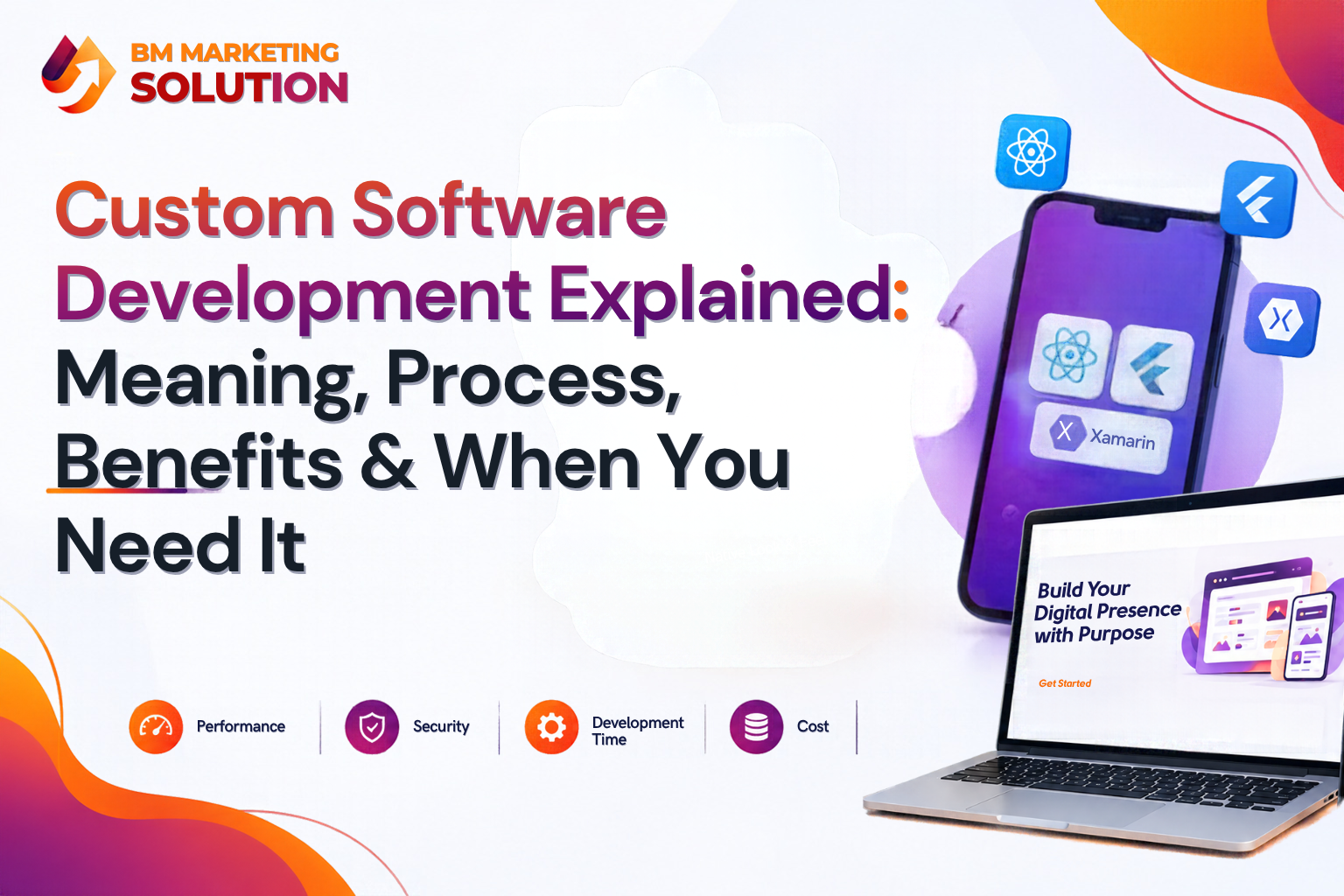
In this Custom Software Development Explained guide, you will learn what it means, how the process works, what benefits it offers, and how to know when your business needs it.
Custom software development is the process of designing, building, and maintaining software made specifically for your business. Off-the-shelf software is built for a broad audience, so you adapt your workflow to it. Custom software works the other way around: it is built around your goals, your processes, and your customers.
Examples include a customer portal, an inventory system, a booking platform, a CRM, or a mobile app with features your competitors do not have.
A good development partner follows a clear, structured approach.
The team studies your business, your challenges, and your goals, then defines the project scope, timeline, and budget.
Features and technical needs are documented so everyone shares the same expectations.
Designers create wireframes and prototypes so you can see how the product will look and feel before development starts.
Developers build the software in stages, often using an agile approach that allows regular feedback.
Quality checks cover bugs, speed, security, and compatibility across devices.
The software goes live, and the team provides updates, fixes and improvements as your business grows.
Built for your needs. You pay only for the features you will actually use, and nothing important is missing.
Custom software grows with you. You can add users, features and integrations without switching platforms.
Automating repetitive tasks saves time, reduces human error, and lets your team focus on higher-value work.
Popular off-the-shelf tools are common targets for attacks. Custom software can include security measures designed around your data and compliance needs.
It connects easily with your existing tools, such as payment gateways, accounting software, or third-party APIs.
Unique features and a better customer experience help your brand stand out.
The upfront cost can be higher, but you avoid recurring license fees and expensive workarounds over time.
Custom development is not right for every business, but these signs suggest it may be time:
If two or more of these sound familiar, a custom solution is worth exploring.
This Custom Software Development Explained guide showed that custom software is an investment in efficiency, growth, and flexibility. It turns your ideas and processes into a digital tool that works exactly the way your business does.
By following a clear process and choosing an experienced partner, you can build software that saves time, supports your team, and delights your customers.
Ready to start your project? BM Marketing Solution can help you plan, design, and build software that fits your business.
BM Marketing Solution :
Website : https://bmmarketingsolution.com/
Phone : +91 90220 51223
Email : info@bmmarketingsolution.com
1. How much does custom software development cost?
Ans : The cost depends on project size, features, design complexity, and timeline. A simple tool may cost far less than an enterprise platform, so a detailed requirement discussion is the best way to get an accurate quote.
2. How long does it take to build custom software?
Ans : Small projects can take 6 to 12 weeks, while larger systems may take several months. Clear requirements and quick feedback help keep the timeline on track.
3. Is custom software better than off-the-shelf software?
Ans : It depends on your needs. Off-the-shelf software is quicker to start with and works for common tasks. Custom software is better when you need unique features, deeper integration, and long-term scalability.
4. Who owns the software after it is developed?
Ans : In most cases, you own the source code and intellectual property once the project is complete, but this should always be confirmed in your agreement with the development company.

SEO & Digital Marketing Executive
With 1.5+ years of experience in SEO, WordPress and digital marketing, I focus on creating informative and SEO-friendly content that helps businesses grow online. I believe in writing clear, practical and easy-to-understand articles that provide real value to readers.
BM Marketing Solution - Building Brands That Stand Out Online
Address: Office no. G610, 5th Floor, Mega Center, Pune - Solapur Rd, Magarpatta, North Hadapsar, Hadapsar, Pune, Maharashtra 411013.
Phone : +91 90220 51223
Email: info@bmmarketingsolution.com
Copyright © 2025 BM Marketing Solution All Rights Reserved