Once the app is polished, it is submitted to the Google Play Store and Apple App Store. Google usually approves quickly, while Apple’s review can take a few days and may require adjustments.
Several factors influence the final timeline:
Feature complexity : AI recommendations, AR try-ons, and multivendor support add significant time.
Third-party integrations such as payment gateways, CRM, and inventory tools need careful setup.
Team size and experience: An experienced team works faster and avoids costly mistakes.
Quick decisions: Delayed approvals are one of the biggest hidden causes of delay.
So you have decided to take your online store to mobile. Smart move. More than half of all online shopping now happens on smartphones, and customers expect a smooth, fast app experience. That is why the first question almost every business owner asks is: how long does it take to build an e-commerce mobile app?
The honest answer is that it depends. The time to build an e-commerce app can be as short as two to three months for a simple version, while a feature-rich platform may take six months or more. Every project is different, and the right e-commerce mobile app development approach depends on your goals, features, and budget.
Let us break down the e-commerce app development timeline stage by stage, so you can plan with confidence and avoid costly delays.
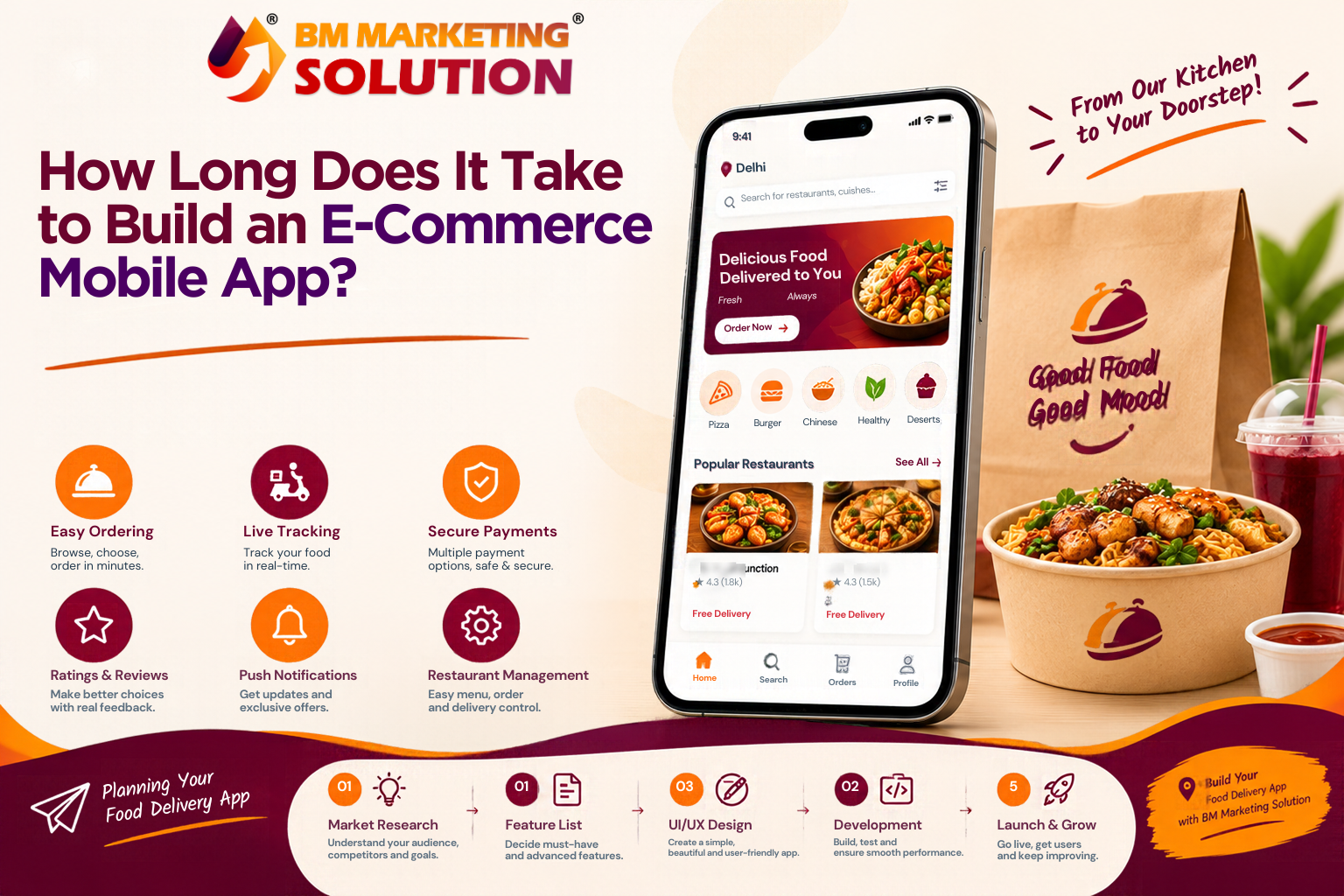
Most e-commerce apps follow a similar path, and each stage takes a different amount of time:
Discovery and planning : 1 to 3 weeks
UI/UX design : 3 to 6 weeks
Development : 8 to 16 weeks
Testing and quality assurance : 2 to 4 weeks
Launch and app store approval : 1 to 2 weeks
Added together, a basic app usually takes around 3 to 4 months, a mid-level app 4 to 6 months, and a complex, enterprise-style app 6 to 9 months.
This is where the foundation is laid. Your development partner studies your business goals, target audience, competitors, and must-have features. You will define the product catalog structure, payment options, and shipping logic.
Rushing this stage is a common mistake. A clear plan now saves weeks of rework later.
Good design is what makes shoppers stay. Designers create wireframes first, followed by detailed screens and clickable prototypes. You will review, suggest changes, and approve the look and feel.
The more feedback rounds you need, the longer this phase runs, so try to give consolidated, timely feedback.
This is the longest phase. Developers build the front end (what customers see) and the back end (servers, databases, admin panel).
Core e-commerce features typically include user registration, product search and filters, shopping cart, secure checkout, order tracking, push notifications, and wishlist. Choosing between native apps for iOS and Android or a cross-platform framework like Flutter or React Native also affects timing.
Cross-platform development often saves several weeks.
Before launch, the app must be tested on different devices, screen sizes, and operating systems. Testers check payment security, loading speed, and bugs.
Skipping thorough testing might save a few weeks now, but it can cost you customers and reviews later.
Once the app is polished, it is submitted to the Google Play Store and Apple App Store. Google usually approves quickly, while Apple’s review can take a few days and may require adjustments.
Several factors influence the final timeline:
Feature complexity : AI recommendations, AR try-ons, and multivendor support add significant time.
Third-party integrations such as payment gateways, CRM, and inventory tools need careful setup.
Team size and experience: An experienced team works faster and avoids costly mistakes.
Quick decisions: Delayed approvals are one of the biggest hidden causes of delay.
Scope changes : Adding new features mid-project can push your deadline back.
A smart strategy is to launch a Minimum Viable Product (MVP) with essential features first, then expand based on real customer feedback.
Building an e-commerce app is an investment of both time and money, but with the right planning and the right partner, the process becomes smooth and predictable. Whether you are estimating the e-commerce app development timeline or deciding how long it takes to launch your first version, focus on what your customers truly need, launch fast, and keep improving.
If you are ready to turn your idea into a high-performing mobile app, the team at BM Marketing Solution, a trusted e-commerce app development company, can guide you from concept to launch with smart planning, clean design, and reliable e-commerce mobile app development services.
Phone : +91 90220 51223
Email : info@bmmarketingsolution.com
Website: https://bmmarketingsolution.com/
Contact Us: https://bmmarketingsolution.com/contact-us/
1. What is the minimum time required to build an e-commerce app?
Ans : A simple MVP with core features can be built in about 2 to 3 months, depending on the team and requirements.
2. Does a cross-platform app take less time than a native app?
Ans : Yes. Using frameworks like Flutter or React Native lets developers write one codebase for both Android and iOS, which usually cuts development time significantly.
3. Can I add new features after launching the app?
Ans : Absolutely. Most successful businesses launch with essential features and release updates regularly based on user feedback and market trends.
4. How can I avoid delays during development?
Ans : Define your requirements clearly, approve designs quickly, avoid frequent scope changes, and work with an experienced development company that follows a structured process.

SEO & Digital Marketing Executive
With 1.5+ years of experience in SEO, WordPress and digital marketing, I focus on creating informative and SEO-friendly content that helps businesses grow online. I believe in writing clear, practical and easy-to-understand articles that provide real value to readers.

BM Marketing Solution - Building Brands That Stand Out Online
Address: Office no. G610, 5th Floor, Mega Center, Pune - Solapur Rd, Magarpatta, North Hadapsar, Hadapsar, Pune, Maharashtra 411013.
Phone : +91 90220 51223
Email: info@bmmarketingsolution.com
Copyright © 2025 BM Marketing Solution All Rights Reserved