If you want to launch on both iOS and Android, a cross-platform framework may help your team share more code.
Flutter uses Dart and supports building apps for multiple platforms from a single codebase.
It can suit teams that want to create a consistent design across devices while keeping much of the app’s development in one place. Platform-specific code may still be needed for certain features or integrations.
React Native is another option. It uses JavaScript to build Android and iOS apps while connecting with the platforms’ native capabilities.
It may be worth considering if your team already works with JavaScript or React.
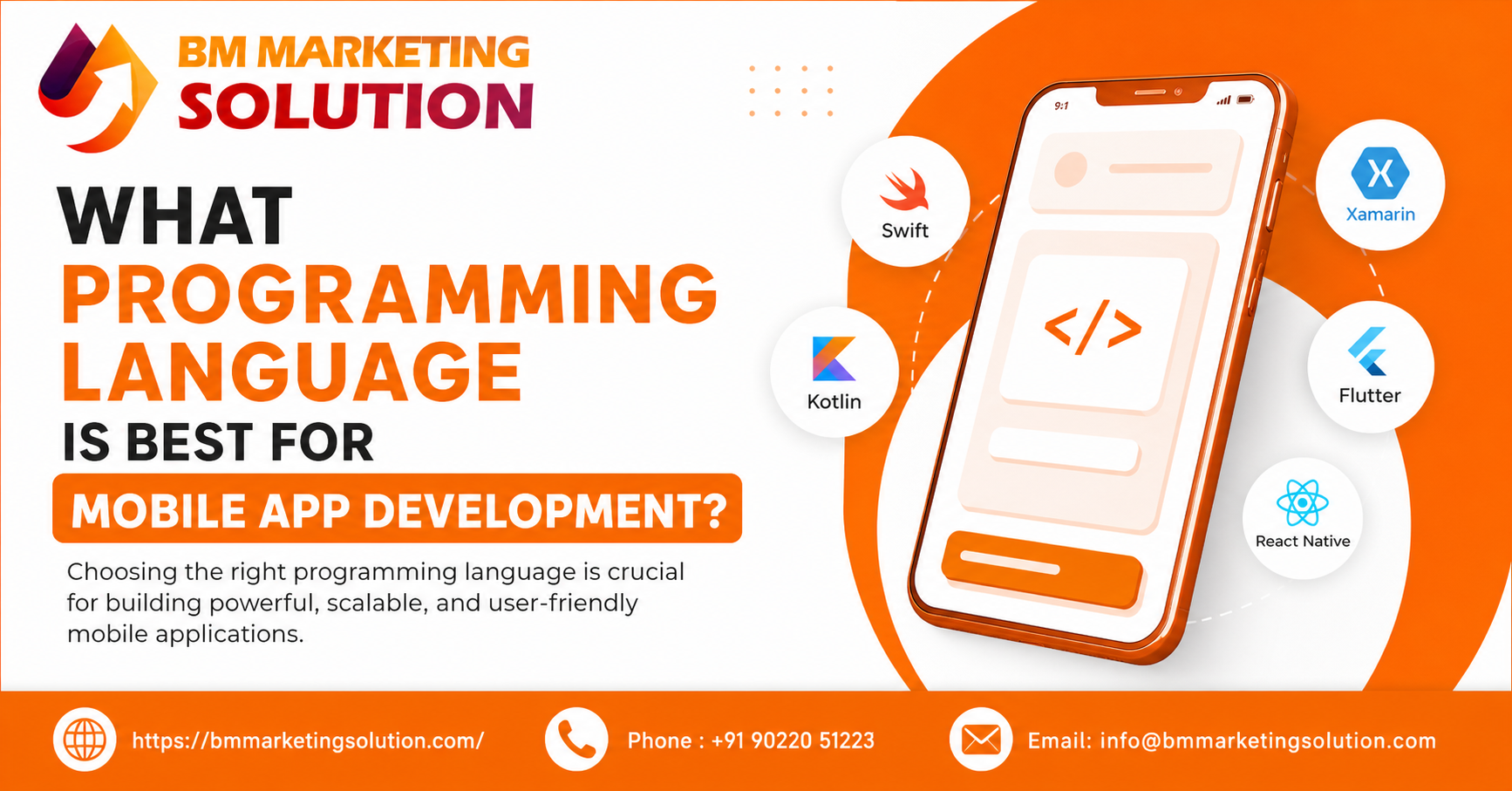
Choosing the best programming language for mobile app development can feel like a big decision. You want an app that works smoothly, looks good, and is easy to maintain without spending more time or money than necessary. So, which language is best?
The honest answer is that there is no single perfect choice for every project. Different mobile app development languages, such as Kotlin, Java, Swift, Dart, and JavaScript, offer different benefits depending on your requirements.
The right option depends on whether you are building for iPhone, Android, or both. Your budget, timeline, and desired user experience also matter. If you want to create an app for multiple platforms using a shared codebase, exploring cross-platform app development languages can help you make a more informed decision.
Here is a straightforward guide to help you choose the right programming language for your mobile app.
Call: +91 90220 51223 ·
Email : info@bmmarketingsolution.com
Before choosing a language, think about what your app needs to do. Is it a simple booking app, an online store, or a feature-rich product with maps, payments, and real-time updates? Will you launch on one platform first, or do you need both iOS and Android from day one?
These details matter because different development approaches come with different strengths. Native development focuses on one platform at a time.
Cross-platform development lets a team build for multiple platforms using a shared codebase. Neither approach is automatically better: the best fit is the one that supports your app’s features and your business goals.
If your main audience uses Apple devices, Swift is a strong choice. It’s Apple’s modern programming language for building apps across its platforms, including iOS and iPadOS.
Swift works well for apps designed specifically for Apple users.
A native app can make it easier to use iPhone features and create an experience that feels at home on the device. This can be useful when performance, polished interactions, or close integration with Apple services is a priority.
The trade-off is that an iOS app usually needs a separate Android development plan if you later want to reach Android users. That may mean more development time and a larger budget.
For an Android-first app, Kotlin is often the natural starting point. Google recommends Kotlin for new Android development, and it works with existing Java code and libraries.
That compatibility can be helpful when a project needs to work with established Android tools or code.
Kotlin is a good fit when your users primarily use Android devices or your app needs a platform-focused experience.
Like Swift, it is a native option, so building a separate iOS app may require additional development work.
If you want to launch on both iOS and Android, a cross-platform framework may help your team share more code.
Flutter uses Dart and supports building apps for multiple platforms from a single codebase.
It can suit teams that want to create a consistent design across devices while keeping much of the app’s development in one place. Platform-specific code may still be needed for certain features or integrations.
React Native is another option. It uses JavaScript to build Android and iOS apps while connecting with the platforms’ native capabilities.
It may be worth considering if your team already works with JavaScript or React.
Cross-platform does not mean “build once and never think about the platforms again.” Testing on real devices, checking platform-specific behavior, and maintaining integrations are still important. A shared codebase can save effort, but the right result depends on the app and the team building it.
A practical way to decide is to start with your users and constraints :
Choose Swift if your app is for Apple users and needs a dedicated iOS experience.
Choose Kotlin if Android is your main platform, or you want a native Android app.
Consider Flutter or React Native if you need both platforms and want to share much of the code.
Talk to a developer if your app relies on complex device features, payments, or real-time functionality.
Also consider the people who will maintain the app after launch. A familiar technology can make hiring and updates easier.
Ask your development team to explain the trade-offs in plain language, including likely costs, testing needs, and long-term support.
The best programming language for mobile app development depends on what you’re building, who will use it, and how you plan to grow it. Swift and Kotlin are solid choices for platform-specific apps, while Flutter and React Native are practical alternatives for building apps for both iOS and Android with a shared codebase.
Understanding different mobile app development languages can help you compare performance, development costs, maintenance, and scalability before making a decision. If you want to build an app for multiple platforms, exploring cross-platform app development languages can help you find an approach that fits your business goals.
You don’t have to make the decision alone. Start by identifying your users, required features, and budget. Then choose the development approach that makes sense for your project, rather than simply following the most popular trend.
Talk Through Your Mobile App Plans
Call : +91 90220 51223 ·
Email : info@bmmarketingsolution.com
Ans : It depends on your experience. Kotlin may feel familiar to developers with Java experience; Swift is designed for Apple development; and JavaScript developers may find React Native approachable.
Ans : Cross-platform frameworks such as Flutter and React Native let teams share much of the code across both platforms. Some platform-specific development may still be needed.
Ans : Not for every project. Flutter uses Dart, while React Native uses JavaScript. Your team’s skills, app requirements, and preferred development approach should guide the choice.
Ans : Choose native when platform-specific performance or features are central. Consider cross-platform when reaching both iOS and Android efficiently is a priority.

SEO & Digital Marketing Executive
With 1.5+ years of experience in SEO, WordPress and digital marketing, I focus on creating informative and SEO-friendly content that helps businesses grow online. I believe in writing clear, practical and easy-to-understand articles that provide real value to readers.
BM Marketing Solution - Building Brands That Stand Out Online
Address: Office no. G610, 5th Floor, Mega Center, Pune - Solapur Rd, Magarpatta, North Hadapsar, Hadapsar, Pune, Maharashtra 411013.
Phone : +91 90220 51223
Email: info@bmmarketingsolution.com
Copyright © 2025 BM Marketing Solution All Rights Reserved