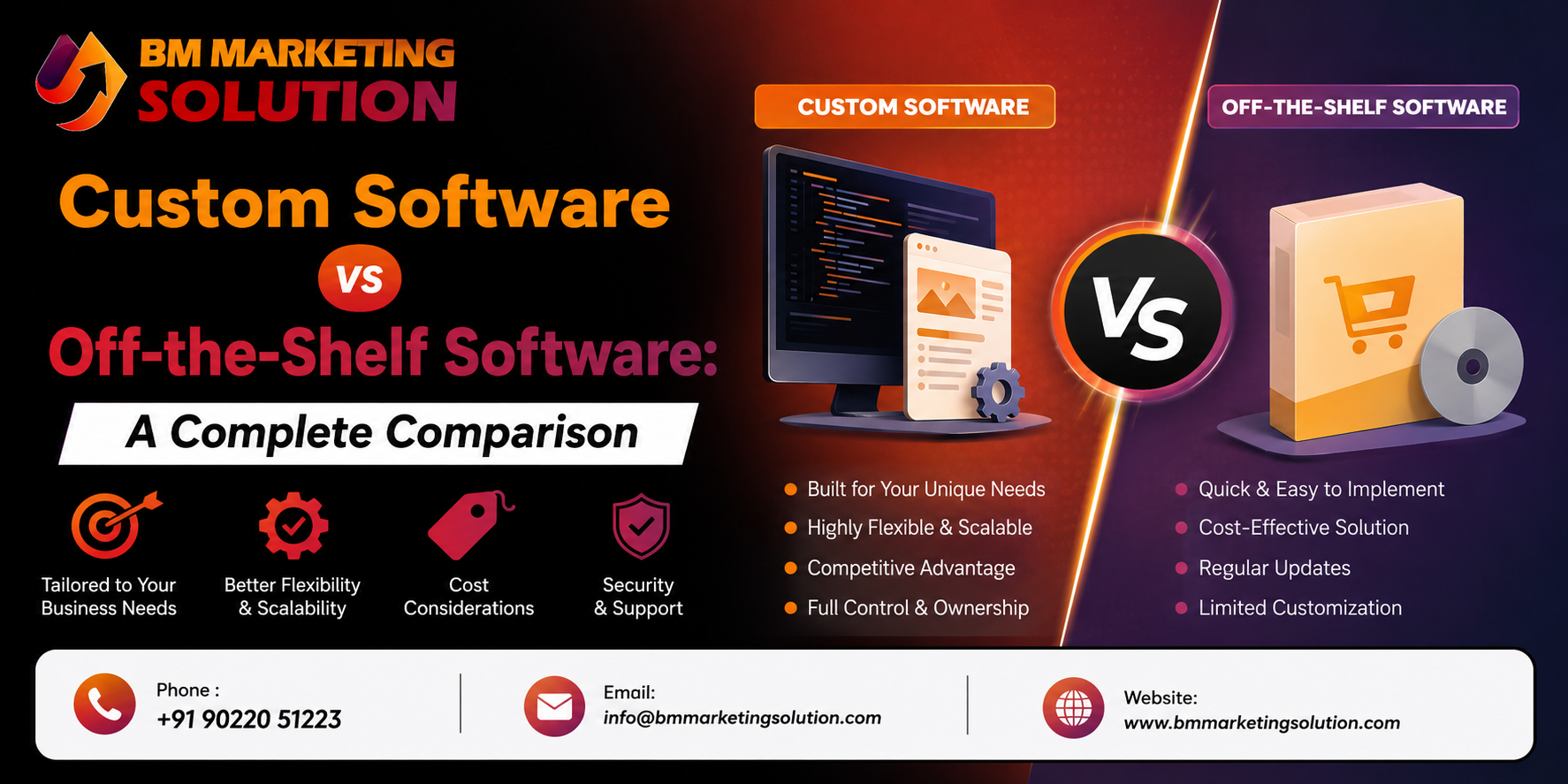
In today’s competitive business environment, software plays a crucial role in managing operations, improving productivity and delivering better customer experiences. Whether you are a startup, a small business, or a large enterprise, choosing the right software can significantly impact your growth and efficiency.
One of the most common questions business owners face is: Should I choose Custom Software vs Off-the-Shelf Software for my business?
As organizations continue to embrace digital transformation, understanding the differences between Custom Software vs Off-the-Shelf Software has become more important than ever. While both options can help streamline business processes and improve operational efficiency, they are designed to meet different needs and objectives.
Choosing between Custom Software vs Off-the-Shelf Software depends on several factors, including your budget, business requirements, scalability goals, and long-term growth strategy. Making the right decision can help improve productivity, reduce costs, and provide a competitive advantage in your industry.
In this article, we will explore the key differences between Custom Software vs Off-the-Shelf Software, including their benefits, limitations, costs, customisation options, and long-term value, helping you determine which solution is the best fit for your business.
Custom software is developed specifically for a business’s unique needs. Instead of adjusting your operations to fit a software product, the software is designed around your existing workflows and goals.
For example, if your company has specialized processes that standard software cannot handle, a custom solution can be built to address those exact requirements.
Businesses looking for tailored software solutions often partner with experienced development companies like BM Marketing Solution. Learn more at https://bmmarketingsolution.com/
Off-the-shelf software refers to ready-made applications designed for a wide range of users. These products are developed to solve common business problems and are available for immediate use.
Examples include accounting software, project management tools, customer relationship management (CRM) systems, and team collaboration platforms.
Since these solutions are created for a broad audience, they typically include standard features that work for many businesses.
When comparing software options, cost is often one of the first factors businesses evaluate.
Custom software usually requires a larger upfront investment because the solution is built from scratch. The development process involves planning, designing, coding, testing, and deployment.
However, the investment often pays off in the long run because the software is designed specifically for your business and can grow alongside your company.
No unnecessary features Long-term value Better return on investment Off-the-Shelf Software Ready-made software generally costs less initially and is commonly offered through monthly or yearly subscription plans.
Benefits :
The downside is that subscription fees can increase over time, especially as your team grows.
Every business operates differently. That is why flexibility is an important consideration.
Custom Software
One of the biggest advantages of custom software is complete customization. Every feature is built around your business processes.
Create uniquee workflows.
Add specific features.
Modify functions whenever needed.
Integrate with existing systems.
This level of flexibility allows businesses to operate more efficiently without changing their processes to fit software limitations.
Off-the-Shelf solutions provide limited customization options. While many platforms offer settings and plugins, businesses often need to adapt their operations to fit the software.
For organizations with simple requirements, this may not be a problem. However, businesses with specialized workflows may find these limitations frustrating.
As businesses grow, their software needs evolve.
Custom Software
Custom solutions can be developed with future expansion in mind. New features, integrations, and capabilities can be added whenever needed.
This makes custom software an excellent choice for companies planning long-term growth.
Off-the-Shelf Software:
Many ready-made platforms offer upgraded plans, but businesses may eventually reach a point where the software no longer meets their needs.
Occasionally, companies are forced to switch platforms entirely, resulting in additional costs and operational disruptions.
Modern businesses often use multiple tools and platforms.
Custom Software
Custom software can be designed to integrate seamlessly with your existing applications, databases, and third-party services.
Benefits include:
Although many commercial solutions support integrations, compatibility issues can sometimes arise. Businesses may need additional software or plugins to connect systems effectively.
Cybersecurity has become a top priority for organizations of all sizes.
Custom Software
Custom-built applications can include security measures tailored to your industry and business requirements.
Since the software is unique, it is less likely to be targeted by automated attacks designed for widely used platforms.
Off-the-Shelf Software
Popular software providers invest heavily in security and regularly release updates. However, because these platforms are used by millions of customers, they are often attractive targets for cybecriminals.
Time is another important factor when choosing software.
Custom Software
Building software from scratch takes time. Depending on the project’s complexity, development can take several weeks or even months.
However, the result is a solution that aligns perfectly with your business objectives.
Off-the-Shelf Software:
Ready-made software can usually be installed and used immediately.
For businesses that need a solution quickly, this can be a major advantage.
With custom software, your business has complete ownership and control over the system.
The software provider controls the product roadmap, pricing, updates, and feature releases.
Users must rely on the vendor’s decisions and timelines.
There is no one-size-fits-all answer when it comes to choosing between custom software and off-the-shelf software. The right choice depends on your business goals, budget, and long-term vision.
Off-the-shelf software works well for organizations looking for a quick and affordable solution. On the other hand, custom software offers unmatched flexibility, scalability, and control, making it a smart investment for businesses with unique requirements and ambitious growth plans.
If you’re considering a custom software solution that aligns perfectly with your business objectives, visit https://bmmarketingsolution.com/ to explore professional software development services and expert guidance.
Ans : The biggest advantage is that it is built specifically for your business needs, allowing greater flexibility, efficiency, and scalability.
Ans : Yes. Many small businesses choose off-the-shelf software because it is affordable, easy to implement, and requires minimal setup.
Ans : Absolutely. Custom software can be modified and expanded as your business grows and requirements change.
Ans : For businesses with unique workflows and long-term growth plans, custom software often provides better value because it can evolve alongside the organisation.
BM Marketing Solution - Building Brands That Stand Out Online
Address: Office no. G610, 5th Floor, Mega Center, Pune - Solapur Rd, Magarpatta, North Hadapsar, Hadapsar, Pune, Maharashtra 411013.
Phone : +91 90220 51223
Email: info@bmmarketingsolution.com
Copyright © 2025 BM Marketing Solution All Rights Reserved