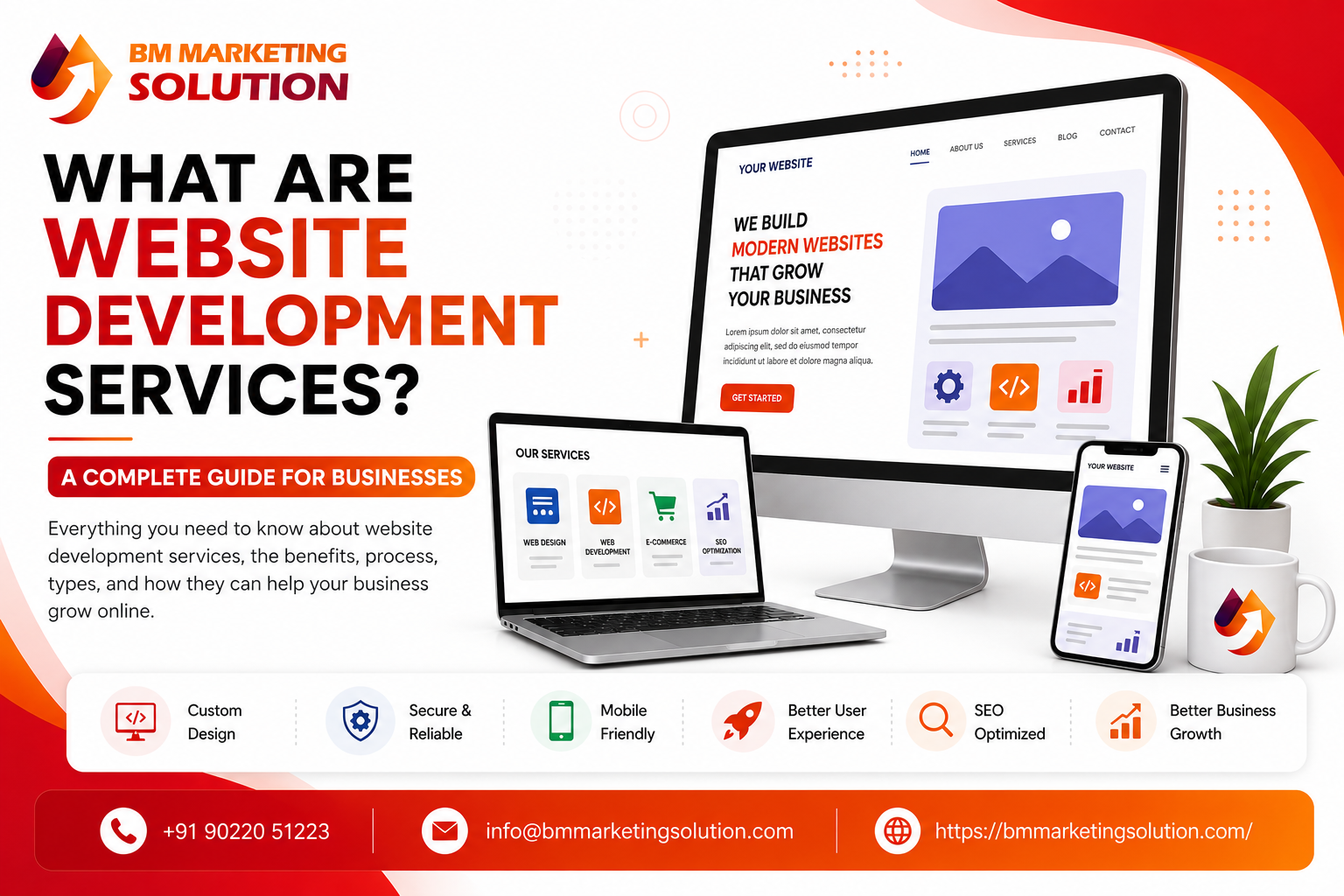
Professional website development generally follows several stages.
Step 1: Understanding Business Requirements.
The first step is understanding your business, target customers, services, competitors, and website goals.
This helps determine what type of website and functionality you actually need.
Step 2: Planning the Website.
The development team creates the website structure, page hierarchy, navigation, and overall functionality.
This stage helps avoid unnecessary changes later in the project.
Step 3: Designing the website.
The design focuses on visual appearance as well as usability.
In today’s digital world, your website is often the first place people visit to learn about your business. Before contacting you, visiting your office, or making a purchase, potential customers may check your website to understand who you are, what you offer, and whether your business can meet their needs.
But simply having a website is not enough. It needs to be fast, secure, mobile-friendly, easy to navigate, and designed around your business goals. This is where website development plays an important role.
So, what are website development services, and why do businesses need them? Website development services cover the process of planning, designing, building, testing, and maintaining a website to create a reliable online presence.
Professional web development services can also include responsive design, e-commerce functionality, CMS integration, custom features, website security, and ongoing maintenance. The right website development services can help businesses create a website that not only looks professional but also provides a better experience for customers.
Website development services cover the complete process of creating and managing a website. This can include planning the website structure, designing the user experience, developing its functionality, testing everything, launching the website, and providing ongoing maintenance.
In simple terms, website development turns your business idea into a working digital platform that customers can access online.
Depending on your requirements, website development may include :
Front-end development : The visible part of your website, including pages, menus, buttons, forms, images, and interactive elements.
Back-end development: The technical functionality behind the website, including databases, server-side processes, and integrations.
UI/UX design : Creating a website that looks professional while making it simple and comfortable for visitors to use.
Making sure your website works properly across smartphones, tablets, laptops, and desktops.
E-commerce development : Building online stores with product pages, shopping carts, payment options, checkout, and order management.
Integrating platforms such as WordPress so businesses can easily manage and update their website content.
Website maintenance : Keeping the website updated, secure, functional, and free from technical issues after launch.
The exact services you need will depend on your business, target audience, website type, and long-term goals.
A website is more than an online brochure. When developed properly, it can become an important part of your marketing and sales strategy.
Your website can shape a customer’s first impression of your business.
If your website looks outdated, loads slowly, or is difficult to navigate, visitors may leave before learning about your products or services. A modern and well-structured website helps create a more professional impression.
People want to know that they are dealing with a genuine and reliable business.
Clear information about your company, services, contact details, customer reviews, and professional website design can help establish credibility and make visitors more comfortable contacting you.
A well-developed website can help turn visitors into potential customers.
Contact forms, inquiry buttons, service pages, landing pages, live chat, and clear calls to action can make it easier for visitors to take the next step.
Website development and SEO work closely together.
A technically sound website with proper structure, mobile responsiveness, good loading speed, crawlable pages, and SEO-friendly elements can provide a stronger foundation for search engine visibility.
Of course, development alone does not guarantee rankings, but a technically healthy website makes ongoing SEO work much easier.
Your website should be able to grow as your business grows.
You may want to add new services, publish blogs, introduce products, integrate third-party tools, or add new features in the future. A properly planned website can make these changes easier without requiring a complete rebuild every time.
Different businesses have different requirements. Some need a simple informational website, while others need complex platforms with advanced functionality.
Here are some common types of website development :
Business websites are designed to present a company’s services, products, information, and contact details online.
They are commonly used by service providers, agencies, consultants, startups, and established companies.
E-commerce websites allow businesses to sell products or services online.
Portfolio websites are useful for freelancers, designers, photographers, developers, agencies, and other professionals who want to showcase their previous work.
The main goal is usually to present work clearly and encourage potential clients to get in touch.
Landing pages are focused pages created for a particular product, service, offer, or marketing campaign.
Instead of providing lots of information, a landing page generally focuses on one specific action, such as submitting an inquiry, booking a consultation, or requesting a quote.
Some businesses require more than a standard website.
Custom web applications can include booking platforms, customer portals, dashboards, business management systems, online tools, and other solutions built around specific business processes.
A Content Management System (CMS) allows businesses to manage website content without depending entirely on a developer for every small change.
WordPress is one of the most commonly used CMS platforms and can be suitable for many business websites.
Professional website development generally follows several stages.
Step 1: Understanding Business Requirements.
The first step is understanding your business, target customers, services, competitors, and website goals.
This helps determine what type of website and functionality you actually need.
Step 2: Planning the Website.
The development team creates the website structure, page hierarchy, navigation, and overall functionality.
This stage helps avoid unnecessary changes later in the project.
Step 3: Designing the website.
The design focuses on visual appearance as well as usability.
The goal is to create a website that represents your brand while making it easy for visitors to find the information they need.
Step 4: Development :
Once the design is approved, developers start building the actual website and implementing its required features and functionality.
Step 5: Testing :
Before launch, the website should be tested across different devices and browsers.
Forms, links, buttons, navigation, page speed, responsiveness, and important functionality should all be checked.
Step 6: Launch :
After testing and final approval, the website is published online and made available to customers.
Step 7: Maintenance and Updates:
Launching the website is not necessarily the end of the process.
Regular updates, backups, security checks, performance improvements, and content updates can help keep the website healthy over time.
Choosing a development partner is an important decision because your website can have a direct impact on your online presence.
Before hiring a company or developer, consider the following:
Check their previous work: Look at their portfolio to understand the quality and variety of websites they have created.
Understand their development approach: Make sure they focus on functionality, performance, security, and usability not just visual design.
Ask about maintenance : Find out whether they provide support after the website goes live.
Discuss timelines and costs clearly. A professional development company should explain what is included in the project and provide a clear estimate.
Consider your long-term requirements: Choose a partner who understands where your business is heading and can support future improvements.
The cheapest option is not always the best option. A website should be viewed as a long-term business investment rather than a one-time expense.
There is no fixed price for website development because every project is different.
The final cost can depend on factors such as:
A basic business website may require a relatively small investment, while an e-commerce platform or custom web application can cost considerably more.
The best approach is to discuss your requirements with a development company and request a project-specific quotation.
The development timeline depends on the size and complexity of the project.
A simple business website may take a few weeks, while an e-commerce website or custom web application may require several weeks or even months.
The timeline can also be affected by content availability, design revisions, integrations, testing, and the number of features required.
Website design and website development are connected, but they are not the same.
Website design mainly focuses on how the website looks and how users interact with it. This includes layouts, colors, typography, images, navigation, and user experience.
Website development focuses on building the website and making its features work properly.
For the best results, design and development should work together. A beautiful website that is difficult to use is not effective, and a technically strong website with poor user experience may struggle to engage visitors.
Should you build a new website or redesign your existing
Website development services involve much more than simply creating a few web pages.
A successful website combines good design, reliable functionality, responsive performance, security, usability, and a structure that supports your business objectives.
Whether you’re launching a new business website, building an online store, or upgrading an existing website, choosing the right development approach can make a significant difference to your online presence.
If you’re looking for a website that is designed around your business requirements rather than a generic template, professional website development can give you the foundation you need to grow online.
Ready to improve your business website?
Get in touch with BM Marketing Solution to discuss your website development requirements.
Phone: +91 90220 51223
Email: info@bmmarketingsolution.com
Website: bmmarketingsolution.com
Ans : Website development services include the planning, design, development, testing, launch, and maintenance of a website. Depending on the project, they can also include e-commerce, CMS integration, custom functionality, and third-party integrations.
Ans : A simple business website can often be completed within a few weeks. More complex e-commerce websites and custom web applications may take several weeks or months, depending on their features and requirements.
Ans : The cost depends on the website’s size, design, functionality, technology, integrations, and maintenance requirements. A customised quotation is usually the best way to determine the actual project cost.

SEO & Digital Marketing Executive
With 1.5+ years of experience in SEO, WordPress and digital marketing, I focus on creating informative and SEO-friendly content that helps businesses grow online. I believe in writing clear, practical and easy-to-understand articles that provide real value to readers.
Binary MLM Software with Mobile App: Features & Benefits : https://bmmarketingsolution.com/binary-mlm-software-with-mobile-app-features-benefits/
https://bmmarketingsolution.com/how-binary-mlm-software-works-a-beginners-guide/
BM Marketing Solution - Building Brands That Stand Out Online
Address: Office no. G610, 5th Floor, Mega Center, Pune - Solapur Rd, Magarpatta, North Hadapsar, Hadapsar, Pune, Maharashtra 411013.
Phone : +91 90220 51223
Email: info@bmmarketingsolution.com
Copyright © 2025 BM Marketing Solution All Rights Reserved