Once the main functionality is ready, website content is added.
This may include:
SEO should be considered naturally at this stage. Relevant search terms can be incorporated into important areas such as page titles, headings, descriptive URLs, image alt text, and content where appropriate. Google recommends creating helpful, well-written, people-first content rather than writing primarily to manipulate rankings.
Building a website is more than choosing a design and putting some information online. A successful website requires proper planning, user-friendly design, clean development, testing, security, and ongoing maintenance. Whether you are creating a small business website, an eCommerce store, or a custom web application, understanding the website development process can help you build a website that is effective, reliable, and easy to manage.
But how does website development work?
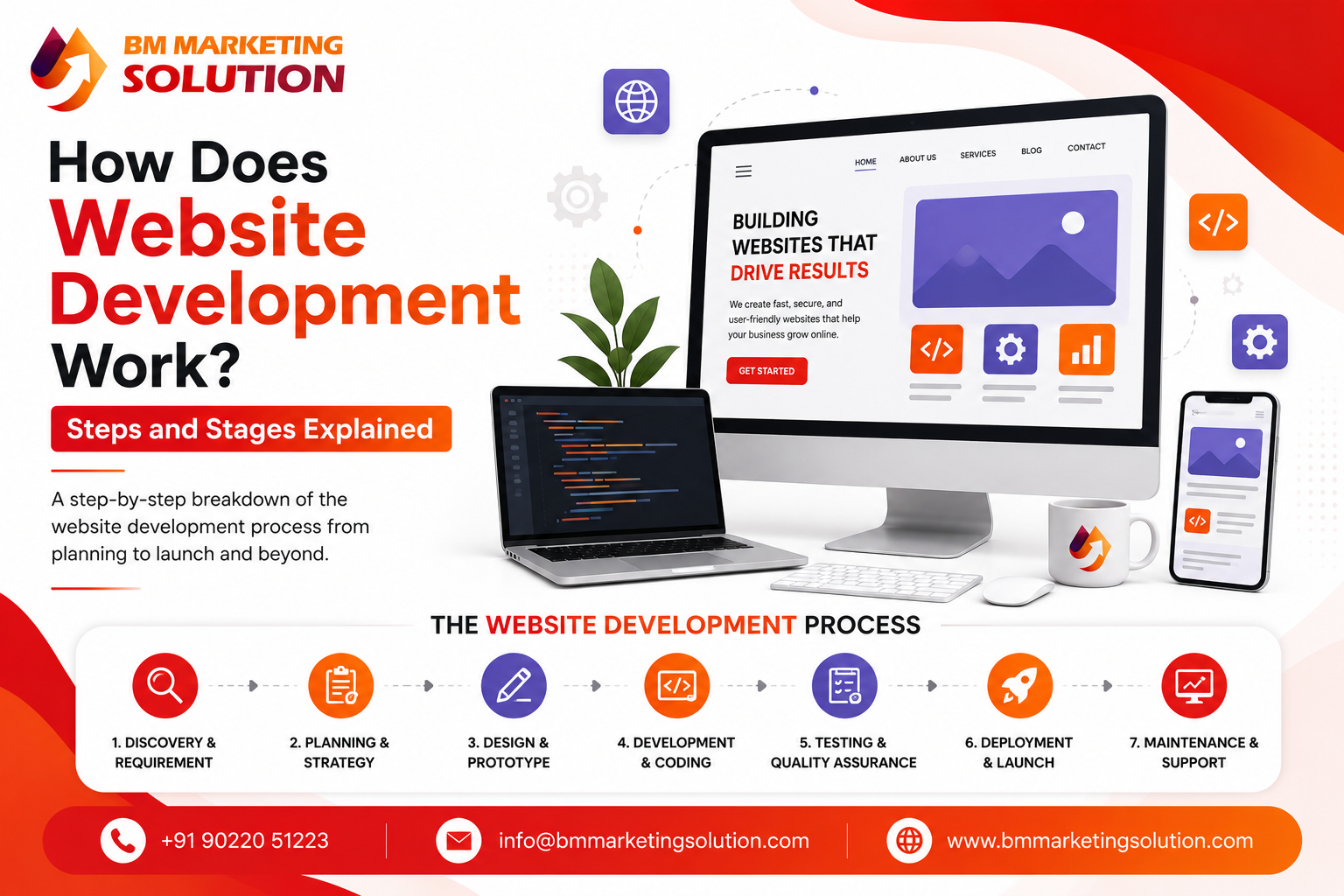
The answer involves several important stages, from understanding business requirements and planning the website structure to designing, developing, testing, launching, and maintaining the finished website. Each stage plays an important role in creating a website that provides a smooth user experience and supports your business goals.
In this guide, we will explain the major website development steps and website development stages in a simple way. We will also look at how the web development process works and what businesses should consider before launching a website.
Website development is the process of planning, designing, building, testing, launching, and maintaining a website. It can involve different technologies, content management systems, databases, APIs, and programming languages depending on the project’s requirements.
The goal is not simply to create a website that looks attractive. A good website should also be easy to navigate, responsive across devices, secure, fast, accessible, and useful to its target audience.
SEO should also be considered during development because search engines need to be able to crawl, understand, and index website content effectively.
The website development process generally moves through several stages. Each stage has a specific purpose and contributes to the final quality of the website.
The first stage is understanding what the website needs to achieve.
Before development begins, the team discusses questions such as:
What is the purpose of the website?
Who is the target audience?
What products or services will be offered?
What pages are required?
What features should the website include?
What type of content will be published?
Are there specific business or technical requirements?
For example, a service-based business may need pages such as Home, About Us, Services, Blog, and Contact. An ecommerce business may require product pages, categories, shopping carts, payment integration, customer accounts, and order management.
This stage helps create a clear direction before design and development begin.
Once the requirements are understood, the next step is planning the website structure.
Developers and designers decide how pages will be organized and how users will move from one page to another. This is often called the website architecture.
A basic structure might look like:
Home → Services → Service Details → Contact
During planning, the team may also decide on:
Good planning can reduce unnecessary changes later in the project.
After planning, the website moves into the design stage.
Designers create the visual appearance and user experience of the website. This includes elements such as:
The focus should be on creating a design that looks professional while making it easy for visitors to find information and complete actions.
A website should also be responsive, meaning it should work properly on desktops, tablets, and smartphones. How Does Website Development Work?
The website development process generally moves through several stages. Each stage has a specific purpose and contributes to the final quality of the website.
The first stage is understanding what the website needs to achieve.
Before development begins, the team discusses questions such as:
What is the purpose of the website?
Who is the target audience?
What products or services will be offered?
What pages are required?
What features should the website include?
What type of content will be published?
Are there specific business or technical requirements?
For example, a service-based business may need pages such as Home, About Us, Services, Blog, and Contact. An ecommerce business may require product pages, categories, shopping carts, payment integration, customer accounts, and order management.
This stage helps create a clear direction before design and development begin.
Once the requirements are understood, the next step is planning the website structure.
Developers and designers decide how pages will be organized and how users will move from one page to another. This is often called the website architecture.
A basic structure might look like:
Home → Services → Service Details → Contact
During planning, the team may also decide on:
Website navigation
URL structure
Page hierarchy
Content requirements
Technology or CMS
SEO requirements
Third-party integrations
Project timeline
Good planning can reduce unnecessary changes later in the project.
After planning, the website moves into the design stage.
Designers create the visual appearance and user experience of the website. This includes elements such as:
The focus should be on creating a design that looks professional while making it easy for visitors to find information and complete actions.
A website should also be responsive, meaning it should work properly on desktops, tablets, and smartphones.
This is where the approved design is converted into a working website.
Developers build the website using suitable technologies or platforms. Depending on the project, this could involve WordPress, HTML, CSS, JavaScript, PHP, databases, frameworks, APIs, or other technologies.
Website development can involve two major areas:
Front-end development:
This focuses on what visitors see and interact with, including layouts, buttons, menus, forms, animations, and responsive elements.
Back-end development:
This handles behind-the-scenes functionality such as databases, user accounts, server-side processes, APIs, and application logic.
For a simple business website, the development process may be relatively straightforward. A complex web application can require much more advanced development and integration.
Once the main functionality is ready, website content is added.
This may include:
SEO should be considered naturally at this stage. Relevant search terms can be incorporated into important areas such as page titles, headings, descriptive URLs, image alt text, and content where appropriate. Google recommends creating helpful, well-written, people-first content rather than writing primarily to manipulate rankings.
Internal links can also help users navigate the website and help search engines discover related pages.
Before launching the website, everything needs to be tested.
Testing helps identify technical problems that could affect visitors.
Links and navigation Contact forms Buttons Mobile responsiveness Page loading Browser compatibility Images Forms and validations Security Website functionality Basic SEO elements Testing on different devices and browsers is particularly important because visitors may access the website in different ways.s.
Once testing is complete and major issues have been resolved, the website can be launched.
The website is connected to its domain and hosting environment and is made publicly accessible.
Before or around launch, the team may also check technical SEO elements, indexing settings, analytics, Search Console, sitemap configuration, SSL/security, and redirects where required.
However, launching a website does not mean the project is finished. Google notes that meeting technical requirements does not automatically guarantee crawling, indexing, or ranking in search results.
A website needs ongoing attention after launch.
Regular maintenance may include:
Updating content;
Updating software and plugins;
Fixing broken links;
Monitoring website performance;
Improving security;
Creating new content;
Checking forms;
Reviewing analytics;
Making SEO improvements;
Adding new features.
As your business grows, your website may also need new pages, integrations, functionality, or design improvements.
A structured development process helps businesses avoid unnecessary confusion and reduces the chances of missing important requirements.
It also makes it easier to create a website that supports both business objectives and user needs.
A well-developed website can help a business:
Build online credibility
Generate leads
Improve customer experience
Showcase products and services
Support digital marketing
Strengthen its online presence
Provide information to customers 24/7.
The best websites are not created only for search engines. They are created to solve real problems for real users while also making the content accessible to search engines.
The timeline depends on the type and complexity of the website.
A small business website may take less time than an ecommerce platform or custom web application. The number of pages, design requirements, integrations, content, revisions, and functionality can all affect the development timeline.
Instead of focusing only on speed, businesses should focus on creating a website that is reliable, useful, secure, and easy to maintain.
Ans : The first step is usually requirement gathering and research. The development team needs to understand the website’s purpose, target audience, required features, content, and business goals before planning the project.
Ans : The main stages generally include requirement gathering, planning, design, development, content and SEO integration, testing, launch, and ongoing maintenance.
Ans : Yes. SEO can be considered during website planning and development. Factors such as site structure, page titles, URLs, content, internal links, mobile usability, performance, and crawlability can affect how search engines understand a website.
Ans : Yes. Regular maintenance helps keep a website secure, functional, updated, and relevant. Businesses may also need ongoing content, SEO, performance, and feature updates as their needs change.
Website development is a step-by-step process that starts with understanding a business’s goals and ends with launching and maintaining a functional online presence. From planning and design to development, testing, SEO and maintenance, every stage plays an important role in creating a reliable and effective website.
Understanding how website development works can help businesses make better decisions when planning a new website or improving an existing one. A successful website should not only look professional but also provide a smooth experience for visitors, work well across different devices, support business goals, and make important information easy to find.
A well-planned website development process also helps ensure that the website is built with the right structure, functionality, and user experience from the beginning. Whether you need a business website, eCommerce store, or custom web solution, following the right website development steps can make the entire project more organized and effective.
If you are planning to build a new website or improve an existing one, working with an experienced website development team can help you create a solution that fits your business requirements and supports your long-term digital goals.
Ready to build a better website for your business?
For professional website development services, you can connect with BM Marketing Solution.
Website: BM Marketing Solution
Phone: +91 90220 51223
Email: info@bmmarketingsolution.com

SEO & Digital Marketing Executive
With 1.5+ years of experience in SEO, WordPress and digital marketing, I focus on creating informative and SEO-friendly content that helps businesses grow online. I believe in writing clear, practical and easy-to-understand articles that provide real value to readers.
Binary MLM Software with Mobile App: Features & Benefits : https://bmmarketingsolution.com/binary-mlm-software-with-mobile-app-features-benefits/
https://bmmarketingsolution.com/how-binary-mlm-software-works-a-beginners-guide/
Confused between Matrix and Binary MLM plans? Compare their features, advantages, and business suitability to make an informed decision.
Read More : https://bmmarketingsolution.com/matrix-mlm-software-vs-binary-mlm-software-which-is-better/

BM Marketing Solution - Building Brands That Stand Out Online
Address: Office no. G610, 5th Floor, Mega Center, Pune - Solapur Rd, Magarpatta, North Hadapsar, Hadapsar, Pune, Maharashtra 411013.
Phone : +91 90220 51223
Email: info@bmmarketingsolution.com
Copyright © 2025 BM Marketing Solution All Rights Reserved