Once everything is approved, the website is prepared for launch.
This may involve :
The launch itself can be quick, but the preparation before launch is what makes the process smooth.
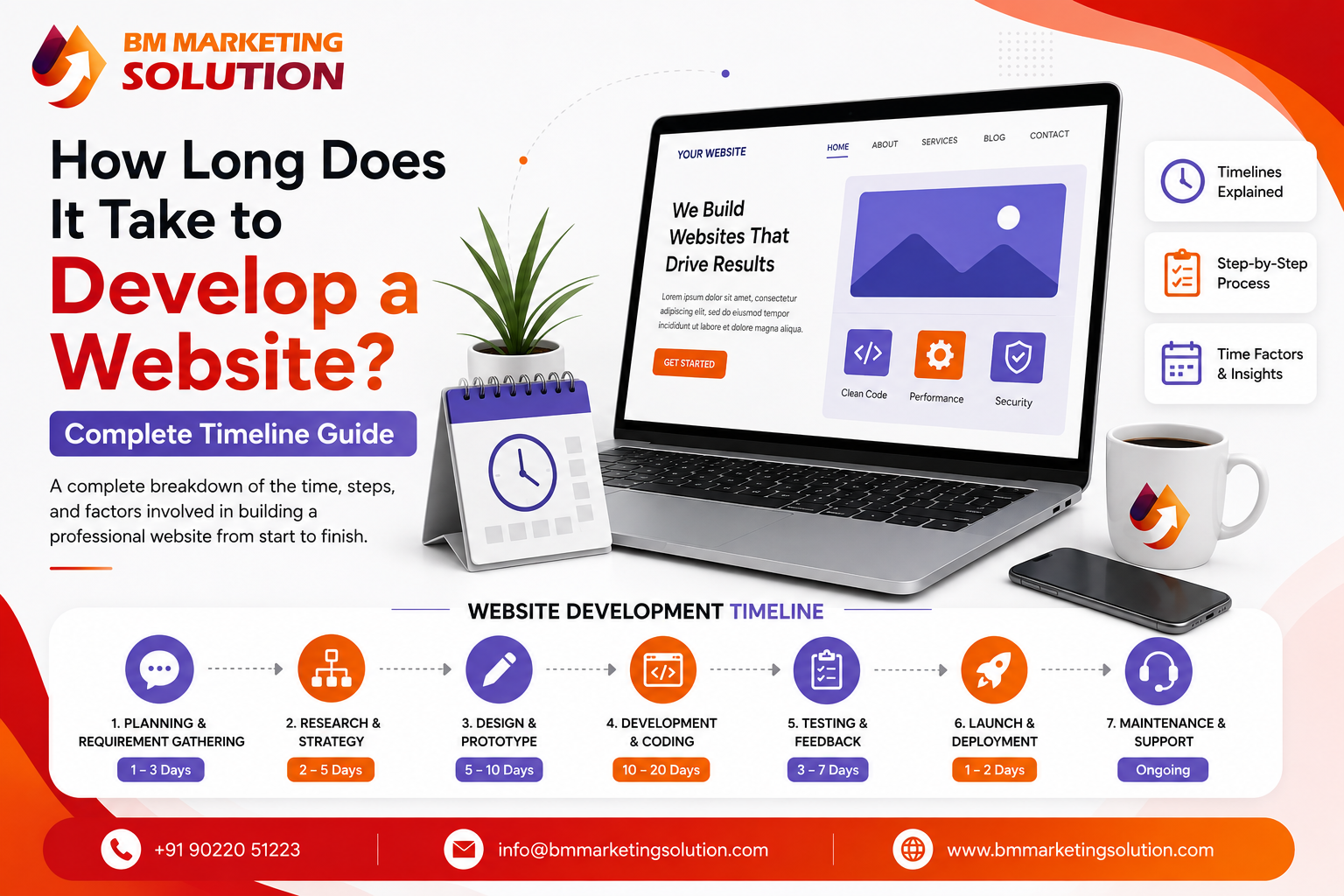
Building a website is more than choosing a template, adding a few pages, and publishing it online. A professional website usually follows a well-planned website development process that includes several website development stages, such as planning, content creation, UI/UX design, development, testing, SEO setup, and launch.
So, how long does it take to develop a website? Understanding the website development timeline can help businesses know what to expect at each stage of the project.
For a small business website, the website development time may be around 3–6 weeks, while larger websites, eCommerce platforms, and custom web applications can take several months. The actual timeline depends on the website’s size, functionality, design requirements, content, integrations, and approval process.
If you are planning a new website, understanding the website development stages and overall website development process can help you set realistic expectations, manage the website development timeline, and avoid unnecessary delays.
Get expert website design and development solutions from BM Marketing Solution.
There is no single timeline that works for every website. A basic business website with a few pages can be completed much faster than a customized eCommerce website or web application.
As a general guide:
| Website Type | Approximate Development Time |
|---|---|
| Landing Page | 1–2 weeks |
| Small Business Website | 3–6 weeks |
| Corporate Website | 5–10 weeks |
| eCommerce Website | 6–12+ weeks |
| Custom Web Application | 3–6+ months |
These are approximate timelines. A project can move faster or slower depending on its requirements. For example, content delays, design revisions, third-party integrations, and changes in project scope can extend the schedule. Recent industry timelines similarly place many standard business websites in the several-week range, while complex builds can take considerably longer.
The first stage is understanding what the website needs to accomplish.
A development team usually discusses :
A clear plan helps prevent confusion later. It also gives the development team a better understanding of what needs to be designed and built.
Once the requirements are clear, the website structure is planned.
This includes creating the sitemap and deciding how users will move between pages. Important pages might include:
Home
About Us
Services
Products
Blog
Contact
FAQs
Content is also planned at this stage. If website content, images, videos, or product information are not ready, the project may take longer.
The design stage determines how the website will look and feel.
Designers create layouts for important pages while considering:
Brand identity
Typography
Colors
Navigation
Buttons and calls-to-action
Mobile responsiveness
User experience
A good design should not only look attractive but also make it easy for visitors to find information and take action.
Multiple revision rounds can increase the timeline, especially when major changes are requested after the design has already been approved.
This is where the approved design is converted into a working website.
Depending on the project, developers may work on:
Front-end development
Back-end functionality
CMS integration
Contact forms
User accounts
Payment gateways
Product catalogs
APIs
Database integration
Third-party tools
A simple WordPress business website may require significantly less development time than a custom web application with advanced functionality.
After development, content is added to the website.
Basic SEO elements may include:
SEO-friendly page titles
Meta descriptions
Heading structure
Image alt text
Internal links
Clean URLs
XML sitemap
Mobile-friendly pages
Search engine indexing setup
SEO should be considered during development rather than treated as an afterthought. Google recommends creating useful, well-organized, people-first content and using descriptive words in important areas such as titles, headings, alt text, and links.
Before launch, the website needs to be tested carefully.
The team may check:
Mobile responsiveness
Desktop compatibility
Page speed
Contact forms
Buttons and links
Navigation
Browser compatibility
Images
Security
Basic SEO elements
Checkout functionality for ecommerce websites
Testing is important because small issues can negatively affect the user experience after launch. Google also recommends considering overall page experience, including mobile usability, security, and Core Web Vitals.
Once everything is approved, the website is prepared for launch.
This may involve :
The launch itself can be quick, but the preparation before launch is what makes the process smooth.
You can reduce unnecessary delays by preparing important things before development begins.
1. Finalize your website requirements: Decide which pages and features you actually need.
2. Prepare your content: Keep your website copy, images, logos, and product information ready.
3. Set clear priorities: Separate essential features from features that can be added later.
4. Give timely feedback: Quick approvals help the project move from one stage to another.
5. Choose the right development approach: A simple business website does not always need the same technology or development process as a complex web application.
6. Plan SEO from the beginning: SEO-friendly structure, content, URLs, and technical elements can be considered during development instead of being added at the last minute.
For many small and medium-sized business websites, a realistic timeline is around 3–8 weeks from initial planning to launch.
A typical project may look like this:
Week 1: Planning, requirements, sitemap, and content strategy
Week 2: Wireframes and UI/UX design
Week 3–5: Website development and content integration
Week 6: Testing, SEO checks, revisions, and final approval
Week 7–8: Final optimization and launch, if required
The timeline is flexible. Some projects can be completed faster, while websites with custom features, large catalogs, integrations, or complex functionality may require considerably more time.
Ans : A basic business website with around 5–10 pages can often take 3–6 weeks, depending on the design, content, revisions, and functionality required.
Ans : An eCommerce website commonly takes 6–12 weeks or more because it may require product management, shopping carts, payment gateways, customer accounts, shipping options, security checks, and testing.
Ans : Yes, a simple landing page or very small website can sometimes be completed within a week. However, a professional multi-page website usually requires more time for design, development, testing, content, and revisions.
Ans : Common reasons include incomplete content, frequent design changes, additional features, third-party integrations, technical issues, and delayed client approvals.
So, how long does it take to develop a website? There is no fixed answer because every website project is different. A simple business website may take a few weeks, while an eCommerce website or custom web application can take several months. Understanding the website development timeline helps businesses plan each stage more effectively.
The most important thing is not simply launching a website quickly. A successful website should be well-designed, responsive, secure, easy to use, SEO-friendly, and aligned with your business goals. A well-planned website development process ensures that every important aspect of the website is properly handled.
Planning the requirements properly, preparing content early, keeping communication clear, and allowing enough time for testing can make the website development stages smoother and help reduce the overall website development time.
If you are looking for professional website design and development services, BM Marketing Solution can help you create a website designed around your business requirements.
Start your website project with BM Marketing Solution today.
Website: https://bmmarketingsolution.com/
Phone: +91 90220 51223
Email: info@bmmarketingsolution.com

SEO & Digital Marketing Executive
With 1.5+ years of experience in SEO, WordPress and digital marketing, I focus on creating informative and SEO-friendly content that helps businesses grow online. I believe in writing clear, practical and easy-to-understand articles that provide real value to readers.
Binary MLM Software with Mobile App: Features & Benefits : https://bmmarketingsolution.com/binary-mlm-software-with-mobile-app-features-benefits/
https://bmmarketingsolution.com/how-binary-mlm-software-works-a-beginners-guide/

BM Marketing Solution - Building Brands That Stand Out Online
Address: Office no. G610, 5th Floor, Mega Center, Pune - Solapur Rd, Magarpatta, North Hadapsar, Hadapsar, Pune, Maharashtra 411013.
Phone : +91 90220 51223
Email: info@bmmarketingsolution.com
Copyright © 2025 BM Marketing Solution All Rights Reserved