If your business needs to serve users on both platforms, you can consider either native development for each platform or a cross-platform/shared-code approach.
Native development gives teams greater platform-specific control, while cross-platform approaches can allow developers to reuse parts of the codebase.
The right choice depends on performance requirements, development timeline, budget, maintenance plans, and the level of platform-specific functionality required.
For example, a simple business application may work well with a shared development approach.
On the other hand, an application that relies heavily on advanced device-specific features may benefit from native development.
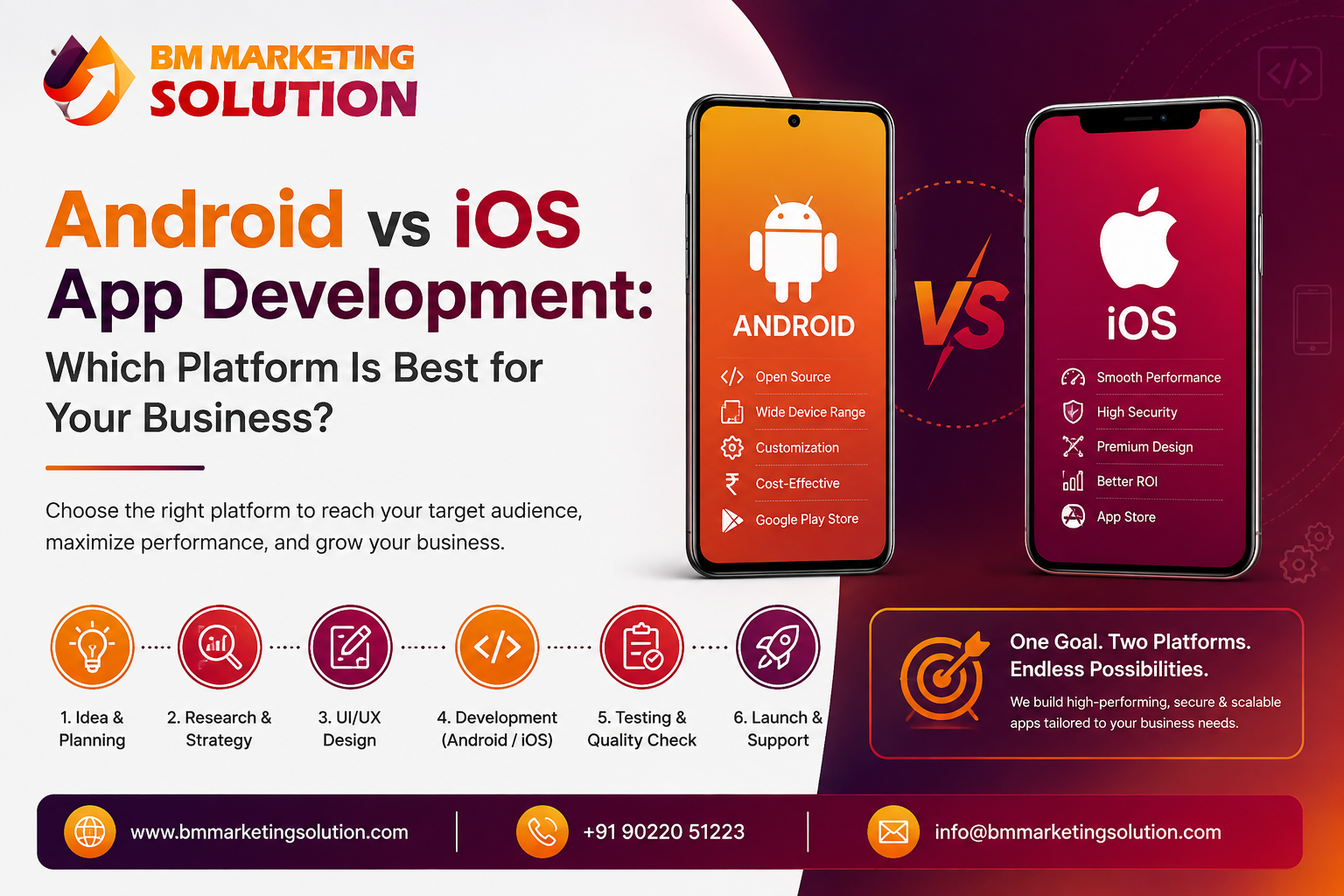
Choosing the right platform is one of the first and most important decisions when planning a mobile app. Businesses often ask, “Should I build an Android app or an iOS app?” The answer depends on your target audience, business goals, budget, required features, and future growth plans.
Android vs iOS App Development offers different opportunities for businesses, as both platforms have their own development environments, user experiences, device ecosystems, and business benefits. Android development commonly uses Kotlin, while iOS development is centered around Swift.
So, which one is better? Instead of choosing a platform based only on popularity, it is important to understand the differences between Android vs iOS App Development and determine which option best fits your specific business requirements, target users, and long-term goals.
1. Primary Language :
2. Development Tool :
3. Device Ecosystem :
4. Testing :
5. Customization :
6. Target Audience :
7. Development Approach :
Android: May require broader testing because of the variety of supported devices.
iOS: Development and testing can be more predictable due to the controlled device ecosystem.
Android app development involves creating applications for devices running Google’s Android operating system. Android development is increasingly Kotlin-first, with Google recommending Kotlin for new Android projects.
One major advantage of Android is its broad device ecosystem. Businesses can reach users across different smartphones, tablets, and price segments. This makes Android a practical option when your goal is to reach a large and diverse audience.
Android also provides developers with considerable flexibility in designing applications and integrating different device capabilities. However, the wide range of devices means developers may need to test the application across different screen sizes, hardware configurations and operating system versions.
iOS app development focuses on creating applications for Apple’s ecosystem, including iPhone and other Apple platforms. Swift is Apple’s modern programming language for building applications across its platforms.
One of the biggest advantages of developing for iOS is the controlled hardware and software environment. Because Apple manages both, developers can create experiences that are consistent across supported devices. Apple also provides Xcode and a comprehensive development ecosystem for building and testing apps.
There is no universal answer because development complexity depends on the app’s features and technical requirements.
Android development may involve more testing because an application can run on devices from different manufacturers and with different screen sizes. iOS development benefits from a more controlled ecosystem, which can make device testing more predictable.
However, the development platform itself should not be the only consideration. Features such as payment integration, GPS, notifications, APIs, user accounts, dashboards, AI functionality, and third-party integrations can significantly influence development time.
The better platform depends mainly on your target customers.
Your target audience uses a wide range of smartphones.
You want to reach different device and price segments.
Your business requires extensive device flexibility.
You want to focus on a broad market.
For some businesses, choosing only one platform may not be necessary. If your customers use both Android and iOS, developing for both can provide broader market coverage.
If your business needs to serve users on both platforms, you can consider either native development for each platform or a cross-platform/shared-code approach.
Native development gives teams greater platform-specific control, while cross-platform approaches can allow developers to reuse parts of the codebase.
The right choice depends on performance requirements, development timeline, budget, maintenance plans, and the level of platform-specific functionality required.
For example, a simple business application may work well with a shared development approach.
On the other hand, an application that relies heavily on advanced device-specific features may benefit from native development.
There is no single winner between Android and iOS.
Android is often the better choice for businesses that want broad device coverage and a diverse user base. iOS can be the better choice for businesses focused on Apple users and a more controlled ecosystem.
The best decision should come from your target audience rather than simply choosing the platform that appears more popular.
If your business has customers on both platforms, developing both Android and iOS applications can be a strong long-term strategy. A professional mobile app development team can evaluate your requirements and recommend the most suitable technology before development begins.
Choosing the right development partner can make a major difference in the quality, security, performance, and scalability of your application.
BM Marketing Solution provides mobile application development services for Android and iOS, with a focus on user experience, security, performance, and business requirements. The company states that its mobile development services cover iPad, iPhone, Android, and iOS platforms, from planning through deployment.
Whether you need a business application, e-commerce app, customer-facing platform, or a customized mobile solution, the development process should begin with understanding your users and business goals.
Ans : Neither platform is universally better. Android is suitable for businesses targeting a broad range of devices, while iOS can be ideal for businesses targeting Apple users. Your audience, features, budget, and business goals should determine the choice.
Ans : The cost depends on the application’s complexity, features, integrations, design, testing, and development approach. Platform choice alone does not determine the final development cost.
Ans : Yes. Businesses can develop separate native applications or consider cross-platform/shared-code technologies. The best approach depends on the application’s technical requirements and long-term goals.
Ans : Look for a company with relevant development experience, a clear development process, strong communication, security practices, testing procedures, and post-launch support. It is also important to discuss your requirements and expected outcomes before starting the project.
Choosing between Android vs iOS App Development is not simply a technical decision; it is an important business decision that can influence your market reach, development process, user experience, and future growth.
Android can be a strong option when you want to reach users across a wide variety of devices, while iOS can be a better choice when your target audience is focused on Apple’s ecosystem. If your business wants maximum market coverage, developing an application for both platforms may be the most practical long-term approach.
Before investing in Android vs iOS App Development, define your target audience, required features, budget, development timeline, and future expansion plans. Once these factors are clear, selecting the right platform becomes much easier.
If you are planning to build an Android or iOS application, BM Marketing Solution can help you turn your idea into a secure, scalable, and user-friendly mobile app designed around your business goals.
Ready to build your mobile app? Contact BM Marketing Solution today and take the next step toward bringing your app idea to life.
Ready to build your mobile app?
Website: https://bmmarketingsolution.com/
Phone: +91 90220 51223
Email: info@bmmarketingsolution.com

SEO & Digital Marketing Executive
With 1.5+ years of experience in SEO, WordPress, and digital marketing, I focus on creating informative and SEO-friendly content that helps businesses grow online. I believe in writing clear, practical and easy-to-understand articles that provide real value to readers.
Local SEO Guide for Small Businesses: How to Get More Local Customers in 2026 :
Custom Software Development Cost in Pune: A Complete Pricing Guide for Businesses 2026 :
Best Matrix MLM Software Company in Delhi: Features, Price & Demo :
https://bmmarketingsolution.com/best-matrix-mlm-software-company-in-delhi-features-price-demo/
Which Tools Are Used for UI/UX Design? A Complete Guide for Beginners & Businesses :
https://bmmarketingsolution.com/which-tools-are-used-for-ui-ux-design-a-complete-guide-for-beginners-businesses/
How Much Do Digital Marketing Services Cost in India?
https://bmmarketingsolution.com/how-much-do-digital-marketing-services-cost-in-india/
BM Marketing Solution - Building Brands That Stand Out Online
Address: Office no. G610, 5th Floor, Mega Center, Pune - Solapur Rd, Magarpatta, North Hadapsar, Hadapsar, Pune, Maharashtra 411013.
Phone : +91 90220 51223
Email: info@bmmarketingsolution.com
Copyright © 2025 BM Marketing Solution All Rights Reserved