The exact requirements should be reviewed with qualified legal, compliance, and security professionals for the relevant jurisdiction.
Healthcare organizations often use multiple systems. A new application may need to exchange information with existing EHR, EMR, laboratory, pharmacy, billing, or other systems.
This makes interoperability an important consideration during development.
FAIR (Fast Healthcare Interoperability Resources) is an HL7 standard designed for exchanging healthcare information electronically. HL7 also maintains standards such as FAIR, Version 2, and CDA for healthcare information technology.
Planning integrations early can help reduce technical problems later. Depending on the project, APIs, FAIR, HL7, or other integration methods may be considered.
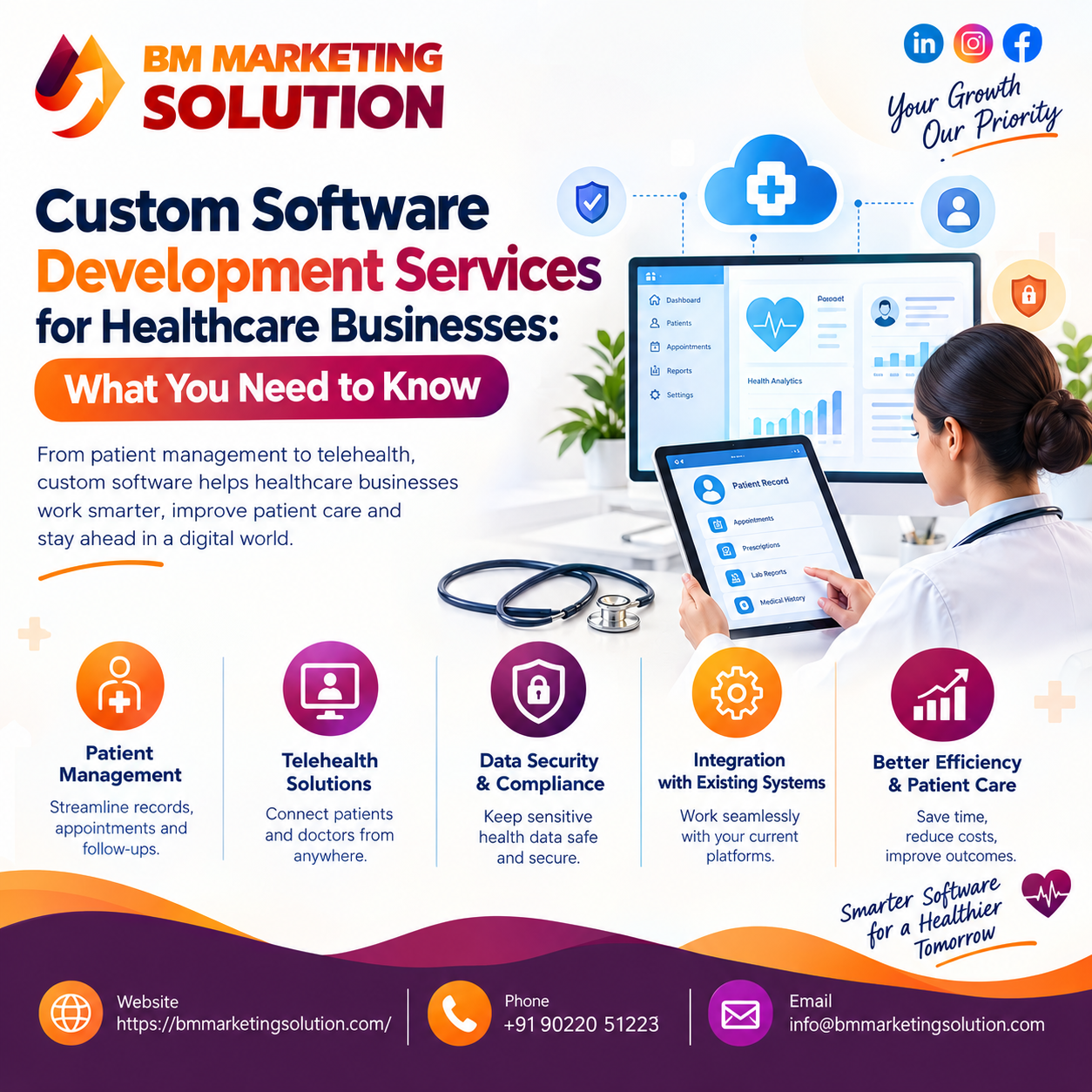
Healthcare businesses handle sensitive information, complex workflows, appointments, patient records, billing, communication, and many other daily operations. Managing all these activities with generic software may not always provide the flexibility or functionality a healthcare organization needs. This is where Custom Software Development Services for Healthcare Businesses can provide a more tailored approach.
Custom healthcare software development allows businesses to create digital solutions based on their specific workflows, users, and operational requirements. From hospitals and clinics to diagnostic centers, healthcare startups, pharmacies, and medical service providers, organizations can use Healthcare software development services to build applications that address their unique business challenges.
Unlike ready-made platforms, Custom healthcare software can be developed around the way a healthcare business actually works. This can include solutions for patient management, appointment scheduling, billing, staff management, reporting, dashboards, communication, and integration with existing systems.
If your organization is considering custom healthcare software development, it is important to understand the development process, required features, security considerations, integrations, scalability, and long-term maintenance before starting the project. A well-planned solution can help create a more organized digital workflow while supporting the changing needs of a growing healthcare business.
Custom healthcare software development means creating a digital solution specifically for a healthcare organization’s business and operational requirements.
For example, a clinic may need appointment scheduling, patient management, billing, doctor dashboards, and automated reminders. A hospital may require a more advanced system that connects multiple departments, manages records, supports staff workflows, and integrates with existing healthcare systems.
The software can be developed as a web application, mobile application, management platform, patient portal, or complete healthcare management system.
The main advantage is flexibility. Businesses can select the features they actually need instead of paying for unnecessary functions.
The required features depend on the healthcare business and its workflow. Some commonly requested features include:
A custom system can organize patient profiles, appointments, medical information, communication history, and other relevant records according to the organization’s requirements.
Healthcare businesses can create appointment scheduling systems that allow staff or patients to manage available slots, cancelations, reminders, and follow-ups.
Different users may require different information. Custom dashboards can provide doctors, administrators, receptionists, and other staff members with access to the information relevant to their responsibilities.
Healthcare software can include billing workflows, invoices, payment records, and reporting features. These functions can be connected with other business processes where required.
A patient-facing portal or mobile application can provide features such as appointment requests, notifications, communication, and access to permitted information.
Custom dashboards can help healthcare businesses monitor operational information such as appointments, revenue, service usage, and other business metrics.
Healthcare software may handle highly sensitive information, so security should be considered from the planning stage rather than added at the end.
Depending on the country, business model, and type of data being handled, different privacy and security requirements may apply. For example, organizations operating in the United States may need to consider HIPAA requirements, while businesses operating in other regions may have different regulatory obligations.
Important technical considerations can include:
The exact requirements should be reviewed with qualified legal, compliance, and security professionals for the relevant jurisdiction.
Healthcare organizations often use multiple systems. A new application may need to exchange information with existing EHR, EMR, laboratory, pharmacy, billing, or other systems.
This makes interoperability an important consideration during development.
FAIR (Fast Healthcare Interoperability Resources) is an HL7 standard designed for exchanging healthcare information electronically. HL7 also maintains standards such as FAIR, Version 2, and CDA for healthcare information technology.
Planning integrations early can help reduce technical problems later. Depending on the project, APIs, FAIR, HL7, or other integration methods may be considered.
A structured development process can make the project easier to manage.
The development team first understands your business, users, workflows, problems, required features, integrations, and project objectives.
The interface is planned around the needs of patients, doctors, administrators, and other users.
Developers build the frontend, backend, database, APIs, and required integrations according to the approved specifications.
The software should be tested for functionality, usability, security, performance, integrations, and different user scenarios before launch.
After testing and approval, the software can be deployed to the selected infrastructure.
Healthcare businesses often need new features, security updates, bug fixes, integrations, and performance improvements as their requirements change.
Before selecting a development partner, look beyond the price. Ask about their experience with healthcare workflows, security practices, integrations, testing process, technology stack, communication process, maintenance, and post-launch support.
It is also useful to clearly define your project scope before development begins. A well-defined scope can make budgeting, development, testing, and project management easier.
Ans : Custom healthcare software development involves creating software specifically according to the workflows, requirements, users, and operational needs of a healthcare organization.
Ans : Healthcare businesses can develop solutions such as patient management systems, hospital management software, telemedicine platforms, appointment systems, patient portals, healthcare mobile apps, billing systems, dashboards, and integration platforms.
Ans : Yes. Healthcare software may handle sensitive information, so security and privacy should be considered from the beginning. The specific compliance requirements depend on the country, organization, data, and type of healthcare service involved.
Ans : Yes. Depending on the existing technology and requirements, custom software can be designed to integrate with other systems using APIs and healthcare interoperability standards such as FHIR or HL7.
Custom Software Development Services for Healthcare Businesses can help organizations create digital solutions that fit their real workflows, users, and operational requirements. Instead of adjusting important business processes to match a generic platform, healthcare organizations can build Custom healthcare software around the features and functionality they actually need.
From patient management and appointment scheduling to billing, dashboards, mobile applications, reporting, and system integrations, Healthcare software development services can support different areas of a healthcare organization’s digital operations.
However, successful healthcare software development is not only about adding features. Security, privacy, usability, interoperability, scalability, and applicable regulatory requirements should also be considered during the planning and development stages.
If your organization is exploring Custom healthcare software development, start by identifying the problems you want to solve, understand your users and workflows, and define the features your business actually requires. A clear development plan can make it easier to select the right technology and build a solution that can grow with your organization.
Looking for a reliable technology partner for your healthcare software project? BM Marketing Solution can help you discuss your requirements and explore a suitable custom software development approach.
Ready to discuss your healthcare software project?
BM Marketing Solution
Website: https://bmmarketingsolution.com/
Phone: +91 90220 51223
Email: info@bmmarketingsolution.com

SEO & Digital Marketing Executive
With 1.5+ years of experience in SEO, WordPress and digital marketing, I focus on creating informative and SEO-friendly content that helps businesses grow online. I believe in writing clear, practical and easy-to-understand articles that provide real value to readers.
https://bmmarketingsolution.com/binary-mlm-software-with-mobile-app-features-benefits/
https://bmmarketingsolution.com/how-binary-mlm-software-works-a-beginners-guide/

BM Marketing Solution - Building Brands That Stand Out Online
Address: Office no. G610, 5th Floor, Mega Center, Pune - Solapur Rd, Magarpatta, North Hadapsar, Hadapsar, Pune, Maharashtra 411013.
Phone : +91 90220 51223
Email: info@bmmarketingsolution.com
Copyright © 2025 BM Marketing Solution All Rights Reserved