SaaS may be suitable for businesses that:
For example, if a business needs a standard project management or accounting tool and an existing SaaS platform already provides the required features, developing a completely new application may not be necessary.
Choosing business software is not always as simple as picking the cheapest or most popular option. Every business has different processes, employees, customers, budgets, and future plans. A software solution that works well for one company may not be the right fit for another.
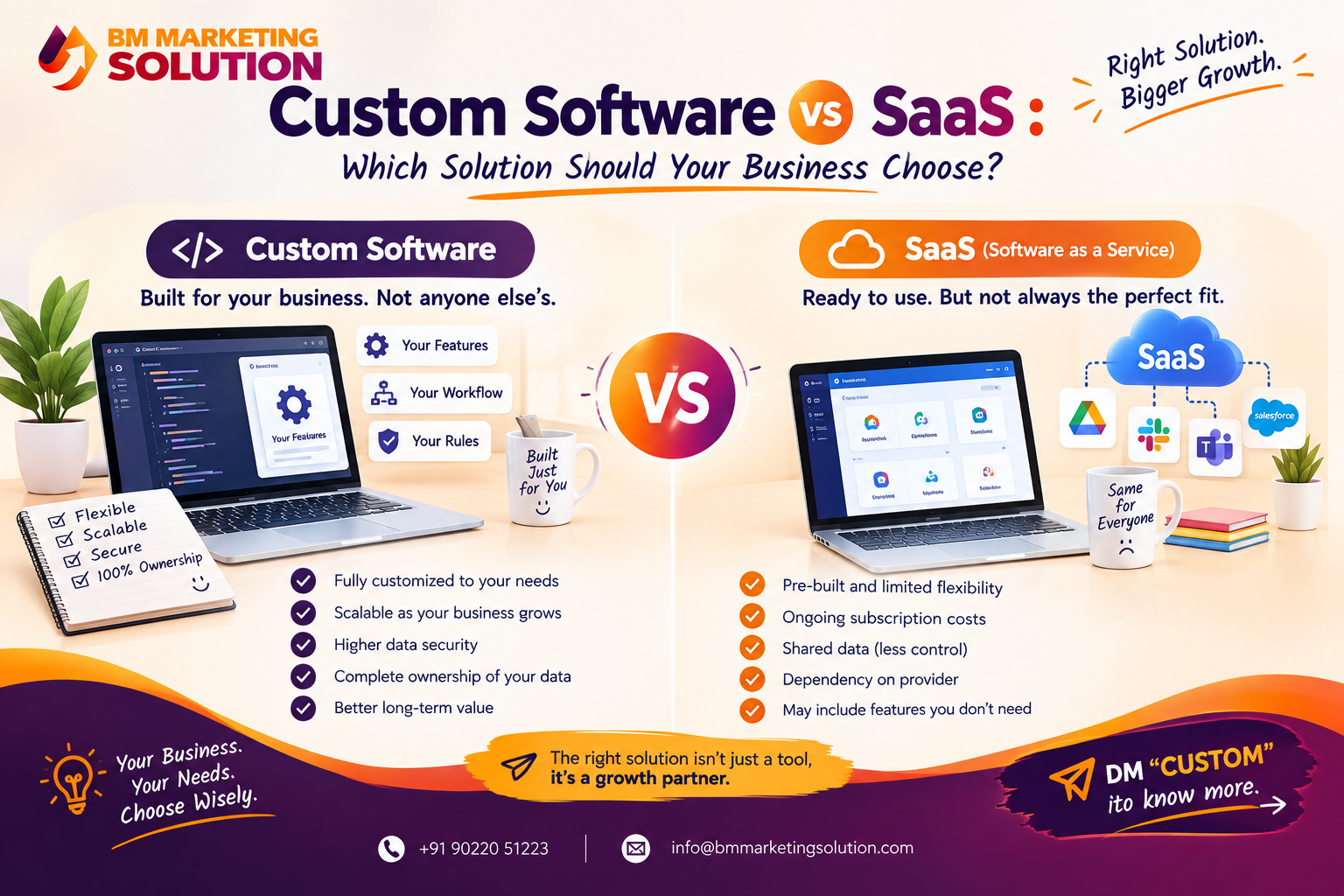
When businesses compare custom software vs SaaS for businesses, they are generally choosing between two different approaches. Custom software vs SaaS is an important consideration for companies that want to select a solution based on their specific requirements, budget, and growth plans. Custom software is developed around the needs of a particular business, while SaaS (Software as a Service) provides an existing software platform that users can access online, usually through a subscription.
The SaaS vs custom software decision depends on several factors, including customization, implementation time, scalability, maintenance, ownership, integrations, and long-term business requirements. Both options have their own advantages and limitations, so businesses should understand the differences before selecting a solution.
Whether you are a startup, small business, or growing company, comparing these options carefully can help you choose software that supports your current operations while also fitting your future business plans.
Custom software is a software application created for the specific requirements of a business.
Instead of asking your team to change its existing workflow to match a ready-made tool, custom development allows the software to be planned around your actual business processes.
For example, a company may require a customized CRM, ERP system, inventory management platform, employee management system, customer portal, or business automation solution.
The development team can plan features, dashboards, user permissions, reports, integrations, and workflows according to the business requirements.
This approach can provide more control and flexibility, but it generally requires more planning, development time, testing, and ongoing maintenance.
SaaS stands for Software as a Service. It refers to software that is hosted by a provider and accessed online.
Instead of developing and hosting the application yourself, your business subscribes to an existing platform. The provider generally manages the infrastructure, software updates, maintenance, and other technical operations.
SaaS products are available for many common business requirements, including accounting, CRM, project management, communication, marketing, HR, customer support, and collaboration.
For businesses with standard requirements, SaaS can provide a convenient way to start using software without building an application from scratch.
The biggest difference is how the software fits your business.
With SaaS, your business selects an existing product and works within the features and configuration options offered by that provider.
With custom software, the development process starts with your business requirements. The application can then be designed around those requirements.
Customization is one of the main reasons businesses consider custom software.
A custom application can include specific features, workflows, reports, dashboards, integrations, and user roles required by your organization.
SaaS platforms may provide customization options, but these options depend on what the provider supports.
If your business process is fairly standard, SaaS may provide everything you need. If your workflow is unusual or highly specialized, custom development may provide more flexibility.
SaaS usually requires a subscription rather than a large software development investment at the beginning.
Custom software normally requires a higher initial investment because the application needs to be researched, designed, developed, tested, and launched.
However, businesses should look beyond the initial price. Subscription fees, additional users, premium features, integrations, and future requirements can also contribute to the overall cost of a SaaS solution.
SaaS can often be started much faster because the product has already been developed.
Custom software takes more time because it is created specifically for the business. The process may include requirement gathering, UI/UX planning, development, testing, deployment, and further improvements.
Therefore, businesses should consider whether they need an immediate solution or can spend more time creating a system that closely matches their workflow.
Both SaaS and custom software can support business growth, but they do so differently.
SaaS providers may offer different plans, user limits, storage options, or feature levels as your business grows.
Custom software can be expanded according to your business requirements. New modules, integrations, automation features, and workflows can be added as those requirements develop.
The important point is to discuss future requirements during the planning stage instead of building only for today’s needs.
With SaaS, the software platform is controlled and maintained by the provider. The provider decides how the product develops, which features are introduced, and how the service is maintained.
With custom software, the business can have greater control over the application’s functionality and future development, depending on the ownership agreement with the development company.
This can be particularly important when software is closely connected to a company’s internal operations.
SaaS can reduce the technical maintenance workload for a business because the provider manages much of the platform’s infrastructure and updates.
Custom software requires a plan for maintenance, security updates, hosting, bug fixes, backups, and future improvements.
This does not necessarily make custom software unsuitable. It simply means maintenance should be included in the project plan from the beginning.
SaaS may be suitable for businesses that:
For example, if a business needs a standard project management or accounting tool and an existing SaaS platform already provides the required features, developing a completely new application may not be necessary.
Custom software may be considered when:
For example, a company may currently use separate systems for sales, inventory, customer management, and reporting. If employees have to repeatedly move information between these systems, a customized solution could potentially bring important processes together.
Yes. Choosing between custom software and SaaS does not always have to be an either-or decision.
A business can use SaaS products for standard activities while using custom software for specialized processes.
For example, a company could use an existing accounting SaaS platform while using a custom application for its internal operations, customer portal, inventory workflow, or specialized reporting.
This approach can allow businesses to use ready-made tools where they fit while developing custom solutions where specific requirements exist.
Before selecting a solution, consider these questions:
What problem are you trying to solve?
Does an existing SaaS product provide the required features?
How much customization does your business actually need?
How many users will use the software?
What integrations are required?
What is your expected software budget?
How quickly do you need the solution?
What are your future business requirements?
Who will handle maintenance and technical support?
How important are ownership and control to your business?
Answering these questions can make the decision more practical and less dependent on the initial price alone.
There is no universal answer for every business.
SaaS can be useful when your requirements are standard, you need a solution quickly, and you are comfortable using a provider’s existing features.
Custom software can be considered when your business requires specialized workflows, deeper integrations, customized functionality, or greater control over how the system works.
The best starting point is to understand your actual business requirements before deciding on a technology approach. A proper requirement analysis can help you identify which features are essential and whether an existing SaaS product can provide them.
ans : Custom software is developed around the specific requirements of a business. SaaS is an existing software product provided online, generally through a subscription. The main difference is the level of customization, control, and responsibility involved.
ans : SaaS usually has a lower initial cost because businesses subscribe to an existing product. Custom software generally requires a larger upfront development investment. The overall cost depends on factors such as users, subscription plans, development requirements, integrations, maintenance, and long-term usage.
ans : A business can consider custom software when existing solutions do not properly support its workflows, when specialized automation is required, or when several systems need to work together. The decision should be based on actual business requirements and long-term plans.
ans : Yes. Businesses can use SaaS for common business functions and custom software for specialized processes. This can be useful when a company wants the convenience of existing platforms while also needing customized functionality.
Choosing between custom software vs SaaS for businesses should begin with your actual business requirements rather than focusing only on the software price. Every company has different workflows, goals, budgets, and growth plans, so the right solution can vary from one business to another.
SaaS can provide ready-made solutions for common business needs, while custom software allows businesses to build functionality around their specific workflows and requirements. Understanding the differences between SaaS vs custom software can help you evaluate factors such as customization, scalability, maintenance, integrations, ownership, and long-term costs.
Before making a decision, consider your current processes, number of users, budget, required integrations, customization needs, maintenance responsibilities, and future plans. A proper custom software vs SaaS comparison can help you understand which approach fits your business requirements.
If you are unsure whether your business needs a ready-made SaaS solution or a custom-built application, a professional software consultation can help you evaluate your requirements and explore suitable custom software solutions before starting development.
BM Marketing Solution
Website:
https://bmmarketingsolution.com/
Phone: +91 90220 51223
Email: info@bmmarketingsolution.com

SEO & Digital Marketing Executive
With 1.5+ years of experience in SEO, WordPress and digital marketing, I focus on creating informative and SEO-friendly content that helps businesses grow online. I believe in writing clear, practical and easy-to-understand articles that provide real value to readers.
https://bmmarketingsolution.com/binary-mlm-software-with-mobile-app-features-benefits/
https://bmmarketingsolution.com/how-binary-mlm-software-works-a-beginners-guide/
BM Marketing Solution - Building Brands That Stand Out Online
Address: Office no. G610, 5th Floor, Mega Center, Pune - Solapur Rd, Magarpatta, North Hadapsar, Hadapsar, Pune, Maharashtra 411013.
Phone : +91 90220 51223
Email: info@bmmarketingsolution.com
Copyright © 2025 BM Marketing Solution All Rights Reserved