A successful ecommerce application needs more than a good customer interface. Businesses also need an efficient system to manage products, inventory, orders, customers, and promotions.
A well-designed admin panel can simplify daily operations and provide valuable insights into business performance. Analytics can help businesses understand customer behavior, popular products, sales trends, and other useful information.
With the right data, businesses can make more informed decisions and continuously improve their ecommerce strategy.
Every ecommerce business has different requirements.
Online shopping has become a natural part of everyday life. Customers want to browse products, compare prices, make secure payments, and track their orders all from their mobile phones. For businesses, this growing preference for mobile shopping creates an important opportunity to connect with customers in a more convenient and personalized way through Ecommerce Mobile App Development.
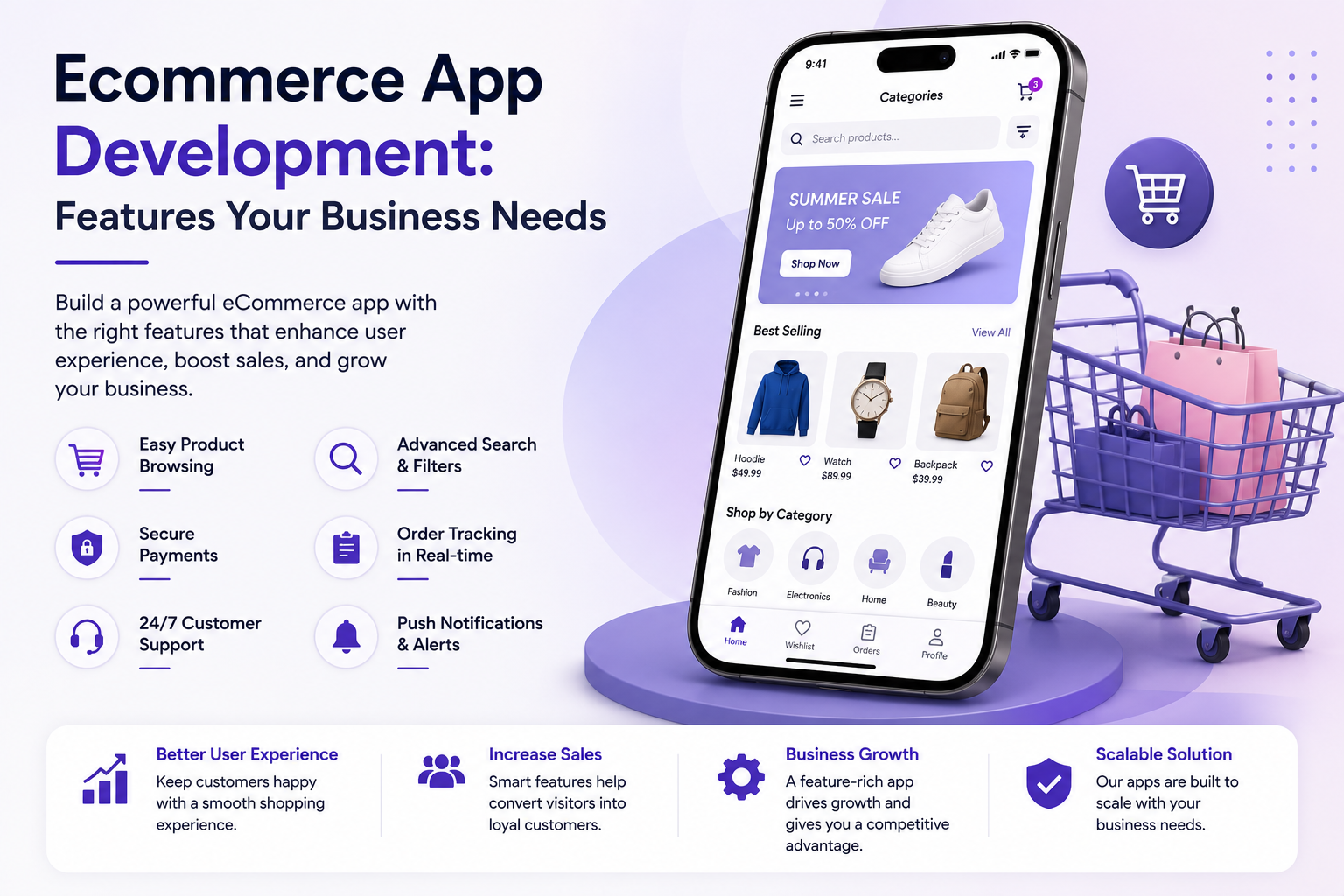
However, simply creating an ecommerce app is not enough. A successful application should make the shopping journey easy, fast, secure, and enjoyable. The right Ecommerce App Features can help customers find what they need quickly while giving businesses better control over products, orders, payments, and customer relationships.
Whether you are launching a new online store or expanding an existing ecommerce business, investing in professional Ecommerce App Development can make a meaningful difference. From simple navigation to secure payment options, every feature should be designed around your customers’ needs and your business goals.
The first impression of your ecommerce app matters. If customers find the app confusing or difficult to navigate, they may leave without completing a purchase.
A clean layout, clear categories, and easy navigation help users explore products without unnecessary effort. Important sections such as the home page, product categories, cart, wishlist, and user account should be easy to access.
The goal is simple : customers should be able to find what they are looking for without feeling lost.
Customers often visit an ecommerce app with a specific product in mind. A powerful search feature can help them find it quickly.
Search filters can make the experience even better by allowing users to narrow down products based on categories, price, size, color, brand, ratings, or other relevant options. This saves time and helps customers discover products that match their needs.
For businesses with a large product catalog, effective search and filtering are especially important.
Customers cannot physically touch or examine products when shopping online, so your app needs to provide enough information to help them make confident decisions.
Each product page should include clear images, descriptions, pricing, available options, and relevant specifications. Product reviews and ratings can also help customers understand the experiences of other buyers.
Accurate and useful product information can reduce confusion and create a smoother shopping experience.
Payment is one of the most important stages of the customer journey. Your ecommerce application should support secure and convenient payment methods that are suitable for your target audience.
Depending on your business requirements, this may include cards, UPI, digital wallets, net banking, or other trusted payment options. The checkout process should also be simple and avoid asking customers for unnecessary information.
A secure and smooth payment experience can help build trust and encourage customers to complete their purchases.
A shopping cart allows customers to collect products and purchase them when they are ready. A wishlist gives them the option to save products for future consideration.
These features may seem simple, but they can improve the overall shopping experience. Customers do not always make a purchase during their first visit. By allowing them to save products, businesses can make it easier for users to return and continue their shopping journey later.
After placing an order, customers want to know what happens next. An order-tracking feature allows them to check the status of their purchase without repeatedly contacting customer support.
Updates about order confirmation, shipping, delivery, and other important stages can create a more transparent experience. This can also reduce the workload on your support team by answering common customer questions automatically.
Push notifications can help businesses stay connected with customers after they leave the app. They can be used to share information about order updates, special offers, new products, or important announcements.
However, notifications should be relevant and useful. Sending too many promotional messages can frustrate users. A thoughtful notification strategy can help improve engagement without negatively affecting the customer experience.
Personalization can make an ecommerce app feel more relevant to individual users. Based on customer preferences and browsing behavior, an app may recommend related products or show categories that match their interests.
For example, a customer who regularly browses a particular category may appreciate relevant product suggestions. When used responsibly, personalization can make product discovery easier and create a more engaging shopping experience.
Reviews and ratings are valuable for both customers and businesses. They help new buyers learn about products while giving businesses useful feedback about customer expectations.
An ecommerce app should make it easy for verified customers to share their experiences. Businesses can use this feedback to identify opportunities for improvement and build stronger relationships with their audience.
A successful ecommerce application needs more than a good customer interface. Businesses also need an efficient system to manage products, inventory, orders, customers, and promotions.
A well-designed admin panel can simplify daily operations and provide valuable insights into business performance. Analytics can help businesses understand customer behavior, popular products, sales trends, and other useful information.
With the right data, businesses can make more informed decisions and continuously improve their ecommerce strategy.
Every ecommerce business has different requirements.
A small online store may need a simple application with essential shopping features, while a growing business may require advanced integrations, automation, analytics, and scalability.
This is why the development process should begin with a clear understanding of your business goals and customer needs. The right development partner can help you identify the features that truly add value instead of unnecessarily complicating the application.
A well-planned ecommerce app should be user-friendly, secure, scalable, and ready to adapt as your business grows.
Ans : Some of the most important features include user-friendly navigation, product search and filters, detailed product pages, a shopping cart, wishlist, secure payment options, order tracking, notifications, reviews, and an efficient admin management system.
Ans : The development time depends on the app’s complexity, features, design, platform requirements, integrations, and testing needs. A simple app may take less time, while a feature-rich ecommerce application requires more planning and development.
Ans : Yes. An ecommerce app can be integrated with multiple suitable payment methods based on business and customer requirements. Secure payment integration is an important part of creating a convenient shopping experience.
Ans : Yes. A properly planned ecommerce application can be designed to support future updates and additional features. As your business grows, you may add new products, integrations, user features, or business management tools based on changing requirements.
Ecommerce Mobile App Development is not just about displaying products on a mobile screen. It is about creating a convenient, reliable, and engaging shopping experience that encourages customers to return.
The right Ecommerce App Features, such as easy navigation, smart search, secure payments, order tracking, personalized recommendations, and efficient business management, can help create an application that supports both customer satisfaction and business growth.
The best approach to Ecommerce App Development is to focus on the features your customers genuinely need and build the app around a clear business strategy. With thoughtful planning and professional development, an ecommerce app can become a valuable part of your long-term digital growth.
If you are planning to build a secure, user-friendly and scalable ecommerce application, BM Marketing Solution can help turn your business idea into a practical digital solution. Our approach focuses on understanding your business requirements and creating solutions designed to support long-term growth.
Visit BM Marketing Solution
Phone : +91 90220 51223
Email : info@bmmarketingsolution.com

SEO & Digital Marketing Executive
With 1.5+ years of experience in SEO, WordPress, and digital marketing, I focus on creating informative and SEO-friendly content that helps businesses grow online. I believe in writing clear, practical and easy-to-understand articles that provide real value to readers.
Binary MLM Software with Mobile App: Features & Benefits : https://bmmarketingsolution.com/binary-mlm-software-with-mobile-app-features-benefits/
https://bmmarketingsolution.com/how-binary-mlm-software-works-a-beginners-guide/
Confused between Matrix and Binary MLM plans? Compare their features, advantages, and business suitability to make an informed decision.
Read More : https://bmmarketingsolution.com/matrix-mlm-software-vs-binary-mlm-software-which-is-better/

BM Marketing Solution - Building Brands That Stand Out Online
Address: Office no. G610, 5th Floor, Mega Center, Pune - Solapur Rd, Magarpatta, North Hadapsar, Hadapsar, Pune, Maharashtra 411013.
Phone : +91 90220 51223
Email: info@bmmarketingsolution.com
Copyright © 2025 BM Marketing Solution All Rights Reserved