Internal links connect related pages within your own website.
For example, this blog could link naturally to pages about:
Internal linking helps visitors discover related information and can help search engines discover and understand pages across your website.
The links should be relevant and useful rather than added simply to increase the number of links on a page.
Images make a website more engaging, but poorly optimized images can also make pages unnecessarily heavy.
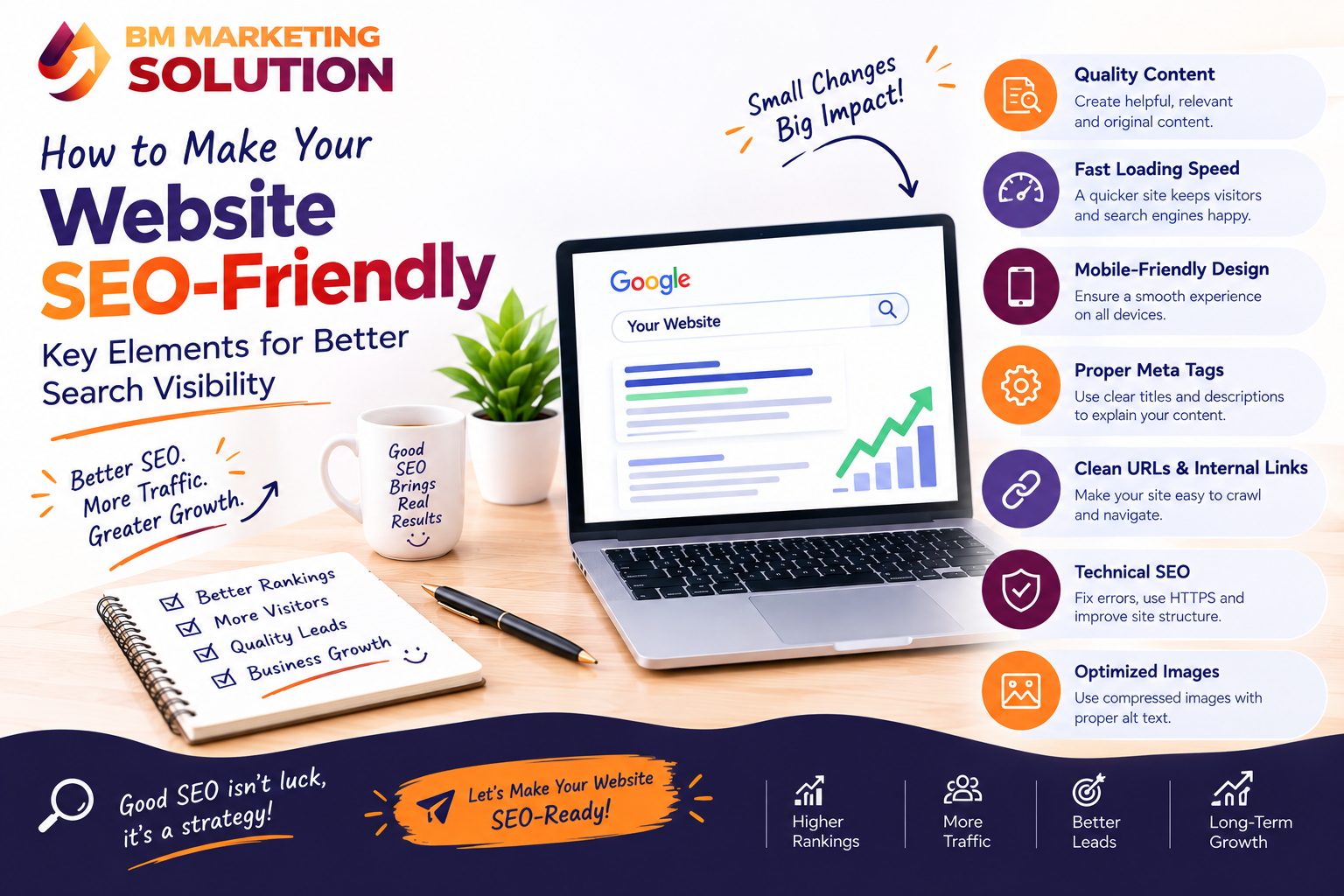
A website can look attractive and still struggle to appear in Google search results. So, what makes a website SEO-friendly? Good design alone is not enough. Your website also needs a clear structure, useful content, fast performance, mobile compatibility, and proper technical SEO.
An SEO-friendly website is built with both users and search engines in mind. Visitors should be able to find information easily, while search engines should be able to crawl, understand and index your important pages. Elements such as mobile responsiveness, page speed, internal linking, optimized content, and clear navigation can all contribute to a better website experience.
If you are creating a new website or improving an existing one, understanding what makes a website SEO-friendly can help you build a stronger foundation for long-term organic visibility. From website structure and content optimization to technical SEO and mobile usability, every part of your website should work together to support users and search engines.
An SEO-friendly website is a website designed and developed so that search engines can access and understand its pages while users get a smooth browsing experience.
SEO is not simply about adding keywords to every page. Google recommends creating helpful, reliable, people-first content instead of producing content mainly to manipulate search rankings.
A good website therefore needs a balance between technical SEO, content, design, usability and search intent.
Your website structure should make sense to both visitors and search engines.
For example, a business website may have:
Each important page should be easy to reach through your navigation and internal links.
Avoid creating unnecessary pages simply to target slightly different keywords. Pages should have a genuine purpose and provide useful information to visitors.
A clean structure also makes it easier to manage your website as your business grows.
People use smartphones for everything from finding local businesses to researching products and services. Because of this, your website needs to work properly on smaller screens.
A mobile-friendly website should have:
Your desktop website may look perfect, but that is not enough if the mobile experience is difficult to use.
Nobody wants to wait several seconds for a webpage to load.
Large images, unnecessary plugins, excessive scripts, poor hosting, and unoptimized website files can all contribute to slow performance.
You can improve your website speed by:
Google provides performance-related guidance and recommends paying attention to page experience and Core Web Vitals rather than treating one technical score as the entire SEO strategy.
Keywords help describe what a webpage is about, but they should never make your content sound unnatural.
For example, if your target keyword is SEO-friendly website, you can naturally include related phrases such as:
Instead of repeating the same phrase again and again, explain the topic naturally and cover related questions your audience may have.
Google specifically identifies excessive repetition of keywords as keyword stuffing.
Your website content should give visitors a reason to stay on the page.
If you provide website development services, for example, don’t simply write generic statements such as “We provide the best website development services.”
Explain what you actually offer.
You could discuss:
Original information and practical explanations make content more useful.
Avoid publishing the same article across multiple websites or creating many pages with almost identical content. Google has specific guidance around duplicate and substantially similar content.
Every important webpage should have a clear title that describes its content.
For example:
Weak title:
Services
More descriptive title:
Website Development Services for Growing Businesses
Your headings should also follow a logical structure. Use the main heading for the primary topic and supporting headings for different sections.
This makes long pages easier for visitors to scan and understand.
Internal links connect related pages within your own website.
For example, this blog could link naturally to pages about:
Internal linking helps visitors discover related information and can help search engines discover and understand pages across your website.
The links should be relevant and useful rather than added simply to increase the number of links on a page.
Images make a website more engaging, but poorly optimized images can also make pages unnecessarily heavy.
Before uploading an image, consider its :
Add descriptive alt text when it helps explain the image to users who cannot see it. Do not fill alt text with unrelated keywords.
Images should support the content rather than distract from it.
Security is another important part of a professional website.
Your website should use HTTPS and should be maintained regularly. This becomes especially important if your website contains contact forms, customer accounts, payment features, or other sensitive interactions.
Website security is not just an SEO consideration. It also helps build trust with visitors.
Even a well-written webpage needs to be accessible to search engines.
Important technical elements can include:
Google also explains that cannibalization helps search engines identify the representative URL when similar or duplicate versions of content exist.
Structured data provides additional information about the content of a webpage in a format that search engines can understand.
Depending on the type of website, relevant structured data may help Google understand information such as articles, products, organizations, or other supported content types.
However, structured data does not mean your page is guaranteed to receive a rich result. It needs to follow Google’s guidelines and be appropriate for the content.
SEO is not something you complete once and forget.
After publishing your website, regularly check:
You can use tools such as Google Search Console and website analytics platforms to understand how people interact with your website.
Small improvements made consistently can create a stronger website over time.
Ans : An SEO-friendly website is designed to be accessible to search engines while providing a useful experience for visitors. It generally includes a clear structure, mobile-friendly design, useful content, optimized pages, internal links, good performance, and proper technical SEO.
Ans : No. SEO best practices can create a stronger foundation, but they do not guarantee a particular ranking position. Search results depend on many factors, including the query, competition, content, website quality, and Google’s systems.
Ans : You can review your website using tools such as Google Search Console and PageSpeed Insights. An SEO audit can also examine technical issues, content, internal linking, page titles, mobile usability, and other areas.
Ans : No. Keywords should be used naturally where they genuinely describe the content. Excessive repetition can make a page difficult to read and may be considered keyword stuffing.
Creating an SEO-friendly website is about much more than inserting keywords into webpages. Understanding what makes a website SEO-friendly means looking at the complete website experience, including useful content, logical navigation, responsive design, good performance, optimized images, internal links, security, and a strong technical foundation.
Most importantly, build your website for the people who will actually use it. Give visitors clear answers, make important information easy to find, and regularly improve your pages based on real search data and user behavior.
If you are planning a new website or want to improve an existing one, BM Marketing Solution can help you with professional website development, SEO, WordPress, and digital marketing solutions.
BM Marketing Solution
Website : https://bmmarketingsolution.com/
Phone : +91 90220 51223
Email : info@bmmarketingsolution.com

SEO & Digital Marketing Executive
With 1.5+ years of experience in SEO, WordPress and digital marketing, I focus on creating informative and SEO-friendly content that helps businesses grow online. I believe in writing clear, practical and easy-to-understand articles that provide real value to readers.
https://bmmarketingsolution.com/binary-mlm-software-with-mobile-app-features-benefits/
https://bmmarketingsolution.com/how-binary-mlm-software-works-a-beginners-guide/

BM Marketing Solution - Building Brands That Stand Out Online
Address: Office no. G610, 5th Floor, Mega Center, Pune - Solapur Rd, Magarpatta, North Hadapsar, Hadapsar, Pune, Maharashtra 411013.
Phone : +91 90220 51223
Email: info@bmmarketingsolution.com
Copyright © 2025 BM Marketing Solution All Rights Reserved