Testing should happen throughout development. Agree on how the team will check key features, accessibility, performance, and compatibility with the devices and operating-system versions your customers use. Set clear criteria for fixing bugs and approving a release. Discuss security and privacy early, especially if the app handles payments or personal information. Clarify who can access sensitive data and who will handle updates and security fixes. A polished demo alone does not prove the app is ready for real users.
Before development ends, decide who will monitor crashes and feedback, fix defects, update dependencies, and support new operating-system releases. Request documentation, design files, deployment instructions, and a knowledge-transfer session.
A successful mobile app needs more than code. It requires thoughtful design, thorough testing, clear planning, and reliable post-launch support. Understanding how to outsource mobile app development can help businesses access the right expertise without hiring a permanent team. Effective mobile app development outsourcing also requires clear communication and collaboration with your development partner.
BM Marketing Solution offers mobile app development for businesses planning Android, iOS, or cross-platform applications. If you want to outsource mobile app development, choosing the right partner can help you build an app that meets your business goals and user requirements.
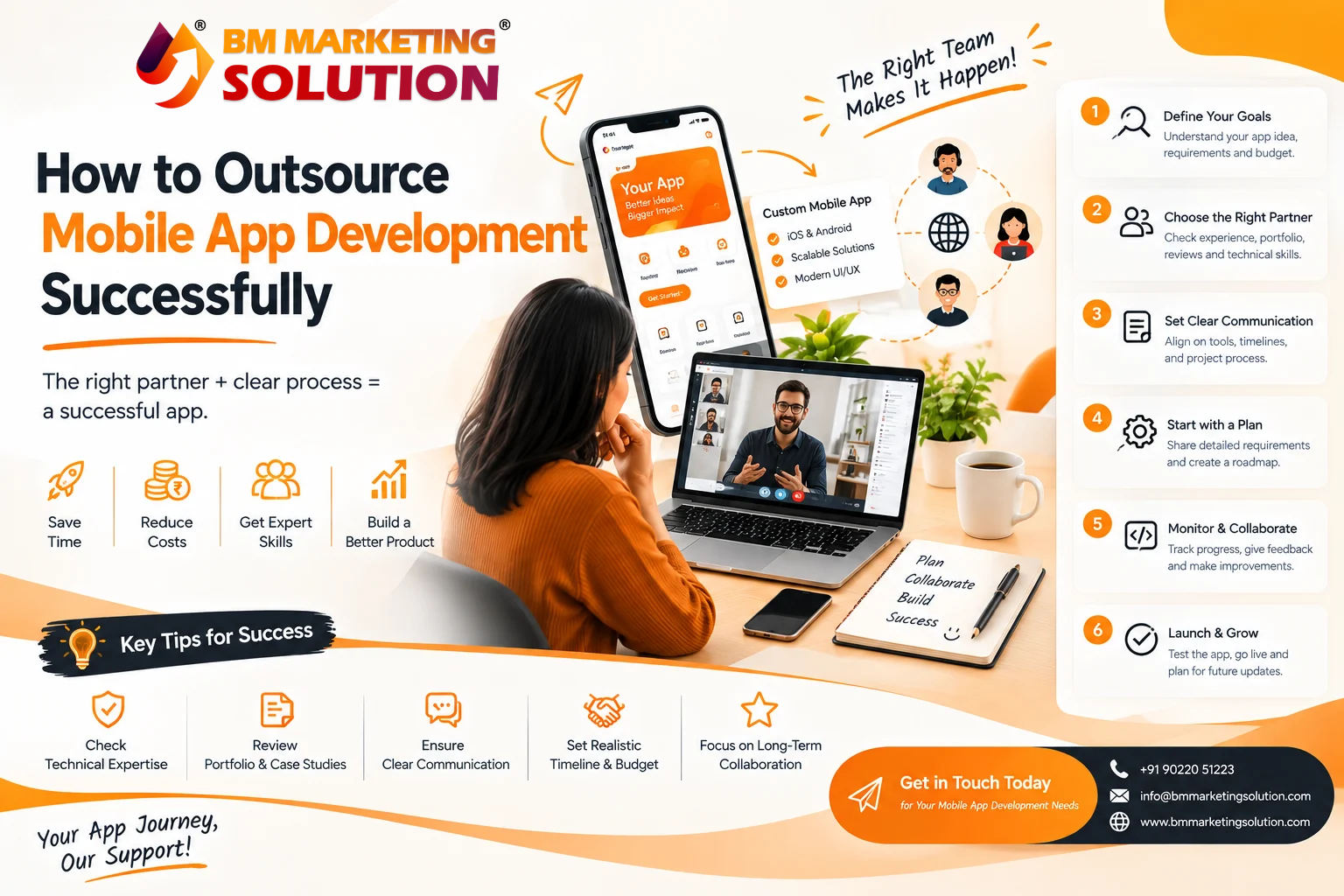
Start with the user and problem. Identify your audience, core actions, and success measures such as more bookings or easier order management.
Separate must-have features from later improvements.
A focused first release lets you test the idea before investing in extras. Share user journeys, sketches, existing systems, and technical requirements, so vendor estimates reflect real needs.
Look beyond the lowest quote. Review apps relevant to your project and ask what the vendor’s team contributed, how it tested the product, and what support it provided after launch. Notice whether they ask thoughtful questions, explain trade-offs clearly, and identify risks.
A reliable partner should help make your plan more realistic not promise every feature on an implausible timeline. Check references when possible, and confirm that communication hours and decision-making processes suit your team.
Put features, platforms, deliverables, milestones, responsibilities, and acceptance criteria in writing. Define how changes will be estimated and approved; this prevents new requests from quietly expanding the schedule or budget. Your contract should also explain intellectual property ownership, confidentiality, data handling, third-party services, source-code access, maintenance, and exit or handover terms.
Keep important accounts, including your code repository and app-store accounts, under your business’s control where practical. Tie payments to clear deliverables and progress. Written ownership and handover terms help reduce dependency on a single vendor.
Choose one decision-maker on your side and agree on a meeting schedule, task tracker, response expectations, and shared place for requirements. Give feedback in terms of the user’s goal: explain where someone gets stuck, rather than simply saying a screen looks wrong.
If teams work across time zones, agree on overlapping hours and record decisions, so details are not lost.
Testing should happen throughout development. Agree on how the team will check key features, accessibility, performance, and compatibility with the devices and operating-system versions your customers use. Set clear criteria for fixing bugs and approving a release. Discuss security and privacy early, especially if the app handles payments or personal information. Clarify who can access sensitive data and who will handle updates and security fixes. A polished demo alone does not prove the app is ready for real users.
Before development ends, decide who will monitor crashes and feedback, fix defects, update dependencies, and support new operating-system releases. Request documentation, design files, deployment instructions, and a knowledge-transfer session.
Mobile app development outsourcing works best when expectations are clear and both sides stay involved. Understanding how to outsource mobile app development helps businesses define project goals, choose a communicative partner, document the scope and ownership, review progress, and plan ongoing support. When you outsource mobile app development, these foundations help the external team turn your idea into a useful app while reducing unexpected challenges and maintaining better project control.
Talk to BM Marketing Solution about your app idea
Cost depends on features, design, platforms, integrations, and testing. Request an itemized, milestone-based estimate and compare what each quote includes not just the total.
Timing depends on scope, complexity, integrations, and feedback speed. Ask for phases, dependencies, and review dates; a focused first release is often easier to plan.
Your contract should specify rights to the code, design files, and documentation, plus access to repositories and accounts. Agree on these terms before work begins.
Contact BM Marketing Solution
Website: bmmarketingsolution.com
Phone: +91 90220 51223
Email: info@bmmarketingsolution.com

SEO & Digital Marketing Executive
With 1.5+ years of experience in SEO, WordPress and digital marketing, I focus on creating informative and SEO-friendly content that helps businesses grow online. I believe in writing clear, practical and easy-to-understand articles that provide real value to readers.
https://bmmarketingsolution.com/binary-mlm-software-with-mobile-app-features-benefits/
https://bmmarketingsolution.com/how-binary-mlm-software-works-a-beginners-guide/

BM Marketing Solution - Building Brands That Stand Out Online
Address: Office no. G610, 5th Floor, Mega Center, Pune - Solapur Rd, Magarpatta, North Hadapsar, Hadapsar, Pune, Maharashtra 411013.
Phone : +91 90220 51223
Email: info@bmmarketingsolution.com
Copyright © 2025 BM Marketing Solution All Rights Reserved