Before development begins, map how orders currently move through your business. Identify where delays happen, which updates staff repeat manually, and what information drivers need while on the road. These answers help define a practical first version of the app.
It is also important to consider usability. Drivers may need large, easy-to-read buttons and quick access to essential actions. Managers may need dashboards and filters, while customers may only need tracking and delivery updates. Security, reliable performance, and integration with existing systems should be considered early, too.
A phased launch can help. Start with the features that address the biggest operational challenges, gather feedback from staff and customers, and improve the app based on real usage.
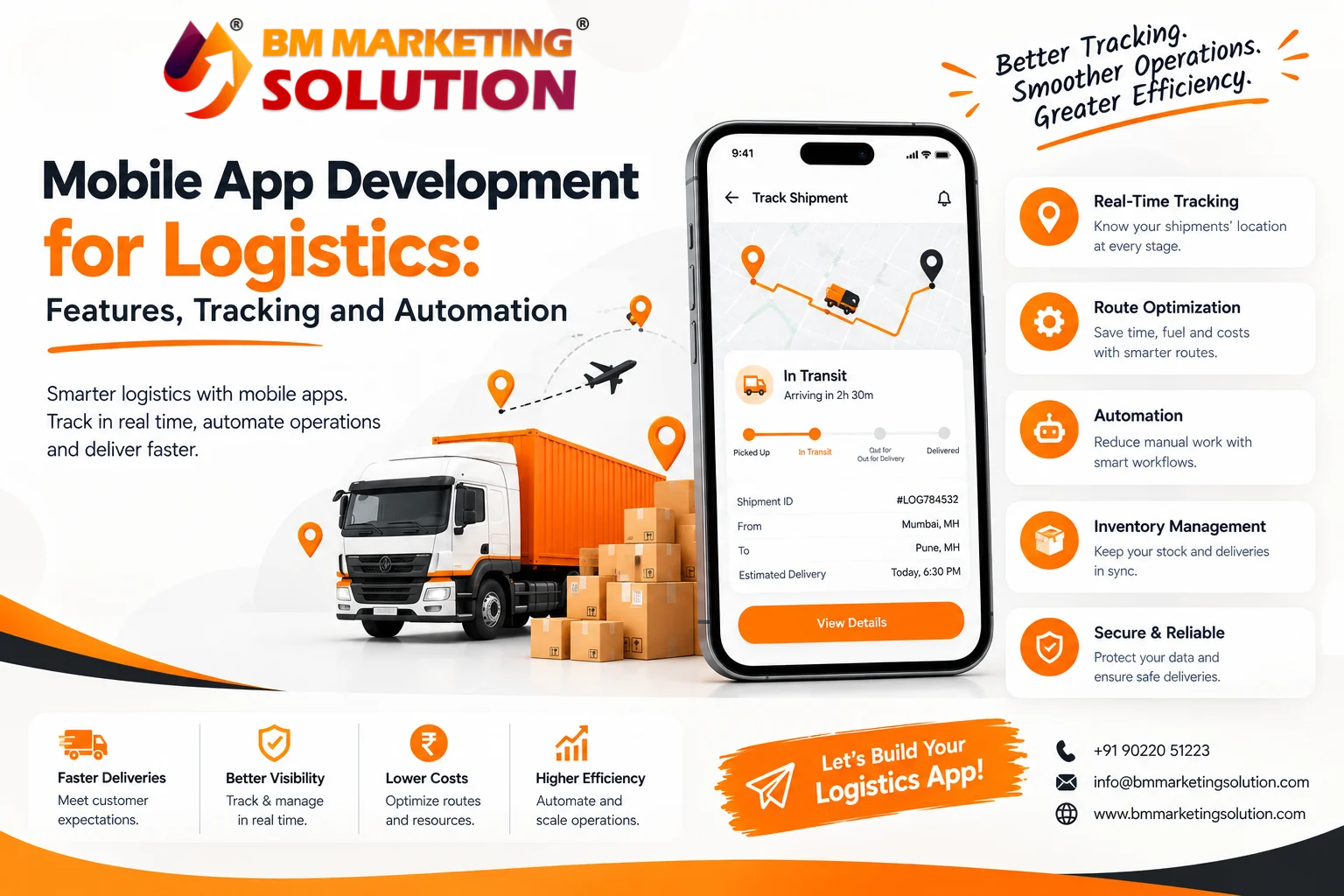
Logistics is no longer just about moving goods from one place to another. Mobile App Development for Logistics helps businesses manage deliveries, track shipments, and improve coordination across their operations.
Customers expect timely updates, businesses need better control over deliveries, and operations teams must coordinate drivers, vehicles, warehouses, and orders. Professional Logistics Mobile App Development brings these moving parts together, helping logistics businesses work more efficiently while providing customers with a smoother experience.
With reliable Logistics App Development Services, businesses can integrate live tracking, automated notifications, and delivery management features into a single platform. Effective Logistics Software Development can simplify everyday tasks, reduce manual work, and support better decision-making. The key is to choose features that solve real operational problems rather than adding technology for its own sake.
Paper-based processes and disconnected systems can make it difficult to track orders, share updates, and respond quickly when plans change.
A logistics mobile app gives drivers, dispatchers, managers, and customers access to relevant information through one convenient platform.
For businesses, this can mean clearer communication, fewer manual updates, and better visibility across deliveries.
The result is a more connected delivery process from pickup to final handover.
GPS tracking helps dispatchers monitor vehicle locations and gives customers useful delivery updates. It can also help teams respond to delays, route changes, or unexpected stops. For best results, tracking should be presented clearly and use location permissions transparently.
Route-planning features can help drivers follow efficient routes based on factors such as distance, traffic, delivery windows, and stop priorities.
A logistics app keeps order details, delivery progress, driver assignments, and proof of delivery in one place. Teams can quickly update each order from pickup to transit to final delivery so everyone stays informed without searching through messages or spreadsheets.
In-app messaging, call options, and automated notifications make it easier to share important updates. Customers can receive alerts when an order is dispatched or delayed, while drivers can contact dispatchers without switching between multiple tools.
Drivers can capture a customer’s signature, a photo, or a delivery confirmation in the app. Digital records make it easier for teams to confirm completed deliveries and review issues when a customer reports a problem.
Automation can take repetitive work off employees’ hands. For example, an app can send status notifications when an order reaches a new delivery stage, assign tasks based on predefined rules, or flag a delivery that has fallen behind schedule.
Automated reports can also help managers review delivery times, order volumes and recurring delays.
These insights are most useful when the underlying information is accurate and the reports are easy to understand.
Automation should support human decision-making not make important decisions impossible to review or correct.
Before development begins, map how orders currently move through your business. Identify where delays happen, which updates staff repeat manually, and what information drivers need while on the road. These answers help define a practical first version of the app.
It is also important to consider usability. Drivers may need large, easy-to-read buttons and quick access to essential actions. Managers may need dashboards and filters, while customers may only need tracking and delivery updates. Security, reliable performance, and integration with existing systems should be considered early, too.
A phased launch can help. Start with the features that address the biggest operational challenges, gather feedback from staff and customers, and improve the app based on real usage.
Logistics Mobile App Development helps businesses manage deliveries more efficiently by connecting shipment tracking, communication, order information, and automation in one place. With the right Logistics App Development Services, companies can simplify daily operations, improve delivery coordination, and provide customers with timely updates. Effective Logistics Software Development focuses on building a solution that fits existing workflows and makes everyday tasks easier for drivers, managers, and customers. The best logistics app is not necessarily the one with the most features, but the one that solves real business challenges.
Planning a logistics app?
Contact BM Marketing Solution to discuss your requirements and explore the next steps.
Phone : +91 90220 51223
Email : info@bmmarketingsolution.com
Ans : It helps businesses manage deliveries, track vehicles or orders, communicate updates, and record delivery information through a mobile platform.
Ans : Yes. If the app includes GPS tracking and customer-facing tracking, customers can view delivery progress and receive relevant status updates.
Ans : Automation can send notifications, update delivery statuses, assign tasks using set rules, and generate reports reducing some repetitive manual work.
Ans : Start with the features that address your main needs. Common starting points include order management, delivery-status updates, driver communication and proof of delivery.

SEO & Digital Marketing Executive
With 1.5+ years of experience in SEO, WordPress and digital marketing, I focus on creating informative and SEO-friendly content that helps businesses grow online. I believe in writing clear, practical and easy-to-understand articles that provide real value to readers.
https://bmmarketingsolution.com/binary-mlm-software-with-mobile-app-features-benefits/
https://bmmarketingsolution.com/how-binary-mlm-software-works-a-beginners-guide/

BM Marketing Solution - Building Brands That Stand Out Online
Address: Office no. G610, 5th Floor, Mega Center, Pune - Solapur Rd, Magarpatta, North Hadapsar, Hadapsar, Pune, Maharashtra 411013.
Phone : +91 90220 51223
Email: info@bmmarketingsolution.com
Copyright © 2025 BM Marketing Solution All Rights Reserved