This may include:
Store review itself may be relatively quick, but businesses should still include some buffer in the launch plan because submissions can sometimes require changes or additional review.
Several things can make an app project take longer than expected.
If you have a mobile app idea, one of the first questions you may ask is, “How long will it take to develop my app?” So, how long does mobile app development take? The answer depends on several factors, including the number of features, app complexity, design requirements, development platform, third-party integrations, testing, and the development team’s experience.
A basic mobile app may take around 2 to 3 months to develop, while a medium-complexity application can take approximately 3 to 6 months. More advanced applications with real-time features, multiple user roles, complex integrations, or enterprise-level requirements may take 6 to 12 months or longer.
The good news is that you do not always have to wait many months to see the first version of your app. With proper planning, businesses can start with a focused MVP (Minimum Viable Product) and gradually add advanced features based on user feedback and business needs.
Looking to build a mobile app for your business?
There is no single timeline for every mobile app because development time depends on the app’s features, design, platform, integrations, backend requirements, and testing needs. As a general estimate, a basic or simple mobile app can take around 2–3 months to develop. These apps usually have limited screens, basic features, simple navigation, and fewer integrations.
A medium-complexity mobile app generally takes around 3–6 months. This category may include applications with user accounts, custom UI/UX, payment gateways, notifications, APIs, dashboards, and other business-specific features.
For a complex mobile app, the development timeline can extend to around 6–9 months. Apps with real-time features, multiple user roles, advanced backend systems, third-party integrations, complex workflows, or higher security requirements usually need more development and testing time.
An enterprise-level mobile app may take 9–12 months or more, especially when it requires advanced security, ERP or CRM integrations, multiple modules, large-scale databases, compliance requirements, and extensive testing.
These are general estimates rather than fixed delivery times. A clearly defined project scope and an experienced development team can help keep the mobile app development timeline more predictable. Current 2026 industry estimates similarly place simple apps around 2–4 months, medium apps around 4–7 months, and complex or enterprise applications at 6–12+ months, depending on scope.
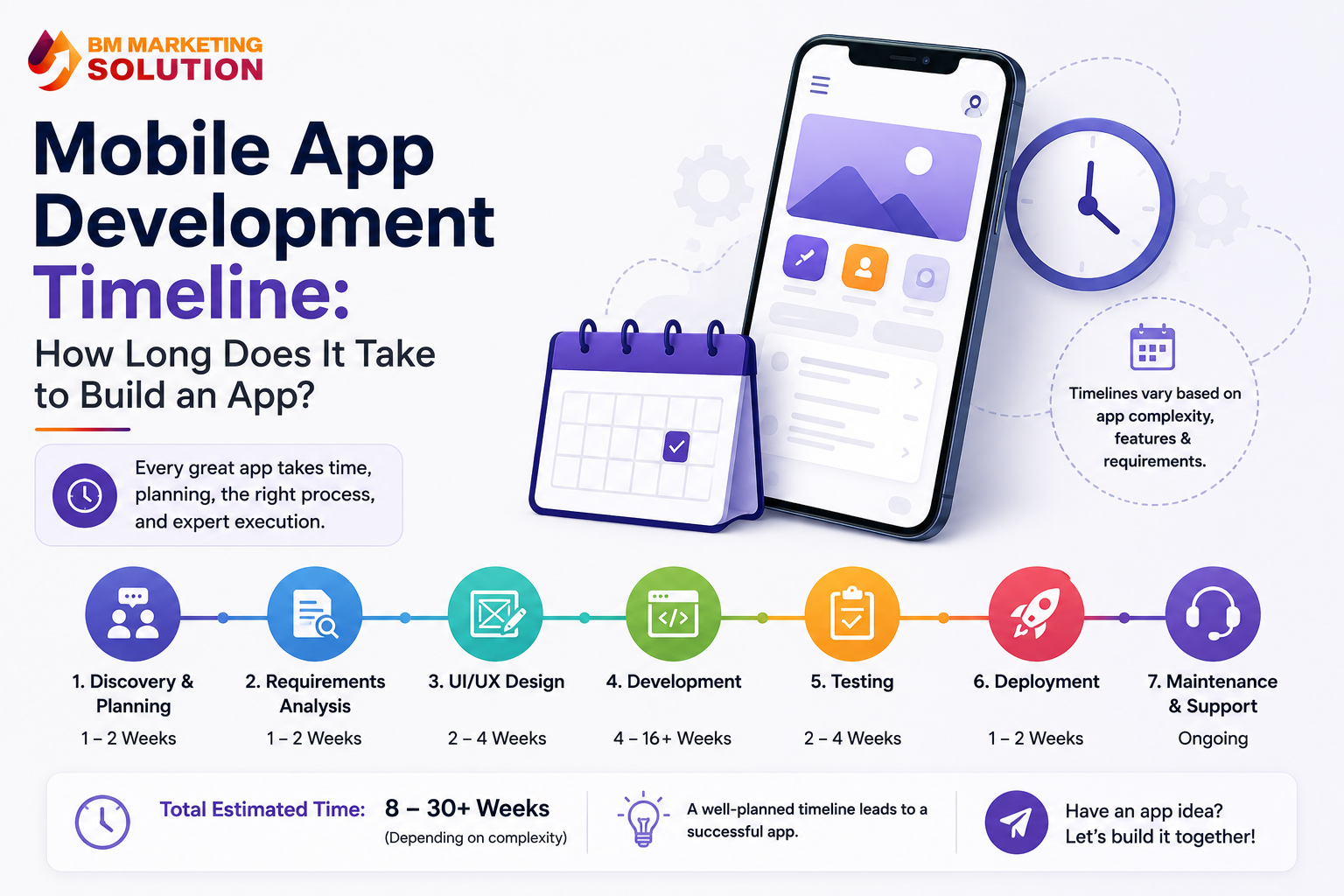
Understanding the development process makes it easier to understand where the time goes.
The first stage is about understanding what the application needs to achieve.
The development team identifies the target audience, business objectives, major features, user roles, required platforms, technical requirements, and third-party integrations.
For example, an eCommerce application may require product listings, search, user accounts, shopping carts, online payments, order tracking, notifications, and an admin panel.
Depending on the project, planning can take 1–3 weeks. Spending enough time here can prevent major changes later in development.
Once the requirements are clear, designers create the user experience and visual interface.
This can include:
A simple application may need only a few screens, while a feature-rich application can require dozens of screens and different user journeys.
UI/UX design commonly takes around 2–6 weeks, depending on the number of screens and revision requirements.
This is where the approved design becomes a functional application.
Developers build the frontend, implement business logic, connect APIs, and integrate required features. If the application needs a backend, developers may also work on databases, authentication, APIs, cloud infrastructure, and admin functionality.
This is usually one of the longest stages of the project.
For a simple application, development may take several weeks. For a larger application with complex workflows and integrations, it can take several months.
Many mobile applications require more than attractive screens.
For example, applications involving payments, bookings, customer accounts, delivery tracking, subscriptions, chat, or dashboards usually need a reliable backend system.
The backend manages information such as:
Backend development and mobile development can often happen in parallel, which can help reduce the overall project timeline.
Testing should not be treated as an afterthought.
Before launch, the application needs to be tested across supported devices and operating systems. The team checks functionality, navigation, performance, responsiveness, security, crashes, and other possible issues.
Beta testing and real-device testing can also reveal problems that are not obvious during development.
Testing and final fixes may take 2–6 weeks, depending on the size and complexity of the application.
After testing is complete, the application needs to be prepared for release.
This may include:
Store review itself may be relatively quick, but businesses should still include some buffer in the launch plan because submissions can sometimes require changes or additional review.
Several things can make an app project take longer than expected.
A simple login and profile application is very different from an app containing payments, live tracking, chat, subscriptions, and analytics.
More features generally mean more development and testing.
Developing separately for Android and iOS can require additional work. Cross-platform technologies can sometimes help teams share more code between platforms, although the best approach depends on the application’s requirements.
Payment gateways, maps, social logins, CRM systems, analytics platforms, shipping services, and other external APIs can increase development and testing requirements.
Frequent changes after development has already started can create rework. Clear requirements and timely feedback can help keep the project moving.
Applications that handle sensitive information, payments, complex workflows, or large numbers of devices may require more extensive testing before launch.
A faster development process does not mean skipping important steps. Instead, it means reducing unnecessary rework.
Start by defining the MVP (Minimum Viable Product). Focus on the features that are genuinely necessary for the first release and keep additional ideas for future updates.
You should also:
Clear decision-making and well-defined requirements can make a significant difference to the overall timeline.
The development team’s experience can influence not only how quickly an application is built but also how smoothly the project progresses.
A professional team can help you evaluate your idea, prioritize features, select suitable technologies, design the user experience, develop the application, test it, launch it, and provide ongoing maintenance.
Instead of focusing only on “How quickly can you build my app?”, it is better to ask, “How can we build the right app without unnecessary delays?”
That approach can help you avoid rushed development and expensive rework later.
So, how long does mobile app development take?
For a basic application, development can take around 2–3 months. A medium-complexity app may take 3–6 months, while complex and enterprise-level applications can require 6–12 months or more. The actual timeline depends on factors such as features, UI/UX design, technology, integrations, platforms, testing requirements, and overall project scope.
The best way to get a realistic estimate is to clearly define your requirements before development begins. A focused MVP, well-planned development process, regular communication, and thorough testing can help reduce delays and keep the project on track.
If you are wondering how long mobile app development takes for your specific business idea, the right development partner can help you understand the required features, estimated timeline, technology, and development process.
Ready to turn your app idea into a working product? Contact BM Marketing Solution today.
Website : https://bmmarketingsolution.com/
Phone : +91 90220 51223
Email : info@bmmarketingsolution.com
Ans : A basic mobile app with limited screens and straightforward functionality can typically take around 2–3 months, depending on the requirements, design, testing, and platform.
Ans : An eCommerce app generally requires more time because it may include product management, user accounts, search, cart functionality, payments, order management, notifications, and an admin panel. A medium-complexity eCommerce app may take around 3–6 months.
Ans : Yes, a focused MVP can often be developed faster when the feature scope is clearly defined. Using reusable components, suitable cross-platform technologies, parallel development, and early testing can help reduce unnecessary delays.
Ans : Common reasons include changing requirements, unclear project scope, delayed design approvals, complex third-party integrations, technical issues, additional features, and insufficient testing time. Defining the MVP and requirements early can help minimize these delays

SEO & Digital Marketing Executive
With 1.5+ years of experience in SEO, WordPress, and digital marketing, I focus on creating informative and SEO-friendly content that helps businesses grow online. I believe in writing clear, practical and easy-to-understand articles that provide real value to readers.
Binary MLM Software with Mobile App: Features & Benefits : https://bmmarketingsolution.com/binary-mlm-software-with-mobile-app-features-benefits/
https://bmmarketingsolution.com/how-binary-mlm-software-works-a-beginners-guide/
Confused between Matrix and Binary MLM plans? Compare their features, advantages, and business suitability to make an informed decision.
Read More : https://bmmarketingsolution.com/matrix-mlm-software-vs-binary-mlm-software-which-is-better/

BM Marketing Solution - Building Brands That Stand Out Online
Address: Office no. G610, 5th Floor, Mega Center, Pune - Solapur Rd, Magarpatta, North Hadapsar, Hadapsar, Pune, Maharashtra 411013.
Phone : +91 90220 51223
Email: info@bmmarketingsolution.com
Copyright © 2025 BM Marketing Solution All Rights Reserved