A website is more than just a collection of attractive pages. It is an important digital asset that can help a business build credibility, attract customers, generate leads, and grow online. But creating a successful website requires proper planning, the right strategy, and careful execution.
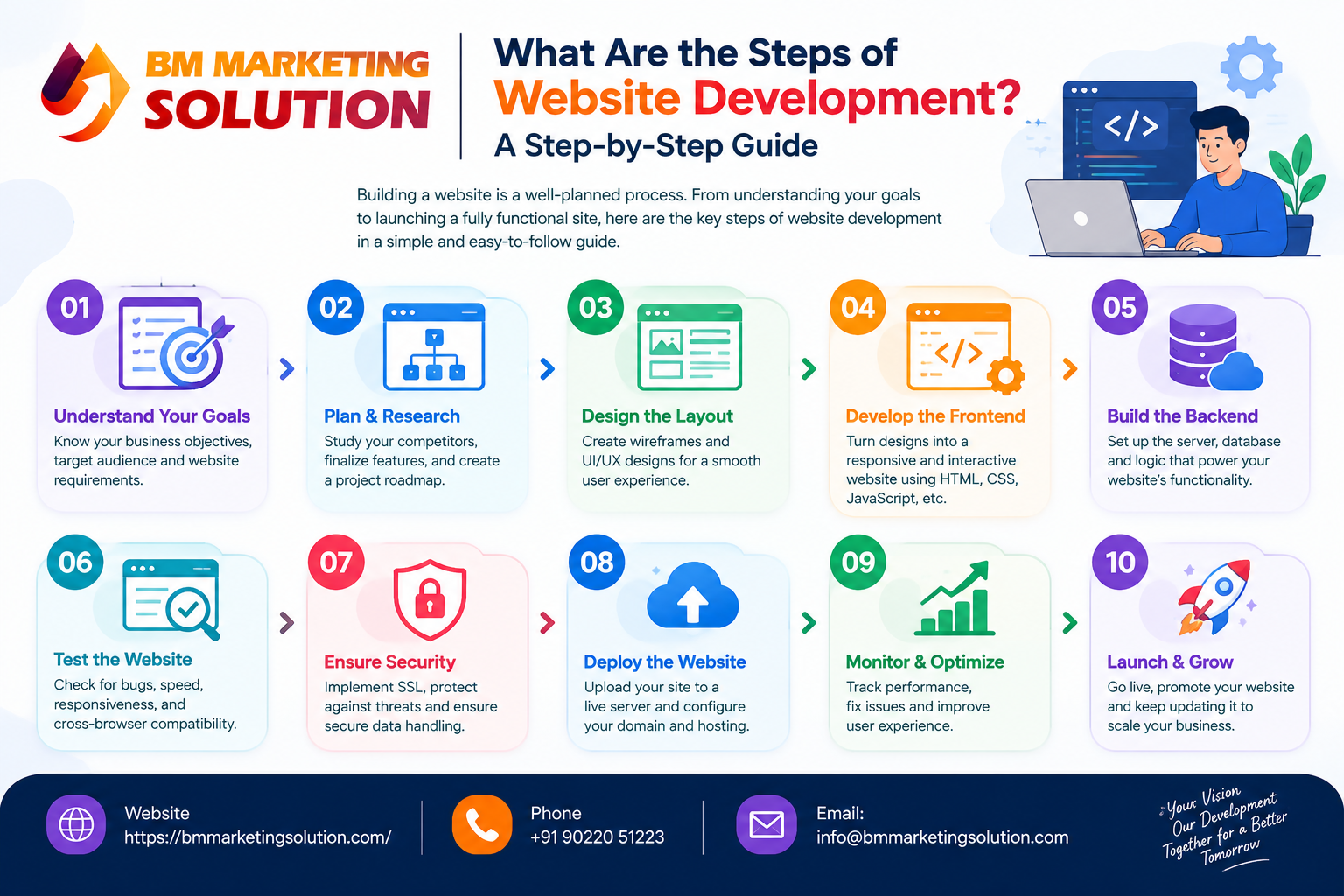
So, what are the steps of website development ? The website development process usually begins with understanding the business goals and target audience. It then moves through several important website development steps, including planning, designing, content creation, development, testing, launching and ongoing maintenance.
Whether you are a startup, small business, or established company, understanding the steps of website development can help you make better decisions, manage the project effectively and avoid common website development mistakes.
Get expert website development guidance from BM Marketing Solution and turn your business idea into a professional online presence.
Call : +91 90220 51223
Email : info@bmmarketingsolution.com
Website : BM Marketing Solution
The first step in website development is understanding why you need a website.
Before starting the design or coding process, you should clearly define your business objectives. For example, your website may be created to:
Generate leads and enquiries;
Sell products online;
Promote services;
Build brand awareness;
Provide information to customers;
Allow customers to book services;
Create an online platform or web application;
You should also identify your target audience. Understanding who will visit your website makes it easier to create relevant content, navigation, and features.
A clear goal gives the entire website development project the right direction.
Once your goals are clear, the next step is planning the website structure.
This includes deciding which pages your website needs and how those pages will connect with each other. A typical business website may include:
At this stage, developers and designers may also create a sitemap and plan the website’s navigation.
A well-planned structure makes it easier for visitors to find information and also helps search engines understand your website.
After planning the structure, the design stage begins.
Wireframes are simple layouts that show where important elements such as headings, images, menus, buttons, forms, and content will appear. They help the team understand the page structure before the final visual design is created.
The visual design then focuses on elements such as:
The goal is not simply to make the website look attractive. The design should also make it easy for visitors to navigate and take action.
Now the actual development work begins.
During this stage, developers convert the approved design into a working website. Depending on the project, the website may be developed using platforms such as WordPress or through custom technologies.
Website development can involve both front-end and back-end development.
The front end includes everything visitors see and interact with, such as menus, buttons, forms, images and page layouts.
The back end handles functionality, databases, user management, integrations, and other processes that work behind the scenes.
For business websites, developers may also integrate contact forms, payment gateways, CRM systems, analytics tools, booking systems, or other third-party services.
Today, people access websites from smartphones, tablets, laptops, and desktops. Therefore, a website should work properly across different screen sizes.
A responsive website automatically adjusts its layout according to the device being used.
During development, the team should check :
Mobile responsiveness is important for both user experience and search visibility.
Before launching the website, thorough testing is essential.
A website may look perfect during development but still have broken links, form errors, layout problems, or compatibility issues.
Links Contact forms Buttons Navigation Images Videos Forms Browser compatibility Mobile responsiveness Page speed Basic security Content formatting SEO-related elements should also be reviewed before launch, including metadata, indexing settings, redirects, sitemap, canonical tags and structured data where appropriate.
Testing helps identify problems before real customers start using the website.
A website launch is an important milestone, but it should not be treated as the end of the project. Post-launch monitoring is equally important.
So, what are the steps of website development? The website development process generally includes defining goals, planning the website structure, designing the user interface, preparing content, developing the website, making it responsive, testing its functionality, launching the site, and maintaining it regularly.
A successful website is not created by focusing only on design or coding. The right website development steps combine strategy, user experience, quality content, development, SEO, testing, security, and ongoing optimization. Each stage plays an important role in creating a website that is professional, user-friendly, and aligned with business goals.
If you are planning a new website or want to improve your existing one, working with an experienced website development team can make the entire process smoother and more effective. A well-planned website can give your business a stronger online presence, improve customer engagement, and create more opportunities for growth.
Phone : +91 90220 51223
Email : info@bmmarketingsolution.co

SEO & Digital Marketing Executive
With 1.5+ years of experience in SEO, WordPress and digital marketing, I focus on creating informative and SEO-friendly content that helps businesses grow online. I believe in writing clear, practical and easy-to-understand articles that provide real value to readers.
Binary MLM Software with Mobile App: Features & Benefits : https://bmmarketingsolution.com/binary-mlm-software-with-mobile-app-features-benefits/
https://bmmarketingsolution.com/how-binary-mlm-software-works-a-beginners-guide/

BM Marketing Solution - Building Brands That Stand Out Online
Address: Office no. G610, 5th Floor, Mega Center, Pune - Solapur Rd, Magarpatta, North Hadapsar, Hadapsar, Pune, Maharashtra 411013.
Phone : +91 90220 51223
Email: info@bmmarketingsolution.com
Copyright © 2025 BM Marketing Solution All Rights Reserved