Your software requirements can change as your company grows.
A custom application can be developed with future expansion in mind, allowing new features, users, locations, or integrations to be added as your business evolves.
Businesses rarely use just one technology platform.
You may already have accounting software, payment gateways, CRM tools, databases, ERP systems, or other applications.
Custom software can be developed to connect these systems and help information move between them more efficiently.
Every business has its own way of working. Some companies manage hundreds of orders every day, while others need to handle complex customer data, inventory, employees, or internal approvals.
So, why should every business depend on the same software?
This is where custom software development comes in.
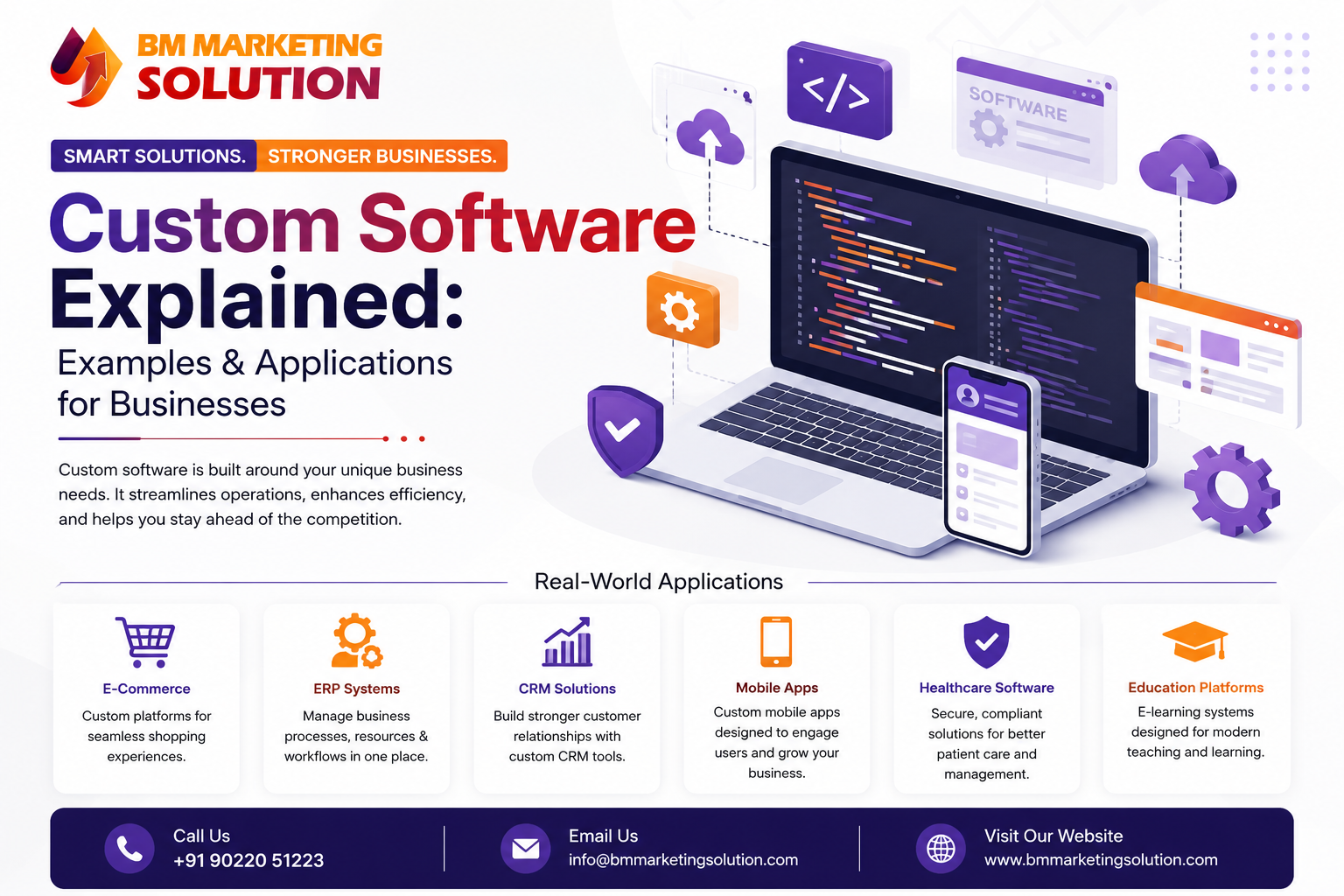
Custom Software Explained simply means understanding how software can be designed specifically around a business’s unique needs rather than forcing the business to adapt to a ready-made solution. Custom software is built for a particular organization and its requirements, helping teams manage their work in a way that makes sense for them.
Instead of changing your business processes to fit a standard application, custom software is designed around the way your business actually works. From customized CRM systems and inventory tools to e-commerce platforms and business automation solutions, there are many custom software examples that show how technology can solve specific business challenges.
Different custom software applications can help businesses improve efficiency, manage data, automate repetitive tasks, and create smoother workflows. Whether you need an employee portal, a custom CRM, an inventory management system, or an e-commerce platform, the right solution can help your business operate more efficiently.
In this guide, we’ll explain what custom software means, explore practical custom software examples, understand different custom software applications, and look at how businesses can benefit from a solution built around their specific needs.
Custom software is software developed specifically for a particular business, organization, or group of users.
Unlike ready-made software, which is designed for a large number of businesses, custom software is created after understanding your company’s workflows, challenges, goals, and requirements.
For example, imagine a manufacturing company that needs to manage production, raw materials, suppliers, inventory, and sales from one system.
A standard software package may provide some of these features, but it may not match the company’s exact workflow.
With custom software, the business can build the features it actually needs and leave out the ones it doesn’t.
A simple way to understand it is:
Off-the-shelf software = ready-made solution
Custom software = solution designed for your business
Both options can be useful, but the right choice depends on your business requirements.
Off-the-shelf software is designed for a broad audience. It is usually easier to purchase, faster to implement, and often less expensive initially. However, businesses may have to work around its limitations.
You might find yourself paying for features your team never uses while still relying on spreadsheets or other tools for tasks the software doesn’t support.
Custom software, on the other hand, is developed around your specific business processes. You decide which features are required, which systems need to be connected, and how users should interact with the application.
| Custom Software | Off-the-Shelf Software |
|---|---|
| Built for specific business needs | Built for a general audience |
| Flexible features and workflows | Fixed or limited workflows |
| Can integrate with existing systems | Integration options may be limited |
| Can scale with business requirements | Scaling may require plan or platform changes |
| Higher initial development investment | Usually lower initial cost |
| Greater control over functionality | Less control over the product |
The goal isn’t to say custom software is always better. If a ready-made tool already does everything your business needs, there may be no reason to build something from scratch.
Custom development becomes more valuable when your business has unique processes, complex requirements, or limitations that existing software cannot solve effectively.
Custom software can be used across almost every industry. Here are some common examples.
A standard CRM may offer dozens of features, but your sales team might only need a specific set of tools.
A custom CRM can be designed around your sales process and include features such as:
This allows your team to work within a system that matches its actual sales process.
Businesses with multiple warehouses, suppliers, products, or sales channels often have complex inventory requirements.
Custom inventory software can help businesses manage :
Instead of maintaining separate spreadsheets or systems, businesses can bring important inventory information into one centralized platform.
Platforms such as standard e-commerce solutions work well for many businesses. But some companies need shopping experiences that go beyond standard features.
For example, a business may require :
A customized checkout process.
Product configurators :
Membership or loyalty programs.
Subscription management.
Personalized product recommendations.
Special pricing rules.
Custom payment or shipping integrations.
A custom e-commerce platform gives businesses greater control over how customers browse, purchase, and interact with their products.
Healthcare organizations often deal with sensitive information and complex workflows.
Custom healthcare software can be developed to support processes such as:
Patient registration
Appointment scheduling
Medical records management
Billing
Staff management
Reports
Notifications
Internal workflow management
The exact features can be designed around the organization’s operational requirements and applicable privacy or regulatory obligations.
Not every custom application needs to be customer-facing.
Many companies develop internal software to reduce repetitive manual work.
These tools can reduce unnecessary emails, spreadsheets and manual data entry.
The biggest advantage of custom software is that it is designed around the business rather than forcing the business to adapt to the software.
Here are some of the main benefits :
When software matches your existing workflow, employees spend less time finding workarounds or entering the same information into multiple systems.
Automating repetitive tasks can also give your team more time to focus on important business activities.
Your software requirements can change as your company grows.
A custom application can be developed with future expansion in mind, allowing new features, users, locations, or integrations to be added as your business evolves.
Businesses rarely use just one technology platform.
You may already have accounting software, payment gateways, CRM tools, databases, ERP systems, or other applications.
Custom software can be developed to connect these systems and help information move between them more efficiently.
Your employees and customers do not have to navigate features they do not need.
A custom application can provide a simpler interface based on the actual tasks users perform.
This can make the software easier to understand and use.
With a custom solution, your business has greater control over its functionality and future development.
Instead of waiting for a software provider to introduce a feature you need, you can work with a development team to plan and implement the functionality according to your requirements.
Businesses in industries such as healthcare, finance, and logistics may have specific security and compliance requirements.
Custom software can be designed with appropriate access controls, authentication, data protection, logging, and other security measures based on the application’s requirements.
However, security is not automatic simply because software is custom-built. It needs to be planned, implemented, tested, and maintained properly.
Custom software is not necessary for every company.
If a ready-made application already solves your problem effectively and fits within your budget, it may be the smarter choice.
But custom development may be worth considering if you regularly experience problems such as:
Your current software does not support important business processes.
Employees rely heavily on spreadsheets to fill software gaps.
You are using several disconnected applications.
Your team spends too much time on repetitive manual work.
You need integrations that existing tools do not provide.
Your business has complex or industry-specific workflows.
You need a solution that can grow with your organization.
These are signs that your business may have outgrown generic software.
One of the biggest concerns businesses have is cost.
Yes, custom software usually requires a larger initial investment than purchasing a ready-made application.
However, the cost should not be considered only in terms of development.
You should also look at the long-term value.
If custom software reduces manual work, eliminates duplicate systems, improves productivity, simplifies reporting, and supports business growth, it may provide a strong return on investment over time.
The key is to build only what your business actually needs instead of creating unnecessary features.
A successful custom software project usually starts long before developers begin writing code.
The process generally includes :
1. Requirement Analysis :
The development team understands your business, users, problems, and goals.
2. Planning :
The required features, technology, integrations, timeline, and project scope are defined.
3. UI/UX Design :
The application’s screens and user experience are planned to make the system easy to use.
4. Development :
Developers build the software according to the approved requirements.
5. Testing :
The application is tested to identify bugs, performance issues, security problems, and usability concerns.
6. Deployment :
Once the software is ready, it is deployed for actual users.
7. Maintenance & Updates :
After launch, the software may require improvements, security updates, bug fixes, and new features as business requirements change.
Let’s say a growing company manages sales leads using Excel, communicates with customers through email, tracks employee tasks separately, and prepares reports manually.
As the company grows, this process becomes difficult to manage.
Instead of using four or five disconnected tools, the company could develop a custom business management platform that combines:
Lead Management + Customer Data + Task Management + Reporting + Notifications
Now the team can access important information from one system.
That’s the real purpose of custom software solving a specific business problem with technology designed around the way the organization works.
Custom software is not simply about creating something from scratch. It’s about building a technology solution that genuinely makes sense for the way your business operates.
When it comes to Custom Software Explained, the main idea is simple: the right software should support your business processes instead of forcing your team to work around unnecessary limitations.
For some companies, a ready-made application will be more than enough. For others, unique workflows, integration requirements, scalability challenges, or operational complexity can make custom software a better long-term option.
There are many Custom Software Examples, from custom CRM and ERP systems to e-commerce platforms, inventory management tools, healthcare systems, and internal business automation solutions. These different Custom Software Applications show how businesses can use technology to solve specific challenges and improve everyday operations.
If you’re spending too much time working around the limitations of your existing software, it may be time to explore a solution built specifically for your business. The right custom solution can help streamline processes, improve efficiency, and support your business as it grows.
BM Marketing Solution can help you plan and develop software around your business requirements, workflows, and growth goals.
Phone: +91 90220 51223
Email: info@bmmarketingsolution.com
Website: bmmarketingsolution.com
Ans : Custom software is an application or system developed specifically for a business or group of users based on their unique requirements, workflows, and goals.
Ans : Off-the-shelf software is designed for a broad range of users, while custom software is developed around the specific requirements of an individual business or organization.
Ans : Custom software generally has a higher upfront development cost than ready-made software. However, it can provide long-term value by improving efficiency, reducing manual work, and supporting specific business requirements.
Don’t force your business to fit someone else’s software.
Let’s build a solution that fits the way your business actually works.
Contact BM Marketing Solution today to discuss your custom software requirements.

SEO & Digital Marketing Executive
With 1.5+ years of experience in SEO, WordPress, and digital marketing, I focus on creating informative and SEO-friendly content that helps businesses grow online. I believe in writing clear, practical and easy-to-understand articles that provide real value to readers.
Binary MLM Software with Mobile App: Features & Benefits : https://bmmarketingsolution.com/binary-mlm-software-with-mobile-app-features-benefits/
https://bmmarketingsolution.com/how-binary-mlm-software-works-a-beginners-guide/
Confused between Matrix and Binary MLM plans? Compare their features, advantages, and business suitability to make an informed decision.
Read More : https://bmmarketingsolution.com/matrix-mlm-software-vs-binary-mlm-software-which-is-better/
BM Marketing Solution - Building Brands That Stand Out Online
Address: Office no. G610, 5th Floor, Mega Center, Pune - Solapur Rd, Magarpatta, North Hadapsar, Hadapsar, Pune, Maharashtra 411013.
Phone : +91 90220 51223
Email: info@bmmarketingsolution.com
Copyright © 2025 BM Marketing Solution All Rights Reserved