This can help reduce development time and simplify the process of maintaining applications for Android and iOS.
For startups and growing businesses that want to reach users on multiple platforms while managing their development budget, cross-platform development can be a practical solution.
There is no universal answer to which approach is better. The right choice depends on your application’s features, users, budget, and long-term objectives.
Selecting the right mobile app development company can have a major impact on your project’s success.
A reliable development partner should understand your business goals, communicate clearly, and provide support throughout the development journey.
Smartphones have changed the way people interact with businesses. Today, customers use mobile devices for almost everything, from ordering products and booking services to making payments, learning online and communicating with brands.
Because of this shift, Mobile App Development Services for Businesses have become an effective way to stay connected with customers and provide convenient digital experiences. A well-planned mobile application can improve user experience, strengthen brand visibility and create new opportunities for business growth.
However, successful app development is not simply about creating screens and writing code. It requires careful planning, intuitive UI/UX design, the right technology, thorough testing, and reliable support after launch. Choosing the right Mobile App Development Company can also make a significant difference in the quality, performance, and scalability of your application.
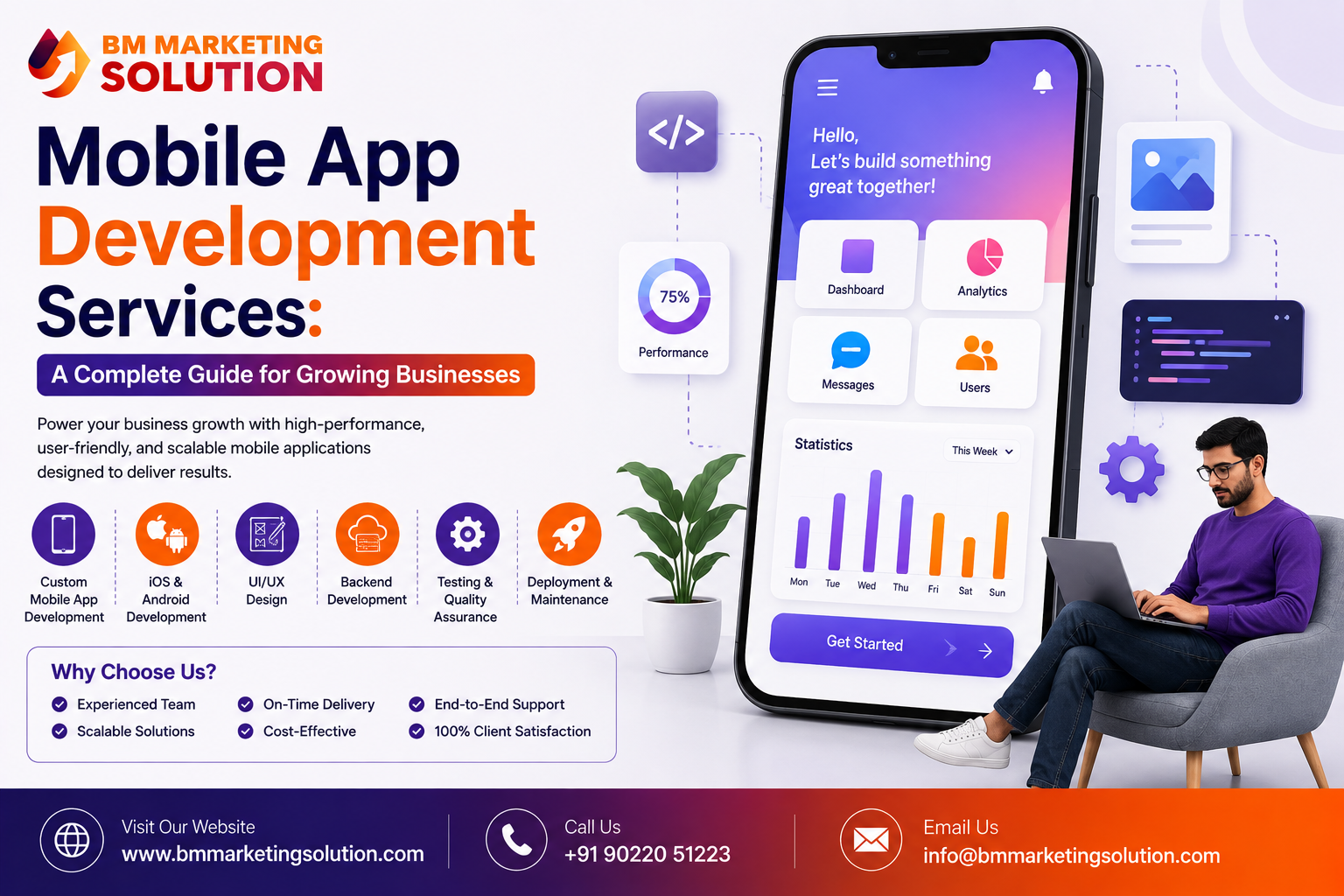
Whether you need Custom Mobile App Development for a startup, eCommerce business, service company, or growing enterprise, having a clear development strategy is essential. The right Mobile App Development Services can help turn your business idea into a practical and user-friendly mobile solution.
In this guide, we’ll explore Mobile App Development Services for Businesses, the major stages involved in creating a mobile application, and the key factors businesses should consider when selecting a development partner.
Mobile phones have become an everyday part of people’s lives. Customers use them to browse products, compare prices, order food, make payments, book appointments, access services, and communicate with companies.
For businesses, this makes mobile applications an effective way to provide faster and more convenient services.
Some important advantages of having a mobile app include :
The key is to develop an application that provides genuine value to users. Simply having an app is not enough; it should solve a real problem or make an existing process easier.
Professional mobile app development services generally cover the complete journey of an application, starting with the initial idea and continuing through development, launch, and maintenance.
Let’s look at the major stages.
Every successful application starts with a clear plan.
At this stage, the development team learns about your business objectives, target customers, competitors, expected features, and future goals. These details help define the scope of the project before development begins.
Proper planning can also prevent unnecessary features from increasing development time and costs.
The design of an app plays a major role in how users interact with it.
UI design covers the visual elements of the application, such as layouts, colors, icons, buttons, typography, and screens. UX design focuses on the overall user journey and how easily people can complete tasks inside the application.
An attractive design is useful, but an intuitive experience is even more important. If users struggle to navigate an app, they may stop using it regardless of how good it looks.
Once the design and functionality are finalized, developers begin building the application.
Depending on the project, businesses can consider different development approaches, such as:
The appropriate technology depends on factors such as budget, target audience, required features, performance expectations, and future scalability.
Before an app reaches customers, it needs thorough testing.
QA teams check the application on different devices and screen sizes to identify issues such as crashes, broken features, navigation errors, slow performance, and security vulnerabilities.
Testing at this stage helps ensure that users receive a stable and dependable application after launch.
After development and testing are complete, the application is prepared for publication.
Depending on the target audience, the app may be submitted to the Google Play Store, Apple App Store, or both.
Developers can also assist with preparing app builds, screenshots, descriptions, technical requirements, and other submission materials.
An application requires attention even after it has been launched.
New operating system versions, device updates, security requirements, and changing customer expectations can affect how an app performs. Regular maintenance can help address bugs, improve performance, strengthen security, and introduce new features.
Ongoing support is therefore an important part of professional mobile application development services.
Choosing the right development approach is another important decision for businesses.
Native applications are created specifically for one operating system, such as Android or iOS.
Because they are designed for a particular platform, native apps can provide strong performance and deeper access to platform-specific features. They may be suitable for applications that require advanced graphics, complex processing, or extensive hardware integration.
Cross-platform development allows businesses to build applications that can run on multiple operating systems using a shared development approach.
This can help reduce development time and simplify the process of maintaining applications for Android and iOS.
For startups and growing businesses that want to reach users on multiple platforms while managing their development budget, cross-platform development can be a practical solution.
There is no universal answer to which approach is better. The right choice depends on your application’s features, users, budget, and long-term objectives.
Selecting the right mobile app development company can have a major impact on your project’s success.
A reliable development partner should understand your business goals, communicate clearly, and provide support throughout the development journey.
Start by looking at applications they have developed previously. Check the quality of their designs, functionality, industries served, and overall user experience.
A relevant portfolio can give you a better idea of whether the company is capable of handling your project.
Make sure the development team has experience with the technologies and platforms required for your application.
You can also ask about their development methodology, security practices, integrations, and approach to solving technical challenges.
Good communication makes the development process much smoother.
Choose a company that provides regular project updates, responds to questions, and keeps you involved when important decisions need to be made.
Your relationship with the development company should not necessarily end when the application goes live.
Ask whether they provide services such as bug fixes, application updates, performance optimization, security improvements, and new feature development.
The cheapest quotation is not always the best option.
Ask the development company to clearly explain what is included in the project cost, which features are covered, and whether additional charges may apply later.
A detailed quotation can make budgeting easier and reduce the possibility of unexpected expenses.
There is no fixed price for developing a mobile application because every project has different requirements.
Several factors can influence the overall development cost, including:
Number of features
Application complexity
UI/UX design requirements
Android and iOS platform requirements
Backend development
API and third-party integrations
Payment gateway integration
Admin panel requirements
Security requirements
Testing and quality assurance
Ongoing maintenance
A basic business application may require a smaller investment, while a complex application with advanced functionality and multiple integrations can require a significantly larger budget.
Instead of depending on a general online estimate, businesses should discuss their requirements with a mobile app development company and request a customized project quotation.
Mobile applications can help businesses build stronger customer relationships, improve accessibility, and provide more convenient digital experiences. However, the success of an app depends on more than simply getting it published. A clear strategy, useful features, intuitive UI/UX design, reliable technology, thorough testing, and continuous improvement are all important for long-term success.
Whether you are a startup developing your first application or an established company looking to expand its digital services, choosing the right Mobile App Development Services for Businesses can make the entire process smoother and more effective. From Custom Mobile App Development to ongoing maintenance, the right development approach can help you create an app that supports your business goals.
If you have an app idea but are not sure how to get started, BM Marketing Solution can help you turn your idea into a practical mobile solution. Our Mobile App Development Services cover planning, UI/UX design, development, testing, deployment, and ongoing support.
Ready to build your mobile app? Contact BM Marketing Solution today and take the next step toward creating a powerful digital experience for your customers.
Phone: +91 90220 51223
Email: info@bmmarketingsolution.com
Website: https://bmmarketingsolution.com/
Ans : The development timeline depends on the size and complexity of the application. A simple app may take several weeks, while applications with advanced features and integrations can take several months.
Ans : It depends on your project requirements. Native development may be suitable when maximum platform performance is important, while cross-platform development can be a practical choice for businesses that want to target Android and iOS with a streamlined development process.
Ans : Features, design complexity, platform selection, backend requirements, integrations, security, testing, and maintenance can all influence the total cost of an application.
Ans : Yes. Regular maintenance helps keep an app compatible with new operating system versions, resolve bugs, improve security, and introduce updates or new functionality as business requirements change.

SEO & Digital Marketing Executive
With 1.5+ years of experience in SEO, WordPress, and digital marketing, I focus on creating informative and SEO-friendly content that helps businesses grow online. I believe in writing clear, practical and easy-to-understand articles that provide real value to readers.
Binary MLM Software with Mobile App: Features & Benefits : https://bmmarketingsolution.com/binary-mlm-software-with-mobile-app-features-benefits/
https://bmmarketingsolution.com/how-binary-mlm-software-works-a-beginners-guide/
Confused between Matrix and Binary MLM plans? Compare their features, advantages, and business suitability to make an informed decision.
Read More : https://bmmarketingsolution.com/matrix-mlm-software-vs-binary-mlm-software-which-is-better/

BM Marketing Solution - Building Brands That Stand Out Online
Address: Office no. G610, 5th Floor, Mega Center, Pune - Solapur Rd, Magarpatta, North Hadapsar, Hadapsar, Pune, Maharashtra 411013.
Phone : +91 90220 51223
Email: info@bmmarketingsolution.com
Copyright © 2025 BM Marketing Solution All Rights Reserved