JavaScript remains the most widely used programming language worldwide. If your business already employs developers skilled in React, transitioning them to React Native is fast and affordable. The vast NPM package ecosystem also provides thousands of ready-to-use plugins that accelerate development speed.
Dart is easy to learn for OOP developers, but the specialized Flutter talent pool is smaller. Recruiting experienced engineers takes time, though Google’s documentation helps teams onboard quickly.
Strategic Verdict : Which Framework Fits Your App?
Choose Flutter if: You want custom animations, require identical cross-platform visual design, or plan to launch across mobile, desktop, and web simultaneously.
Choose React Native if: Your team already specializes in JavaScript or React, you prefer native platform design conventions, or you plan to add mobile features into an existing native application.
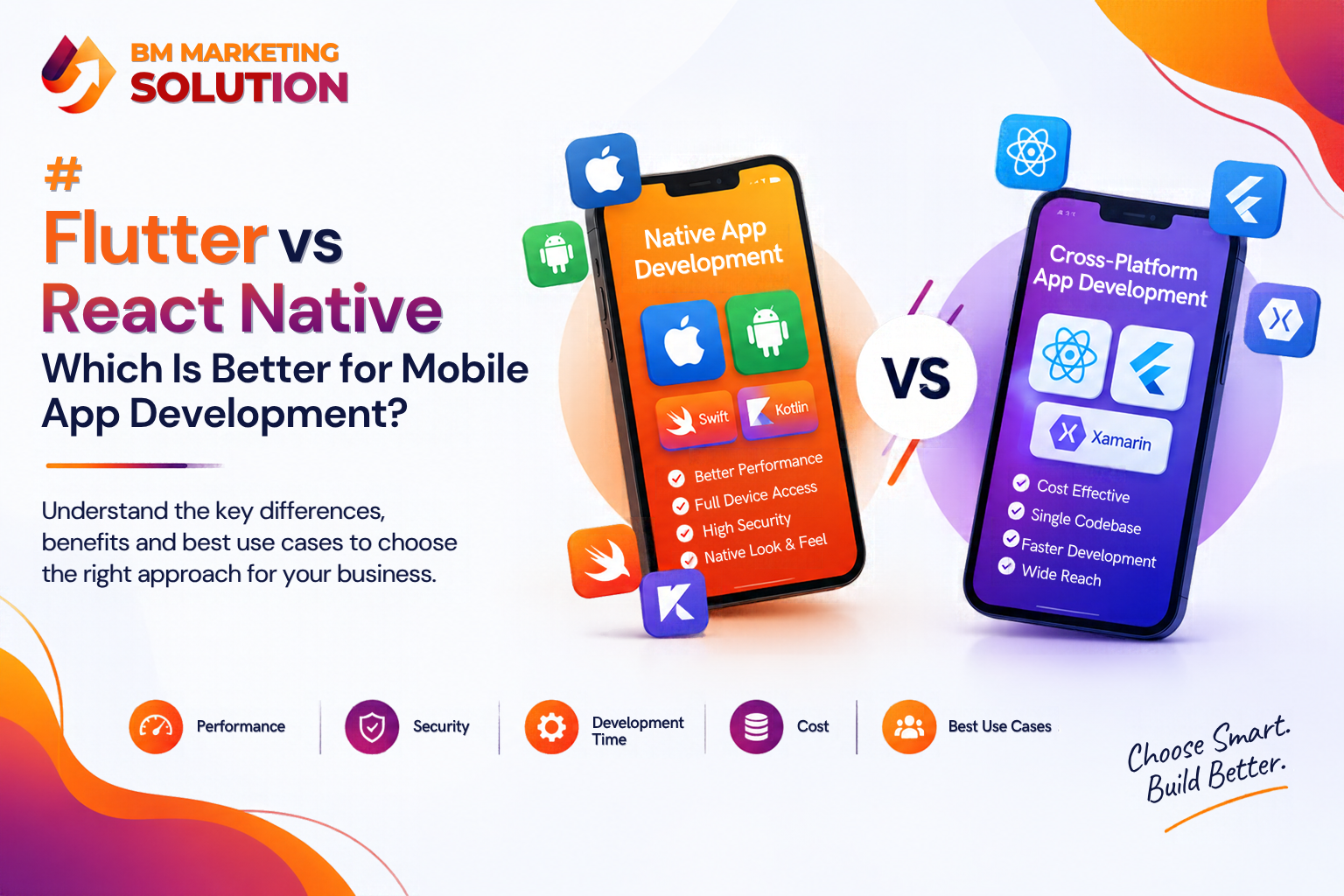
In today’s digital economy, launching a high-converting mobile app is essential for business growth. However, business leaders face a pivotal decision: should you build separate native apps for iOS and Android, or choose cross-platform mobile app development?
Cross-platform development provides a faster time-to-market while keeping development expenses more predictable. This brings us to Flutter vs React Native, two of the most popular frameworks for modern mobile app development. Both offer shared codebases, strong performance, and efficient development, yet choosing the wrong technology stack can lead to development bottlenecks, higher maintenance costs, and scalability challenges.
If you are comparing Flutter vs React Native, understanding their differences in features, development speed, ecosystem, cost, and performance is essential. A detailed Flutter vs React Native comparison can help businesses choose the right framework based on their project requirements, budget, target platforms, and long-term goals.
One of the most important factors to consider is Flutter vs React Native performance. While both frameworks can deliver high-quality mobile applications, their performance, UI rendering approaches, development experience, and suitability can vary depending on the type and complexity of the app. So, which is better, Flutter or React Native? The answer depends on what your business actually needs.
Call: +91 90220 51223
Email: info@bmmarketingsolution.com
Created by Google, Flutter is an open-source SDK designed to build natively compiled apps for mobile, web, and desktop from one codebase. Using Dart and its own rendering engine, Flutter draws every pixel directly on canvas, giving developers complete UI control.
Backed by Meta, React Native lets engineers build mobile apps using JavaScript and React. Rather than rendering canvas graphics, it communicates directly with native platform components, seamlessly preserving the authentic look and feel of iOS and Android.
Flutter compiles directly into native machine code using Dart Ahead-Of-Time compilation. By eliminating background communication bridges, Flutter delivers uninterrupted 60fps animations. It excels in graphic-heavy apps, interactive dashboards, and visually rich digital experiences.
React Native historically used a JavaScript bridge to communicate with native device modules, creating occasional lag during data-heavy calculations. Its modern New Architecture featuring Fabric rendering and Turbo Modules improves execution significantly. While React Native easily powers standard business applications, Flutter retains an advantage in raw graphical throughput.
Flutter builds interfaces using a rich set of pre-built widgets. Because Flutter renders layouts internally, your interface displays identically across older Android models and new iPhones, ideal for brands requiring uniform multi-platform styling.
React Native relies on native operating system components. Components built in React Native reflect Cupertino styling on iOS and Material design on Android, offering an authentic platform-native user experience.
JavaScript remains the most widely used programming language worldwide. If your business already employs developers skilled in React, transitioning them to React Native is fast and affordable. The vast NPM package ecosystem also provides thousands of ready-to-use plugins that accelerate development speed.
Dart is easy to learn for OOP developers, but the specialized Flutter talent pool is smaller. Recruiting experienced engineers takes time, though Google’s documentation helps teams onboard quickly.
Strategic Verdict : Which Framework Fits Your App?
Choose Flutter if: You want custom animations, require identical cross-platform visual design, or plan to launch across mobile, desktop, and web simultaneously.
Choose React Native if: Your team already specializes in JavaScript or React, you prefer native platform design conventions, or you plan to add mobile features into an existing native application.
Ans : For standard e-commerce, directory, and booking applications, users will not see any noticeable speed difference. However, for apps with complex transitions or custom 2D visual elements, Flutter delivers smoother rendering because it compiles straight into machine code without bridge layers.
Ans : Yes. Both frameworks allow development teams to share between 80% and 95% of their application logic across platforms. This drastically reduces development costs, simplifies future updates, and cuts project delivery timelines in half compared to building separate native applications.
Ans : Both frameworks offer outstanding corporate backing. Flutter is backed by Google and powers major applications like Google Pay. React Native is maintained by Meta and runs platforms like Instagram and Shopify. Both options represent reliable, enterprise-grade technologies.
Ans : Both frameworks are open-source. Total costs depend on app complexity, backend infrastructure, and APIs. React Native lowers onboarding costs for JavaScript teams, while Flutter reduces QA testing expenses with its unified rendering engine across devices.
Neither Flutter nor React Native is universally superior. The right choice depends on your product roadmap, UI requirements, performance expectations, budget, and development timeline. Flutter provides greater control over visual consistency and custom UI, while React Native offers strong native integration, JavaScript familiarity, and a mature development ecosystem.
BM Marketing Solution, we help ambitious businesses transform their mobile app ideas into scalable, secure, and high-performing applications. Whether you are considering Flutter vs React Native for a new project or looking for expert cross-platform mobile app development, our experienced team can help you select the right technology based on your business goals.
From UI/UX design and app development to testing, deployment, and ongoing support, our mobile app development experts guide you through every stage of the process. Let’s build a mobile experience that delivers a smooth user experience and supports your long-term business growth.
Let our mobile engineering team build a secure, high-performing app tailored to your business goals.
Website: bmmarketingsolution.com
Call: +91 90220 51223
Email: info@bmmarketingsolution.com

SEO & Digital Marketing Executive
With 1.5+ years of experience in SEO, WordPress and digital marketing, I focus on creating informative and SEO-friendly content that helps businesses grow online. I believe in writing clear, practical and easy-to-understand articles that provide real value to readers.
https://bmmarketingsolution.com/binary-mlm-software-with-mobile-app-features-benefits/
https://bmmarketingsolution.com/how-binary-mlm-software-works-a-beginners-guide/
BM Marketing Solution - Building Brands That Stand Out Online
Address: Office no. G610, 5th Floor, Mega Center, Pune - Solapur Rd, Magarpatta, North Hadapsar, Hadapsar, Pune, Maharashtra 411013.
Phone : +91 90220 51223
Email: info@bmmarketingsolution.com
Copyright © 2025 BM Marketing Solution All Rights Reserved