Maintenance is not only about fixing technical problems. Real users can reveal things that developers may not notice during initial testing.
For example, customers might find a registration process too long or have difficulty finding a particular feature. Businesses can use this feedback to make practical improvements.
Over time, these small changes can make the application easier and more useful for its target audience.
After an app goes live, developers may need to release updated versions from time to time. These updates can include bug fixes, performance improvements, security changes, or small feature enhancements.
Before releasing an update, the new version should be properly tested to make sure existing features continue to work as expected. Developers also check the app on supported devices and operating system versions before making the update available to users.
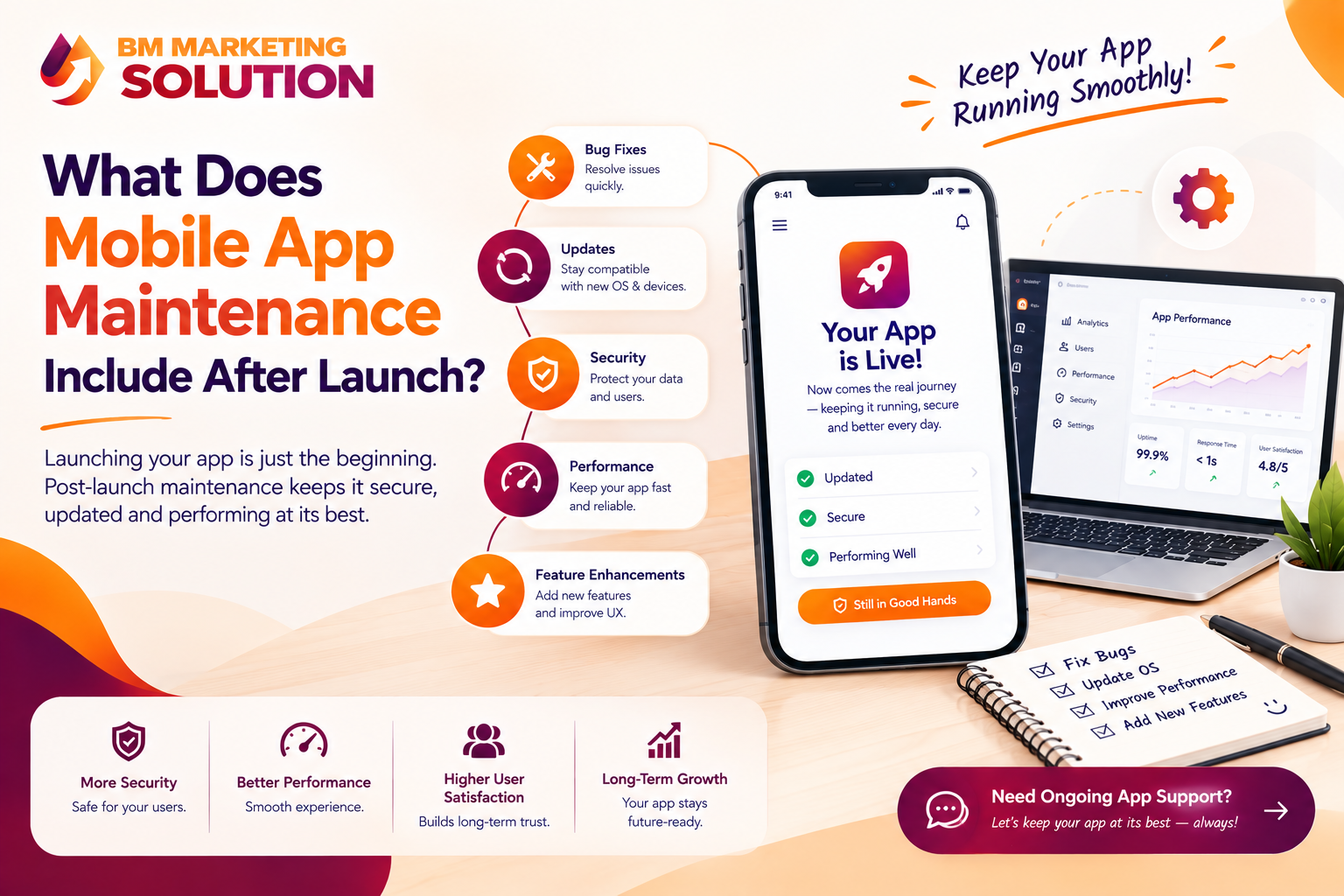
Launching a mobile app is exciting, but getting the app live is not the end of the journey. Once customers start downloading and using it, new requirements, technical issues, device changes, and user expectations can appear. This is why mobile app maintenance after launch is important for keeping an application reliable and user-friendly.
A well-maintained app should continue to work smoothly as smartphones, operating systems, security standards, and third-party technologies change. Professional mobile app maintenance services can help businesses identify technical issues, improve app performance, apply security updates, and keep the application compatible with changing technology. Regular maintenance also gives businesses an opportunity to understand user feedback and improve the app over time.
Whether it is a business application, e-commerce app, healthcare solution, or custom mobile application, ongoing mobile app maintenance and support can help maintain its performance, security, compatibility, and reliability.
Think of a mobile app like a business website or a physical store. Simply opening it once does not mean there is nothing left to manage. Problems can appear later, customers may ask for improvements, and technology can change.
For example, a new Android or iOS update may affect an existing app feature. A payment service may change its API. A security vulnerability may be discovered in an older software component. Users may also report a feature that is confusing or difficult to use.
Regular maintenance helps businesses respond to these changes instead of allowing small problems to affect the overall customer experience.
Even after detailed testing, some issues may only become visible when an app is used by real customers.
Users may experience crashes, login problems, incorrect information, buttons that do not respond, or errors during transactions. Maintenance involves identifying these problems, finding their causes, fixing them, and testing the solution before releasing an update.
Quick bug fixing can prevent a minor technical problem from becoming a major user complaint.
Mobile operating systems are regularly updated. New versions can introduce changes that affect how an application works.
A maintenance team checks whether the app continues to function properly after operating system updates. Developers may need to modify certain parts of the application, update APIs, adjust permissions, or make compatibility changes.
This helps the app provide a consistent experience across supported devices.
Security does not stop being important after an app is launched. As new vulnerabilities are discovered, applications may require security updates.
Maintenance can include updating outdated libraries, checking authentication methods, improving data protection, applying security patches, and reviewing important application components.
For apps that handle payments, customer service is important.
A mobile app may feel fast during development but behave differently when thousands of users start accessing it.
Maintenance can involve checking crashes, loading times, API response times, memory usage, and other performance-related issues. Developers can then optimize areas that are causing delays or instability.
The goal is simple: users should be able to open the app, navigate between screens, and complete important actions without unnecessary waiting.
Most mobile apps are connected to a backend system. They may communicate with databases, payment gateways, cloud services, maps, authentication systems, CRM platforms, or other APIs.
If a connected service changes its technology or requirements, the mobile application may also need adjustments.
Backend and API maintenance helps keep these connections working correctly and reduces the chances of broken functionality.
Mobile applications often depend on external libraries, SDKs, plugins, and development frameworks.
These tools receive updates for new features, security improvements, bug fixes, and compatibility. Older versions may eventually become unsupported.
Regularly reviewing these dependencies helps keep the application technically healthy and reduces the risks associated with outdated components.
New smartphones are introduced regularly, with different screen sizes, hardware capabilities, operating system versions, and device settings.
An app should be tested on relevant devices to make sure its layout, navigation, forms, notifications, and important functions continue to work correctly.
This is especially useful when the application has a large or diverse user base.
Maintenance is not only about fixing technical problems. Real users can reveal things that developers may not notice during initial testing.
For example, customers might find a registration process too long or have difficulty finding a particular feature. Businesses can use this feedback to make practical improvements.
Over time, these small changes can make the application easier and more useful for its target audience.
After an app goes live, developers may need to release updated versions from time to time. These updates can include bug fixes, performance improvements, security changes, or small feature enhancements.
Before releasing an update, the new version should be properly tested to make sure existing features continue to work as expected. Developers also check the app on supported devices and operating system versions before making the update available to users.
Regular and well-tested releases help businesses keep their mobile applications stable, up to date, and ready for changing user needs.
There is no fixed maintenance schedule for every mobile application. The frequency depends on the app’s features, number of users, integrations, security requirements, and business goals.
Security problems and critical bugs may need immediate attention. Other activities, such as performance reviews, dependency updates, device testing, and feature improvements, can be planned as part of regular maintenance.
Having a maintenance plan is usually better than waiting for a major problem to appear.
Mobile app maintenance after launch helps businesses keep their applications reliable as technology and customer expectations change. Professional mobile app maintenance services can cover bug fixing, security updates, operating system compatibility, performance monitoring, backend and API support, dependency updates, device testing, app release management, and improvements based on user feedback.
A successful app is not simply one that launches successfully. It is one that continues to provide a smooth, secure, and reliable experience months and years after launch. Regular mobile app maintenance can help businesses identify issues early, improve the user experience, and keep the application ready for changing technology.
If you have a mobile application that needs regular technical support, improvements, or post-launch maintenance, BM Marketing Solution PVT. LTD. can help you manage and improve your mobile app according to your business requirements.
BM Marketing Solution pvt.ltd
Website: https://bmmarketingsolution.com/
Phone: +91 90220 51223
Email: info@bmmarketingsolution.com
Ans : Mobile app maintenance can include bug fixing, security updates, performance monitoring, operating system compatibility, API and backend support, dependency updates, device testing, and improvements based on customer feedback.
Ans : An app can be affected by new operating system versions, device changes, security vulnerabilities, third-party service updates, and changing user expectations. Regular maintenance helps keep the application functional and reliable.
Ans : Basic maintenance mainly focuses on keeping the existing application stable and functional. New features can also be added, but larger feature additions are usually handled as separate development work depending on their complexity.
Ans : An app should be updated whenever important bugs, security concerns, compatibility issues, or technical changes require attention. Regular reviews can also help identify opportunities to improve performance and the user experience.

SEO & Digital Marketing Executive
With 1.5+ years of experience in SEO, WordPress and digital marketing, I focus on creating informative and SEO-friendly content that helps businesses grow online. I believe in writing clear, practical and easy-to-understand articles that provide real value to readers.
https://bmmarketingsolution.com/binary-mlm-software-with-mobile-app-features-benefits/
https://bmmarketingsolution.com/how-binary-mlm-software-works-a-beginners-guide/

BM Marketing Solution - Building Brands That Stand Out Online
Address: Office no. G610, 5th Floor, Mega Center, Pune - Solapur Rd, Magarpatta, North Hadapsar, Hadapsar, Pune, Maharashtra 411013.
Phone : +91 90220 51223
Email: info@bmmarketingsolution.com
Copyright © 2025 BM Marketing Solution All Rights Reserved