Testing should cover more than whether buttons work. Check how the app behaves with different devices, operating systems, network speeds, and user volumes. Simulate busy periods to find bottlenecks before customers encounter them.
Monitor loading times, crashes, failed transactions, and other important events.
These signals help you spot friction and prioritize fixes. After launch, release updates in manageable stages, review feedback, and make improvements based on real usage rather than guesswork.
A mobile app can help a growing business serve customers more conveniently, improve internal workflows, and create new opportunities. But an app that works well for 100 users may struggle when it has 10,000. Scalable mobile app development focuses on building an application that can handle increasing users, data, and business requirements without affecting performance. Effective scalable app development does not mean adding every feature from day one. It means making thoughtful technology and architecture choices so the app can adapt as your customers, data, and business needs expand.
Before choosing a technology or drawing screens, define what the app should help people do. Are customers trying to place orders faster? Do employees need to manage bookings while away from their desks? Is your business looking to offer a more useful self-service experience?
Talk to customers and staff, review common pain points, and identify the main task the app should make easier. Then separate essential features from ideas that can wait. A focused first version is quicker to test and easier to improve. It also helps keep your budget and development priorities under control. When working with professional mobile app development services, businesses can plan the initial app structure with future growth and scalability in mind.
Think about how the app may change over the next few years. You might add more users, locations, products, payment options, or integrations. You do not need to build every future feature now, but your plan should leave room for them.
Map out the app’s key user journeys and the information it needs to store. Decide how customers will sign in, how data will move between the app and your existing systems, and which tasks should happen automatically. Clear requirements help your team avoid expensive changes caused by assumptions made too early.
Your app’s technology should match your audience, features, budget, and maintenance plans. Native development can be appropriate when you need platform-specific capabilities or a highly tailored experience. Cross-platform development may make sense when you want to support both Android and iOS while sharing much of the code.
The backend matters just as much. It should handle user accounts, business rules, integrations, and data safely.
A modular design where components have clear responsibilities makes it easier to update or replace one part without rebuilding the entire product. Choose tools your team can support, and document important decisions, so future developers can understand the system.
A scalable app must be easy to use, not simply capable of handling more traffic. Keep navigation clear, use familiar language, and make the most important actions easy to find. Test the experience with people who represent your intended audience before investing heavily in development.
Also, plan for imperfect conditions. Users may have slow connections, older devices, or interruptions while completing a task. Helpful error messages, saved progress, sensible loading states, and accessible text can make the app feel more dependable. Good design reduces confusion for users and support requests for your team.
Security should be part of the product plan, not a final checklist. Collect only the information the app needs, limit access to sensitive data, and use secure methods for sign-in and communication. Add role-based permissions where different users need different levels of access.
Prepare a privacy policy that accurately explains what data the app collects and how it is used. Keep software dependencies updated, back up important information, and decide how your team will respond to a security issue. Trust takes time to build, so protect it through consistent, transparent practices.
Testing should cover more than whether buttons work. Check how the app behaves with different devices, operating systems, network speeds, and user volumes. Simulate busy periods to find bottlenecks before customers encounter them.
Monitor loading times, crashes, failed transactions, and other important events. These signals help you spot friction and prioritize fixes. After launch, release updates in manageable stages, review feedback, and make improvements based on real usage rather than guesswork.
Grow through steady improvement.
A launch is the start of learning, not the finish line. Track a small set of useful measures, such as successful sign-ups, completed purchases, repeat visits, or support requests. Review these numbers alongside customer feedback so you understand not just what is happening, but why.
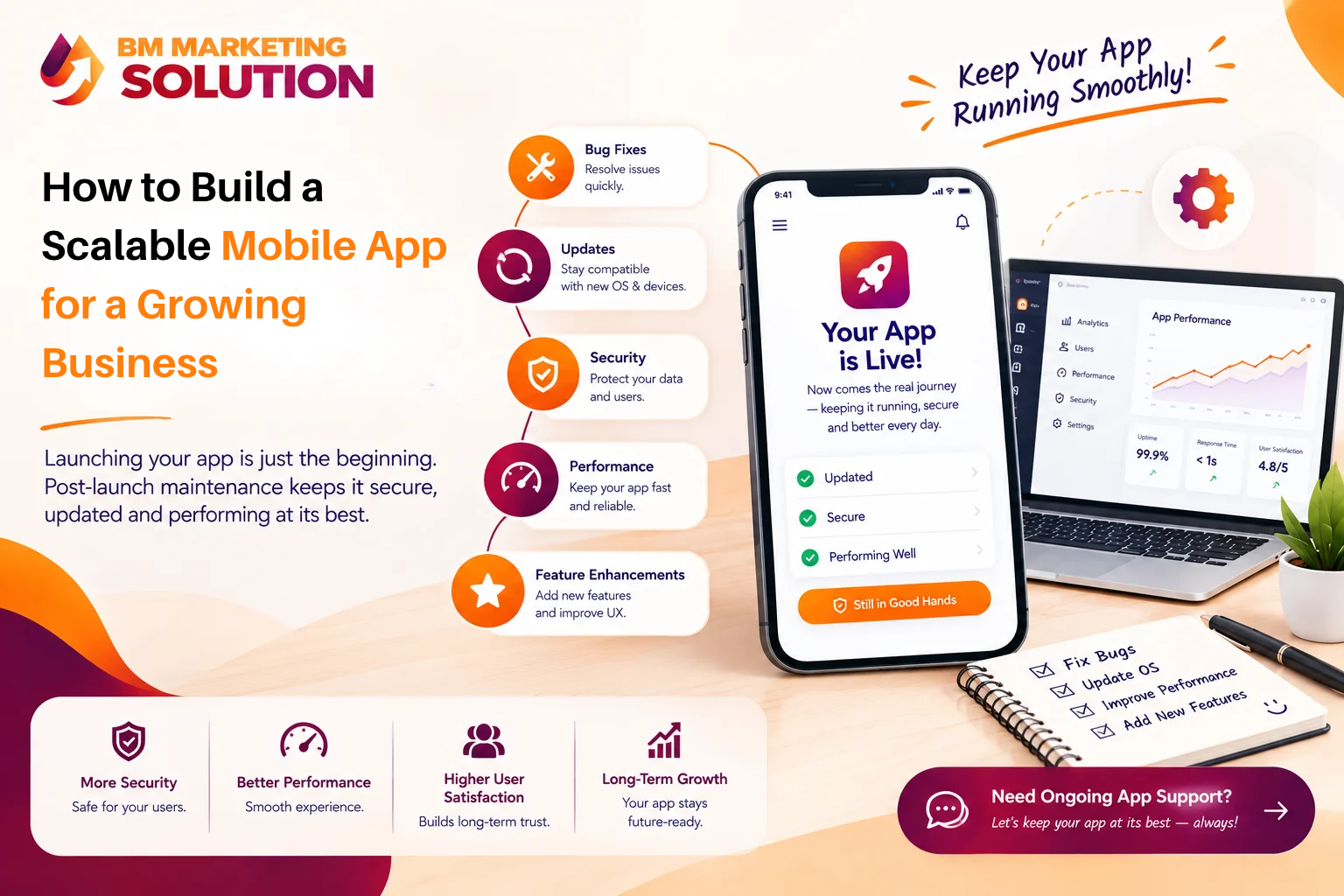
Plan regular maintenance for operating-system changes, security updates, and performance improvements. As your business grows, revisit the app’s architecture and workflows before problems become urgent. Building in stages keeps the product connected to real business needs and gives your team room to adapt.
A scalable mobile app begins with a clear purpose, a focused first release, and a foundation that can evolve. Effective scalable mobile app development helps businesses prepare their applications for increasing users, data, and changing requirements. Prioritize the user experience, plan for security, test under realistic conditions, and use feedback to guide each improvement. With the right scalable app development approach and reliable mobile app development services, your app can support today’s customers while staying ready for tomorrow’s growth.
Ready to discuss your app idea?
BM Marketing Solution pvt. ltd. lists mobile app development among its services and invites businesses to discuss their requirements.
Phone: +91 90220 51223
Email: info@bmmarketingsolution.com
Ans : It depends on your audience, features, budget, and maintenance needs. Native development may suit apps that rely heavily on platform-specific capabilities; cross-platform development can be a practical way to support Android and iOS with shared code.
Ans : Usually, no. Start with the features that solve the main user problem, then learn from testing and feedback. A focused first release can help you validate your idea before expanding it.
Ans : Update dependencies and operating-system support, review access permissions, monitor for unusual activity, and follow a clear backup and incident-response plan. Security needs regular attention as the app evolves.

SEO & Digital Marketing Executive
With 1.5+ years of experience in SEO, WordPress and digital marketing, I focus on creating informative and SEO-friendly content that helps businesses grow online. I believe in writing clear, practical and easy-to-understand articles that provide real value to readers.
https://bmmarketingsolution.com/binary-mlm-software-with-mobile-app-features-benefits/
https://bmmarketingsolution.com/how-binary-mlm-software-works-a-beginners-guide/

BM Marketing Solution - Building Brands That Stand Out Online
Address: Office no. G610, 5th Floor, Mega Center, Pune - Solapur Rd, Magarpatta, North Hadapsar, Hadapsar, Pune, Maharashtra 411013.
Phone : +91 90220 51223
Email: info@bmmarketingsolution.com
Copyright © 2025 BM Marketing Solution All Rights Reserved