Long-term growth depends on how well you understand users and improve the product over time.
Track useful metrics such as downloads, active users, retention, crashes, conversions, and customer feedback. These measurements help you understand what works and where improvements are needed.
Promote your app through your website, social media, email marketing, and relevant digital marketing campaigns. Encourage satisfied customers to share genuine feedback, and use their suggestions to plan future updates.
Create a realistic roadmap for new features, performance improvements, and ongoing maintenance. Reviewing app performance regularly helps your business make informed decisions about future investment.
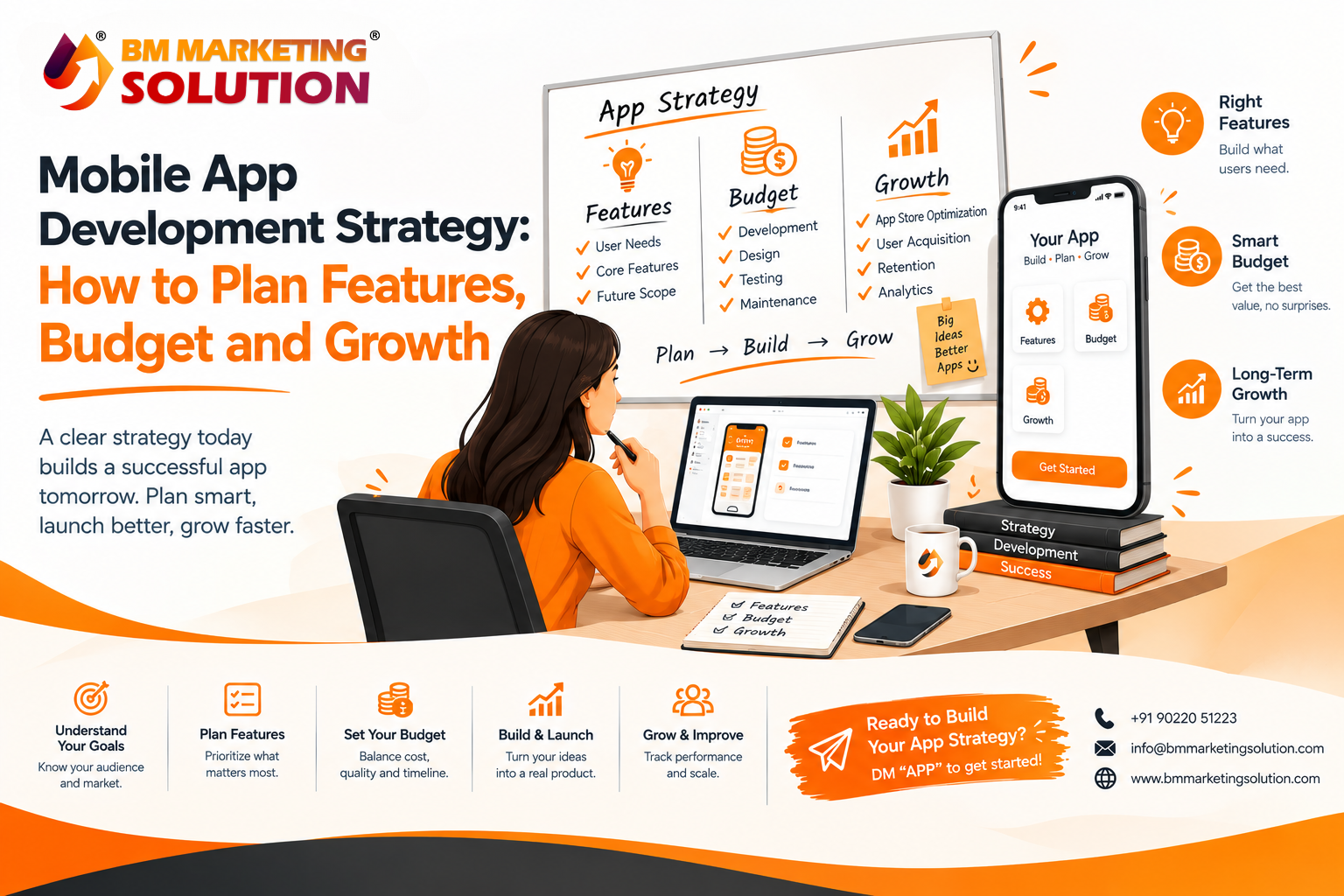
Developing a mobile app is an important step for businesses that want to reach more customers, improve their services, and grow online. However, building a successful app requires more than choosing a design or hiring developers. A clear Mobile App Development Strategy helps businesses plan essential features, select the right technology, and prepare for future growth.
Effective Mobile App Development Planning also helps businesses estimate the Mobile App Development Cost, avoid unnecessary expenses, and reduce development delays. By understanding customer needs and setting clear goals, businesses can create a user-friendly app that supports their objectives and grows with their business.
Whether you are launching a startup app or improving an existing business, proper planning can help you make informed decisions and build a strong foundation for long-term success.
Planning a mobile app for your business?
Discuss your app requirements, essential features, and development goals with BM Marketing Solution.
Before starting development, identify the main purpose of your app. Ask yourself what problem it will solve and how it will help your customers. For example, an e-commerce business may need product browsing and secure payments, while a service-based company may focus on appointment booking and customer support.
Understanding your target audience is equally important. Research their needs, preferences, and common challenges. This information helps you choose useful features instead of adding functions that customers may never use.
Set clear business goals, such as increasing sales, improving customer engagement, simplifying operations, or generating more inquiries. These goals will guide your mobile app development strategy.
One common mistake businesses make is trying to include too many features in the first version. This can increase development costs, extend the timeline, and make the app more complicated.
Start with a Minimum Viable Product (MVP), which includes the essential features needed to solve the main customer problem.
Depending on your business model, these features might include:
– User registration and login
– Simple navigation and a user-friendly interface
– Search and product or service listings
– Secure payment integration, if required
– Push notifications and customer support
– Basic analytics to understand user behaviour.
Once customers start using the app, collect feedback and review performance data. You can then add advanced features based on real user needs.
Your budget should cover more than the initial development cost. The total investment depends on app complexity, platform selection, design requirements, integrations, security, and testing.
Create a budget that includes the following expenses:
– UI/UX design and prototyping
– Front-end and back-end development
– Third-party APIs and integrations
– Testing, security, and quality assurance
– App store publishing and launch preparation
– Maintenance, hosting, and future updates
Request a detailed estimate before development begins. Discuss the project scope, payment milestones, expected timeline, and possible additional charges with your development partner.
A realistic budget helps you control expenses without compromising essential quality and security.
Decide whether your app should be available on Android, iOS, or both. Your choice should depend on your target audience, project requirements, available budget, and long-term plans.
Native development can offer platform-specific capabilities, while cross-platform technologies such as Flutter and React Native may allow businesses to build for multiple platforms with a shared codebase.
Discuss performance, security, integrations, and maintenance requirements with your development team before finalizing the technology.
The best option is the one that supports your business goals without adding unnecessary complexity.
A mobile app should be easy to understand and comfortable to use. Customers should be able to find information, complete tasks, and contact support without confusion.
Use clear navigation, readable text, consistent design, and responsive screens.
Test the app on different devices and screen sizes before launching it.
Security is equally important. Protect sensitive information, use appropriate authentication, and ensure that payment and data-handling processes follow relevant security requirements. Regular testing helps identify problems before they affect users.
Long-term growth depends on how well you understand users and improve the product over time.
Track useful metrics such as downloads, active users, retention, crashes, conversions, and customer feedback. These measurements help you understand what works and where improvements are needed.
Promote your app through your website, social media, email marketing, and relevant digital marketing campaigns. Encourage satisfied customers to share genuine feedback, and use their suggestions to plan future updates.
Create a realistic roadmap for new features, performance improvements, and ongoing maintenance. Reviewing app performance regularly helps your business make informed decisions about future investment.
Choosing a reliable development partner can make the entire process easier. Look for a team that understands your business requirements, explains technical decisions clearly, and provides a defined development process.
Before starting, discuss project milestones, deliverables, testing, ownership of the source code, maintenance, and post-launch support. Ask for a detailed proposal so you can compare the scope and costs properly.
BM Marketing Solution, businesses can discuss their digital requirements and explore suitable software and mobile app development solutions.
A successful Mobile App Development Strategy starts with clear goals, carefully selected features, a realistic budget, and a strong understanding of your target audience. Effective Mobile App Development Planning helps businesses prioritize essential features, manage the Mobile App Development Cost, and avoid unnecessary expenses. Instead of building everything at once, focus on essential features, test your idea, and improve the app using customer feedback and performance data.
With the right planning and development partner, your mobile app can become a valuable business tool that improves customer engagement, supports business growth, and creates long-term opportunities.
Contact BM Marketing Solution to discuss your requirements and development goals.
Let’s discuss your mobile app project :
Website: bmmarketingsolution.com
Ans : A mobile app development strategy is a plan that defines the app’s goals, target audience, features, budget, technology, development process, and future growth.
Ans : Identify your users’ main problems and prioritize features that solve them. Start with essential functionality and add more features based on feedback and usage data.
Ans : Define the project scope, prioritize essential features, compare detailed development proposals, and reserve funds for testing, maintenance, and future updates.
Ans : Improve the user experience, monitor app performance, collect customer feedback, and promote the app through SEO, social media, email marketing, and other relevant channels.

SEO & Digital Marketing Executive
With 1.5+ years of experience in SEO, WordPress and digital marketing, I focus on creating informative and SEO-friendly content that helps businesses grow online. I believe in writing clear, practical and easy-to-understand articles that provide real value to readers.
https://bmmarketingsolution.com/binary-mlm-software-with-mobile-app-features-benefits/
https://bmmarketingsolution.com/how-binary-mlm-software-works-a-beginners-guide/

BM Marketing Solution - Building Brands That Stand Out Online
Address: Office no. G610, 5th Floor, Mega Center, Pune - Solapur Rd, Magarpatta, North Hadapsar, Hadapsar, Pune, Maharashtra 411013.
Phone : +91 90220 51223
Email: info@bmmarketingsolution.com
Copyright © 2025 BM Marketing Solution All Rights Reserved