
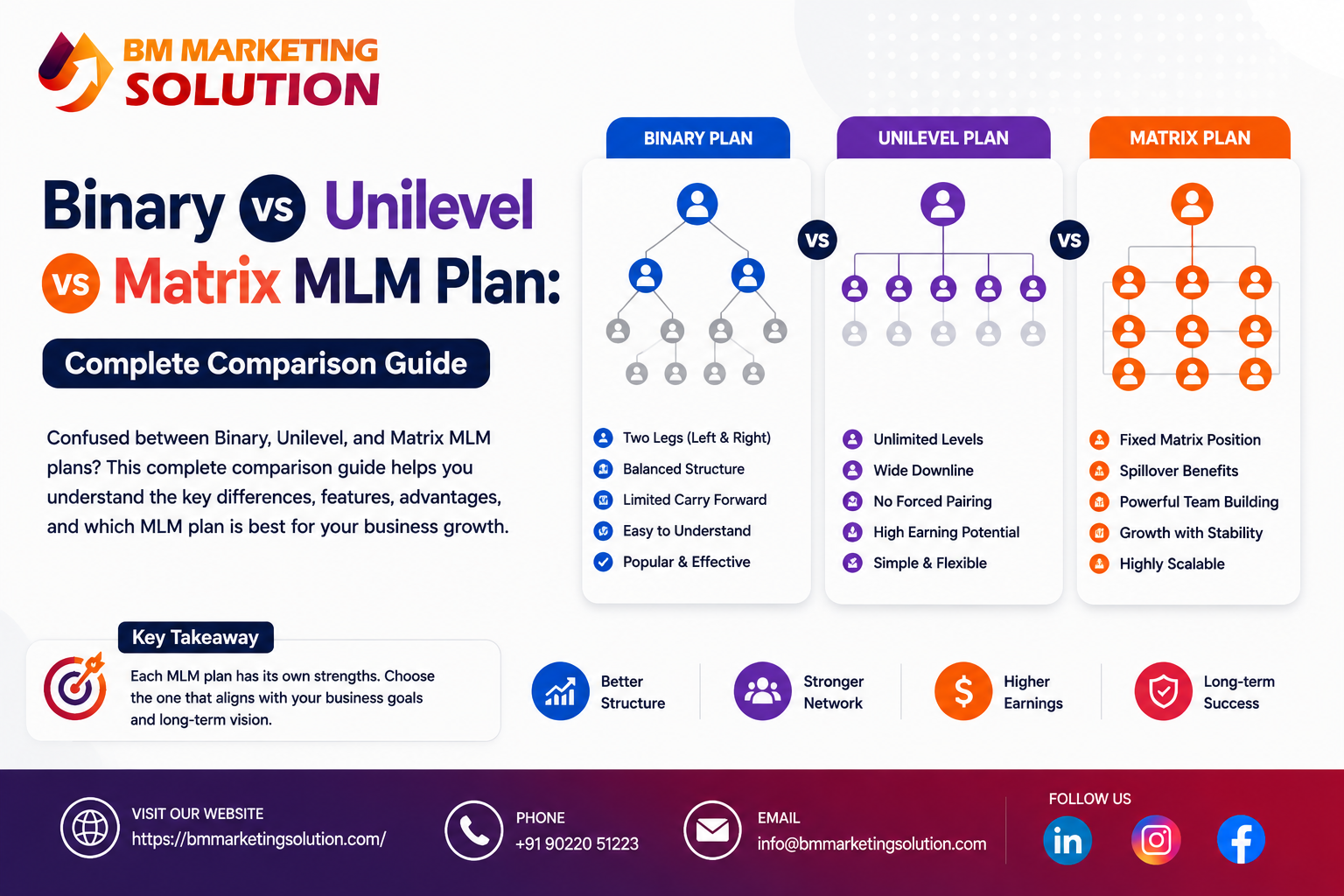
The MLM industry is growing rapidly in 2026, and choosing the right compensation plan has become more important than ever. Whether you are starting a new network marketing company or upgrading your existing business, selecting the right MLM plan can directly impact your company’s growth, distributor motivation, and long-term success.
Among the most popular MLM compensation structures, the Binary vs Unilevel vs Matrix MLM Plan comparison is one of the most searched topics by business owners and network marketers today. These MLM plans are widely used by companies around the world because each offers unique benefits, team structures, and earning opportunities. However, many entrepreneurs still get confused about which MLM plan is best for their business model.
In this complete comparison guide, we will explain the Binary vs Unilevel vs Matrix MLM Plan in simple and human-friendly language so you can clearly understand the differences, advantages, and which compensation plan is the right choice for your MLM business in 2026.
An MLM compensation plan is the earning structure of a network marketing business. It decides how distributors earn commissions, bonuses, referral income, and rewards.
A good MLM compensation plan should help motivate distributors, support strong team growth, offer fair earning opportunities, and create long-term business stability. These factors are very important for building a successful network marketing company.
Today, when comparing the Binary vs Unilevel vs Matrix MLM Plan, all three compensation models are considered among the most trusted and popular MLM plans because they are flexible, scalable, and suitable for different types of MLM business models. Each plan offers unique advantages depending on the company’s goals, distributor strategy, and growth vision.
The Binary MLM Plan is one of the most popular and fastest-growing compensation plans in the MLM industry.
In this structure, every distributor can recruit only two direct members :
This creates a two-leg network system.
If a member recruits more than two people, the extra members are placed under the existing downline. This process is called spillover, which is one of the biggest attractions of the Binary plan.
In a binary plan, commissions are usually calculated based on the weaker leg volume. This means both left and right teams need balanced growth for maximum earnings.
Left Team Business Volume = 500 Points
Right Team Business Volume = 300 Points
The commission will be calculated on 300 points because it is the weaker side.
Binary plans encourage quick expansion because every member focuses on building only two teams.
New distributors may receive additional members from uplines, helping them grow faster.
The plan promotes teamwork because everyone benefits when the network grows together.
If one side becomes stronger than the other, income may get limited.
Slightly Complex for Beginners
Compared to Unilevel plans, binary structures can be harder for new users to understand initially.
The Unilevel MLM Plan is considered one of the simplest and most beginner-friendly MLM compensation plans.
In this structure, distributors can recruit unlimited direct members on their frontline. There are no width restrictions.
This means you can sponsor as many people as you want directly under you.
Every personally sponsored distributor is placed directly under the sponsor. Income is usually paid level-wise.
For example,
Level 1 Commission = 10%;
Level 2 Commission = 5%;
Level 3 Commission = 3%.
The company decides how many levels will receive commissions.
Simple and Easy to Understand.
The structure is straightforward, making it ideal for beginners.
Unlimited Direct Recruitment
There is no restriction on the number of frontline members.
Transparent Income System
Commission calculations are simple and easy to track.
Stable Business Growth
The plan supports long-term and sustainable network building.
No spillover
Members need to build their own teams without extra support from uplines.
Requires Strong Leadership
To create depth in the network, distributors must actively train and guide their teams.
The Matrix MLM Plan is a structured compensation model with fixed width and depth.
Common matrix formats include:
3×3 Matrix
3×5 Matrix
5×7 Matrix
For example, in a 3×3 Matrix:
A member can recruit only 3 people on the first level
The network grows only up to 3 levels deep
Once all positions are filled, additional recruits spill over into lower levels.
The structure keeps the network organized and manageable.
Like binary plans, matrix plans also support spillover.
Because of limited positions, monitoring the network becomes easier.
Matrix systems are often preferred by startups looking for controlled expansion.
Since width and depth are fixed, earning opportunities can become limited.
Growth restrictions may reduce scalability for larger businesses.
Choosing the right MLM plan depends completely on your business goals.
Binary, Unilevel, and Matrix MLM plans are all powerful compensation systems, but each serves different business needs.
Binary plans are excellent for fast-growing businesses focused on teamwork and spillover benefits. Unilevel plans are perfect for companies looking for simplicity and flexibility. Matrix plans work well for businesses that want controlled and organized network growth.
Before selecting any MLM plan, always analyze your business goals, target audience, and long-term expansion strategy.
If you are looking for professional and customized MLM software solutions for Binary, Unilevel, or Matrix plans, connect with BM Marketing Solution today.

BM Marketing Solution - Building Brands That Stand Out Online
Address: Office no. G610, 5th Floor, Mega Center, Pune - Solapur Rd, Magarpatta, North Hadapsar, Hadapsar, Pune, Maharashtra 411013.
Phone : +91 90220 51223
Email: info@bmmarketingsolution.com
Copyright © 2025 BM Marketing Solution All Rights Reserved