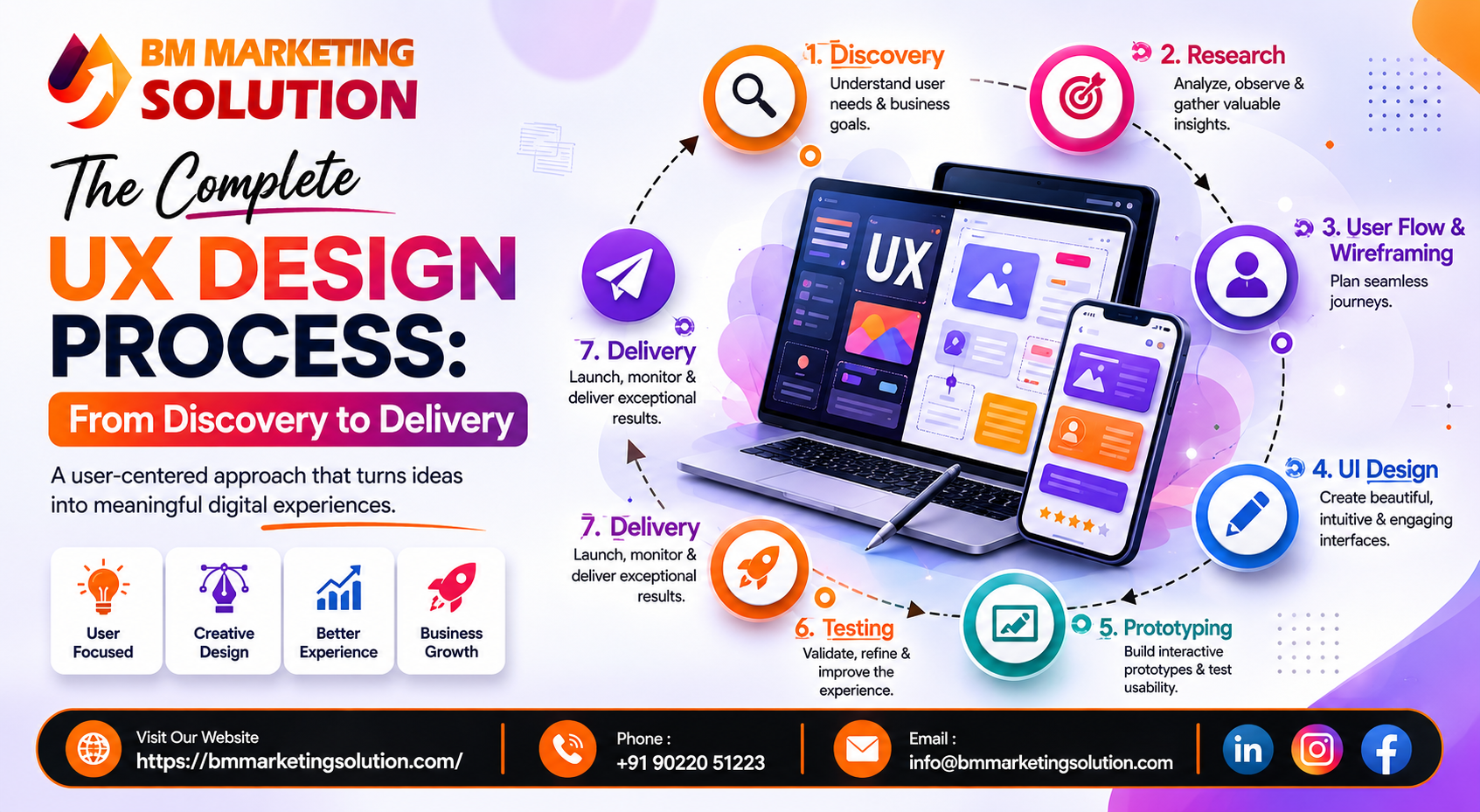
In today’s digital world, users expect websites, mobile apps, and software platforms to be intuitive, fast, and easy to use. However, a visually appealing interface alone is no longer enough to satisfy modern users. Instead, businesses need digital products that solve real problems while delivering a seamless and engaging experience. This is where the UX Design Process plays a critical role in creating successful products.
The UX Design Process is a structured approach that helps designers understand user needs, identify challenges, develop effective solutions, and ultimately deliver products that provide exceptional value. Moreover, rather than relying on assumptions, UX professionals use research, testing, and continuous improvement to create meaningful digital experiences. As a result, businesses can improve customer satisfaction, increase engagement, and achieve better conversion rates.
Similarly, the UI UX Design Process combines user experience strategy with visually appealing interface design to ensure that products are both functional and attractive. From discovery and user research to wireframing, prototyping, usability testing, and final delivery, each stage contributes to creating a product that meets both business goals and user expectations. Therefore, understanding the complete UI UX Design Process is essential for organizations looking to build user-friendly and high-performing digital solutions.
In this guide, we will explore the complete UX Design Process from discovery to delivery and explain how each step contributes to creating exceptional user experiences that drive long-term business success.
In this blog, we will explore the complete UX design process from discovery to delivery and understand why each phase is essential for creating successful digital products.
Every successful UX project begins with discovery. This phase focuses on understanding the business goals, user needs, market challenges, and project requirements before any design work starts. Research shows that discovery helps teams avoid assumptions and make informed decisions throughout the design process.
The primary goal is to answer an important question:
Without a clear understanding of the problem, even the most visually appealing design can fail.
UX design is centered around people, so understanding user behavior is critical.
The information collected helps designers identify pain points, motivations, expectations, and user goals. According to UX industry best practices, user research provides the foundation for making informed design decisions rather than relying on personal opinions.
These tools help keep the design process focused on actual user needs.
After understanding the users, designers organize the product’s structure.
Information Architecture (IA) focuses on arranging content and features logically, so users can easily find what they need.
User flows visualize how users move through the product to complete tasks such as signing up, making a purchase, or submitting a form.
A strong information architecture reduces confusion and improves usability, making the overall experience more efficient.
Wireframes are often compared to architectural blueprints because they define the structure of a product before visual design begins. They focus on layout, functionality, navigation, and content placement rather than colors or graphics.
Visualize page layouts Establish hierarchy Plan user interactions Gather early feedback.
Because wireframes are simple and low-cost to modify, they allow designers to experiment with ideas before investing significant development resources.
Once wireframes are approved, designers create interactive prototypes.
A prototype simulates how the final product will function, allowing users and stakeholders to experience interactions before development begins.
Prototyping helps identify usability issues early and gives stakeholders a clear vision of the final product. It also reduces costly changes during development.
Even the best design ideas require validation.
Usability testing involves observing real users as they interact with the prototype. This phase helps identify friction points, confusion, and areas for improvement.
Common testing methods include :
Designers gather feedback and analyze user behavior to determine whether the product successfully meets user expectations.
One of the most important principles of UX design is iteration. Testing often reveals improvements that lead designers back to earlier stages for refinement. This continuous improvement cycle is considered a core part of UX practice.
After validating the experience, designers focus on the visual layer.
This includes :
The goal is to create an attractive interface that supports usability rather than distracting from it.
Good UI design enhances user trust, improves engagement, and strengthens brand identity while maintaining accessibility standards.
The final stage is delivery and developer handoff.
At this point, UX and UI designs are translated into development-ready assets. Teams collaborate closely to ensure the final product matches the approved design.
Deliverables often include :
An effective handoff minimizes misunderstandings and helps developers build the product accurately. Many modern UX workflows emphasize close collaboration between designers and developers throughout the process.
A structured UX process provides several benefits :
Instead of guessing what users want, organizations can make evidence-based decisions that lead to successful products.
The UX Design Process is far more than creating attractive screens. Instead, it is a systematic journey that begins with understanding users and ends with delivering meaningful digital experiences. From discovery and research to wireframing, prototyping, testing and final delivery, every phase contributes to building products that are useful, usable and enjoyable. As a result, businesses can create solutions that not only meet user expectations but also support long-term business goals.
Furthermore, companies that invest in a well-structured UI UX Design Process often experience better customer engagement, higher satisfaction rates, improved retention, and stronger business growth. By following a user-centered approach, organizations can develop products that truly solve customer problems and stand out in competitive markets. Therefore, implementing an effective UX Design Process for Businesses has become essential for companies seeking to improve user satisfaction and maximize digital success.
Ultimately, whether you are developing a website, mobile application, or custom software platform, a strategic UX Design Process for Businesses can help transform ideas into intuitive, user-friendly, and high-performing digital products. If you are looking to create a seamless digital experience, our team can help bring your vision to life through expert UX and UI design solutions.
Website : https://bmmarketingsolution.com/
Phone : +91 90220 51223
Email : info@bmmarketingsolution.com
Ans : The UX design process is a structured method used to understand users, define problems, create solutions, test designs, and deliver user-friendly digital products.
Ans : User research helps designers understand user needs, behaviors, and challenges, ensuring that design decisions are based on real insights rather than assumptions.
Ans : UX design focuses on the overall user experience and usability, while UI design focuses on visual elements such as colors, typography, buttons, and layouts.
Ans : The timeline depends on project complexity. Small projects may take a few weeks, while large enterprise applications can require several months of research, design, testing and iteration.
BM Marketing Solution - Building Brands That Stand Out Online
Address: Office no. G610, 5th Floor, Mega Center, Pune - Solapur Rd, Magarpatta, North Hadapsar, Hadapsar, Pune, Maharashtra 411013.
Phone : +91 90220 51223
Email: info@bmmarketingsolution.com
Copyright © 2025 BM Marketing Solution All Rights Reserved