In today’s digital world, simply creating a website is not enough. If your website is not visible on Google, your customers may never find your business online. This is where crawling and indexing become extremely important for SEO and website visibility.
Many website owners hear terms like Google crawling, website indexing, and search engine optimization regularly; however, they do not fully understand how these processes work. In simple words, crawling and indexing help Google discover, scan, and store your webpages in its search database.
Moreover, if your pages are properly crawled and indexed, your website has a better chance of appearing in Google search results and generating organic traffic. Therefore, understanding crawling and indexing in SEO is essential for every website owner in 2026.
In this guide, we will explain what crawling and indexing are, how Googlebot discovers websites, and how you can improve website indexing and crawlability for better SEO performance.
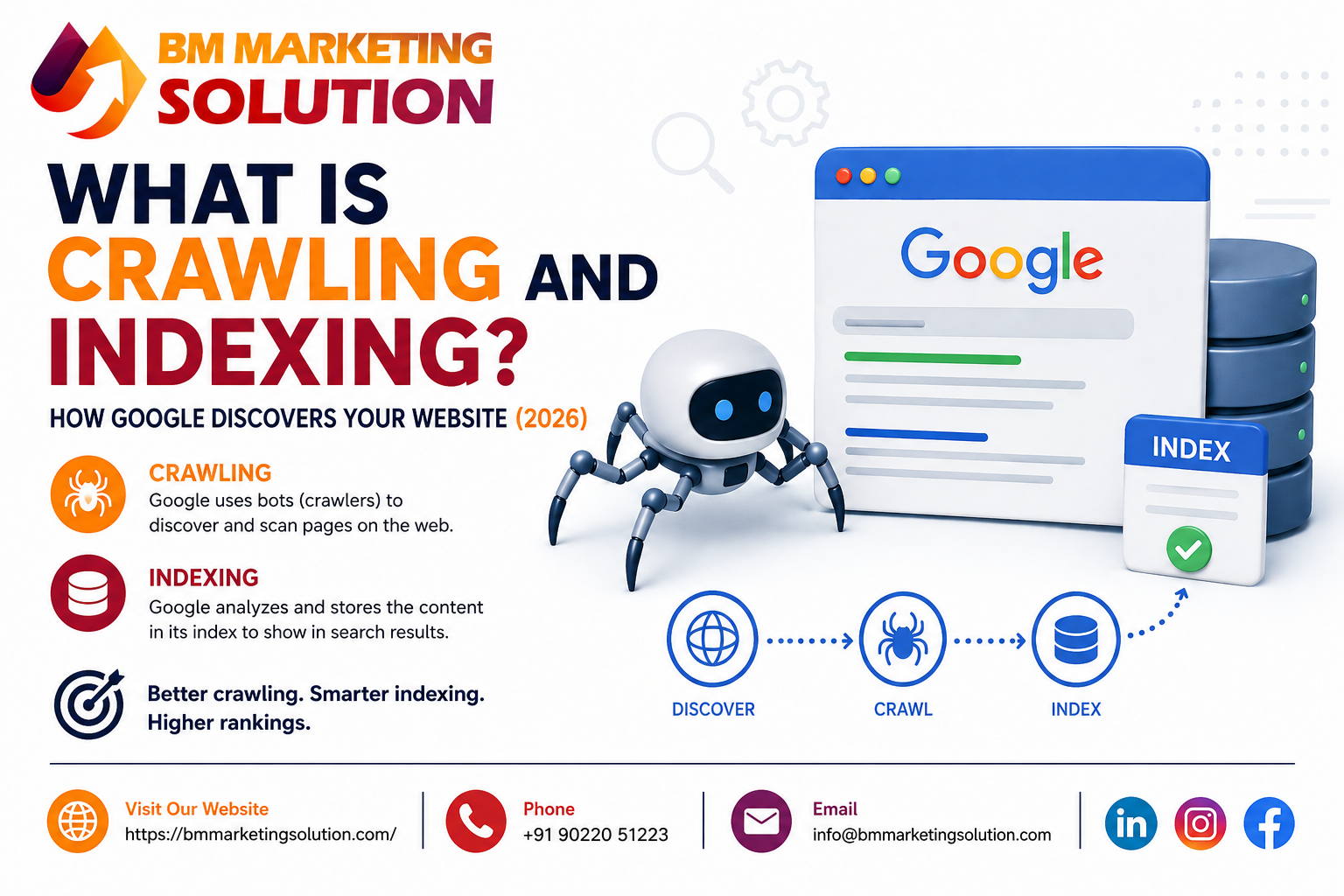
Crawling is the process where Google sends special bots, called Google bots or search engine spiders, to discover pages on the internet.
These bots move from one webpage to another through links. They scan website content, images, videos, and page structure to understand what the page is about.
Imagine Googlebot as a visitor exploring the internet. It moves from page to page, collecting information about websites and saving it for Google’s search engine.
Whenever you publish a new blog, product page, or service page, Google first needs to crawl it before showing it in search results.
Google discovers websites in several ways :
Once Googlebot finds your page, it reads the content and checks important SEO signals such as :
If your website is technically optimized, Google can crawl it faster and more efficiently.
After crawling comes indexing.
Indexing means Google stores and organizes your webpage information inside its massive search database.
If your page is indexed, it becomes eligible to appear in Google search results.
Without indexing, your page cannot rank on Google although your content is excellent.
If you write a blog titled “Best SEO Tips for Small Businesses,” Google first crawls the page, then indexes it. After indexing, Google may show it when someone searches for SEO tips.
Many people think crawling and indexing are the same, but they are different processes.
Google discovers and scans your webpage.
Google stores your webpage in its search database.
A page can be crawled but not indexed if Google thinks the content is low-quality, duplicated, or blocked.
Crawling and indexing are the foundation of SEO.
If Google cannot properly crawl or index your website, your pages will not appear in search results. This means you lose organic traffic, leads, and potential customers.
In 2026, Google focuses heavily on user experience and high-quality content. Websites with strong technical SEO usually get crawled and indexed faster.
There are several reasons why pages may not get indexed:
Thin or duplicate content often gets ignored by Google.
Sometimes websites accidentally block Googlebot from crawling pages.
A no index tag tells Google not to index a page.
Very slow websites can affect crawl efficiency.
If Google cannot navigate your website properly, pages may remain undiscovered.
Brand-new websites may take time to get crawled and indexed.
Here are some effective SEO practices to help Google discover your website faster:
Publish unique, useful, and informative content regularly.
An XML sitemap helps Google understand your website structure.
Fast-loading websites provide better user experience and crawl performance.
Connect related pages using internal links to help Google navigate your site.
Google uses mobile-first indexing, so mobile optimization is essential.
Fix Technical SEO Errors :
Regularly check for broken links, duplicate pages, and crawl errors.
Google Search Console helps monitor indexing issues and website performance.
In 2026, Google mainly uses the mobile version of websites for indexing and ranking.
This means :
A responsive website improves both crawling and indexing performance.
Crawling and indexing are essential parts of SEO and website visibility. Google must first discover your pages through crawling and then store them through indexing before your website can appear in search results.
If your website is properly optimized with quality content, technical SEO, fast speed, and mobile responsiveness, Google can crawl and index your pages more effectively.
Businesses that understand these SEO fundamentals have a much better chance of growing online in 2026.
If you want professional SEO services, website optimization, or technical SEO support, our team is here to help.
Website : https://bmmarketingsolution.com/
Phone : +91 90220 51223
Email : info@bmmarketingsolution.com
Ans : Crawling is the process where Google bots scan and discover webpages on the internet.
Ans : Indexing is when Google stores webpage information in its search database so it can appear in search results.
Ans : Common reasons include poor content quality, technical SEO issues, blocked pages, or slow website speed.
Ans : You can improve indexing by creating quality content, submitting sitemaps, fixing technical errors, and optimizing website speed.
BM Marketing Solution - Building Brands That Stand Out Online
Address: Office no. G610, 5th Floor, Mega Center, Pune - Solapur Rd, Magarpatta, North Hadapsar, Hadapsar, Pune, Maharashtra 411013.
Phone : +91 90220 51223
Email: info@bmmarketingsolution.com
Copyright © 2025 BM Marketing Solution All Rights Reserved